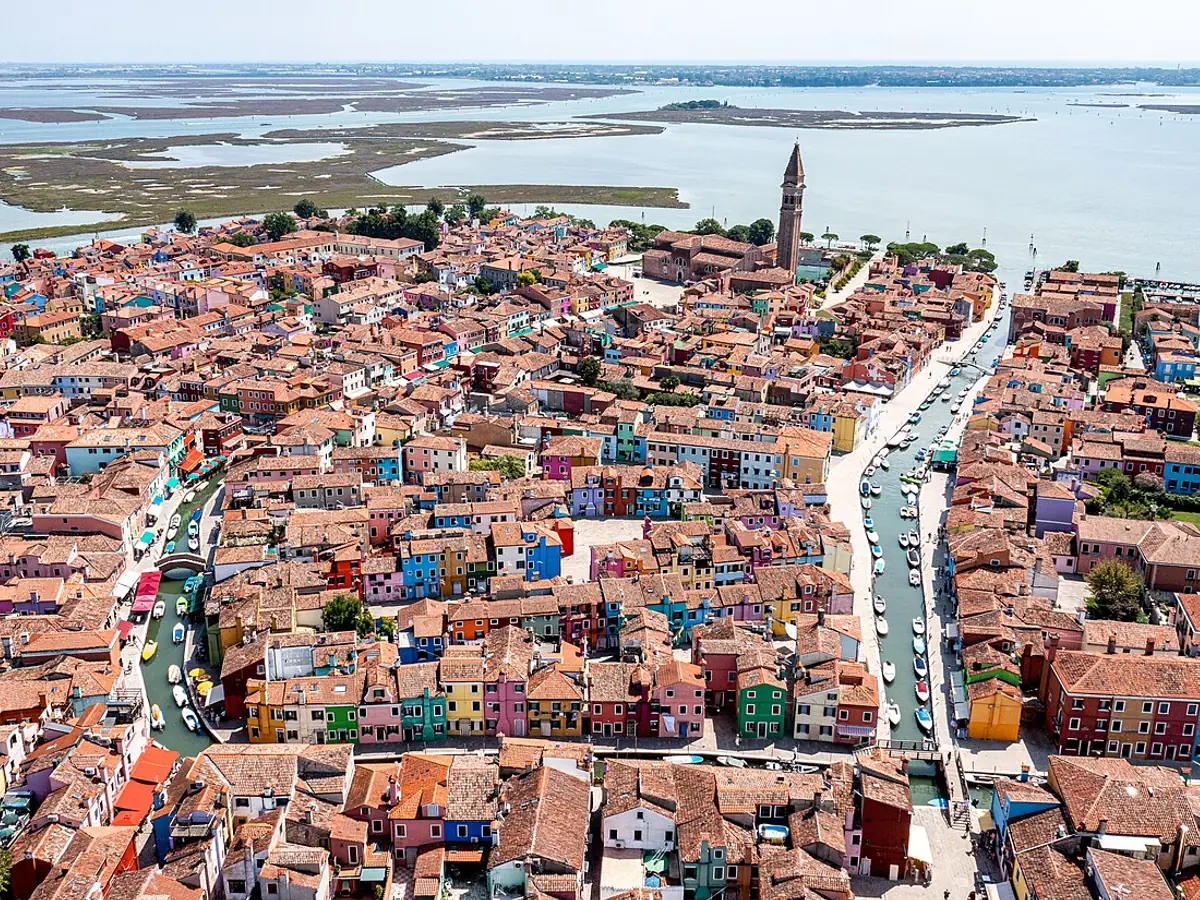
Burano, Venice
Burano is an inhabited island in the northern Venetian Lagoon, linked by a bridge to Mazzorbo. Its fame comes from two striking features: lace-making and houses painted in vivid colours. The colours are not chosen freely; permission is required, and the authorities specify which colours may be used for each property.
This gives the island a deliberately varied appearance, with façades set close together across a densely built settlement. The island’s only square is Piazza Baldassare Galuppi, created by filling in a canal and dedicated to the composer born here in 1706. The square gathers the Lace Museum, the town hall, an Istrian-stone well, and a statue of Galuppi by Remigio Barbaro.
At the edge of the square, look toward the church of San Martino and its markedly leaning campanile. Its foundations stand on piles, and partial subsidence caused the tilt. Inside, Giambattista Tiepolo’s Crucifixion dates from 1725.
Burano’s lace tradition began in the 16th century, when local women learned needlework through Venetian connections with Cyprus. A school opened in 1872, reviving the craft after its earlier decline, though traditional lace now takes so much time that it is costly. The vivid houses and painstaking lace together define this compact lagoon island.