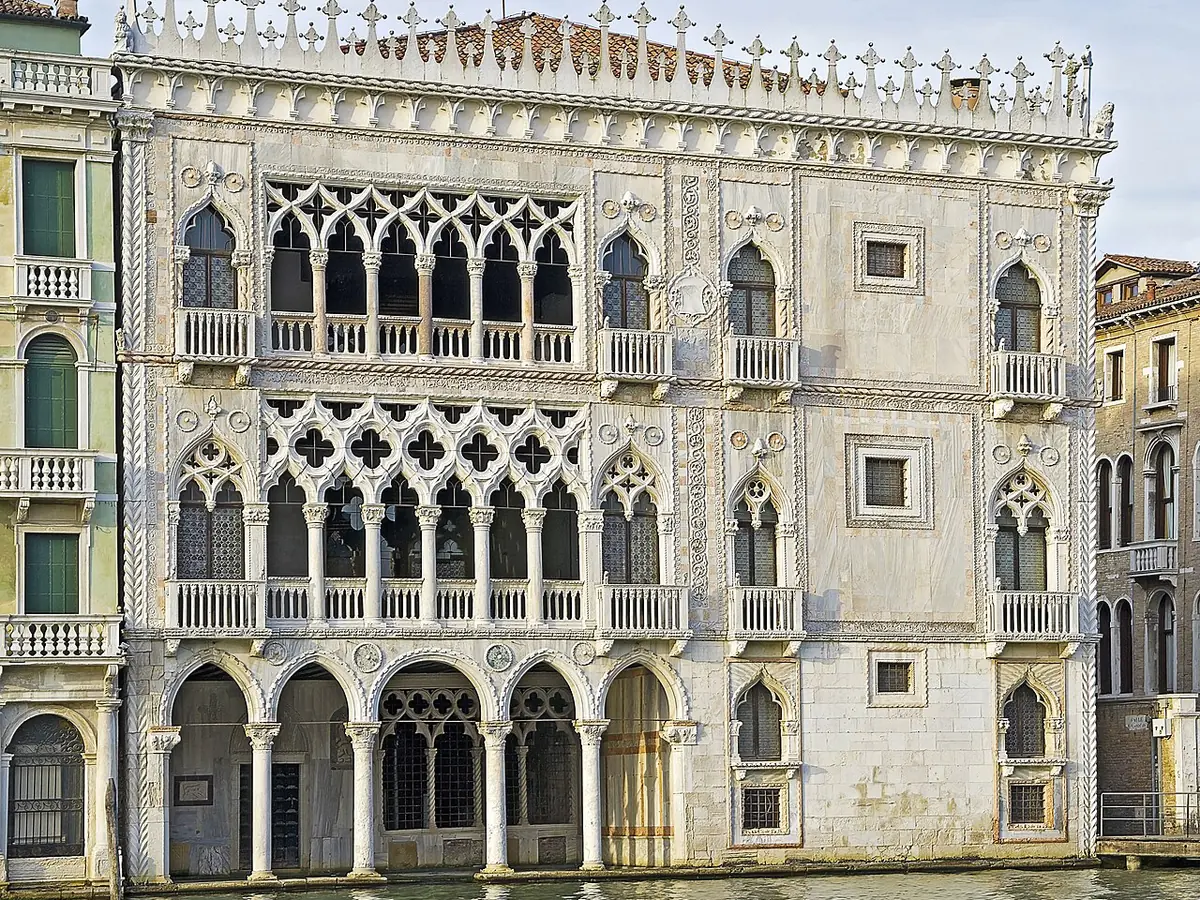
Ca' d'Oro, Venice
Ca' d'Oro is a Venetian palace turned art museum, facing the Grand Canal. Its familiar name means “House of Gold,” recalling the precious surface decoration that once covered parts of its exterior. Today, the façade gives you a remarkable study in Gothic design: open loggias, slender columns, pointed arches, and quatrefoil tracery create a delicate screen against the solid wall.
Look at the grouped windows and the ornate balconies; their repeated patterns make the building feel lighter than its massive scale suggests. The façade is deliberately asymmetrical, a practical response to the restricted spaces between neighboring buildings. Marino Contarini commissioned the palace, and construction took place from 1421 to 1437.
Giovanni Bono, Bartolomeo Bono, and Matteo Raverti carried out the architectural work, with Raverti associated especially with the tracery of the principal loggia. Through the entrance loggia, the building opens toward an inner courtyard containing a wellhead carved in 1427 by Giovanni and Bartolomeo Bono. Its sculpted sides show Justice, Fortitude, and Charity among foliage. Since 1927, the palace has housed the Galleria Giorgio Franchetti, after Baron Giorgio Franchetti restored it and shaped it into a museum.