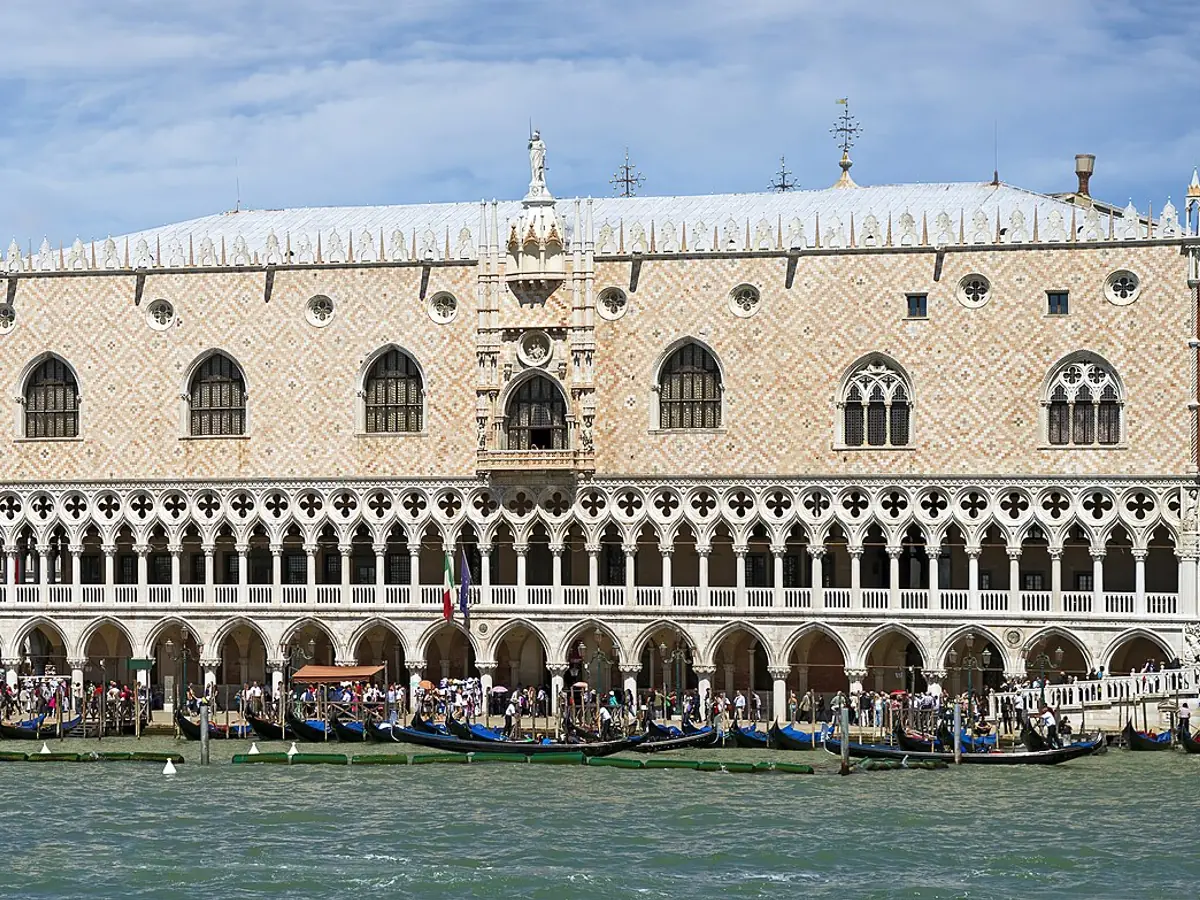
Palazzo Ducale, Venice
Palazzo Ducale is the Doge’s Palace: a historic palace that once joined political power, residence, and confinement within a single building. Its Venetian Gothic form was shaped by Antonio Rizzo and Nicolò Barattiero. Look at the open arcade and the loggia above it; this remarkably light-looking framework carries the heavy mass of the palace above.
The building began as a seat of government in 810, was substantially rebuilt in 1340, and continued to change over later centuries. Fires repeatedly forced major reconstruction, including a blaze in 1483 that brought Antonio Rizzo to the work and introduced Renaissance elements beside the older Gothic fabric. The ceremonial Porta della Carta is marked by sculpted Virtues, the Evangelist Mark, Justice, and Doge Francesco Foscari kneeling before the winged lion.
The Foscari image you see there is a nineteenth-century replacement, made by Luigi Ferrari after the earlier work was destroyed in 1797. Within the courtyard, the Giants’ Staircase is guarded by Sansovino’s figures of Mars and Neptune, symbols of power on land and at sea. After serving the Venetian government for centuries, the palace became a museum in 1923. Its political history is still written into the architecture: this was both the Doge’s residence and the working heart of the former Republic.
_Doge%27s_Palace_facing_the_sea.jpg)