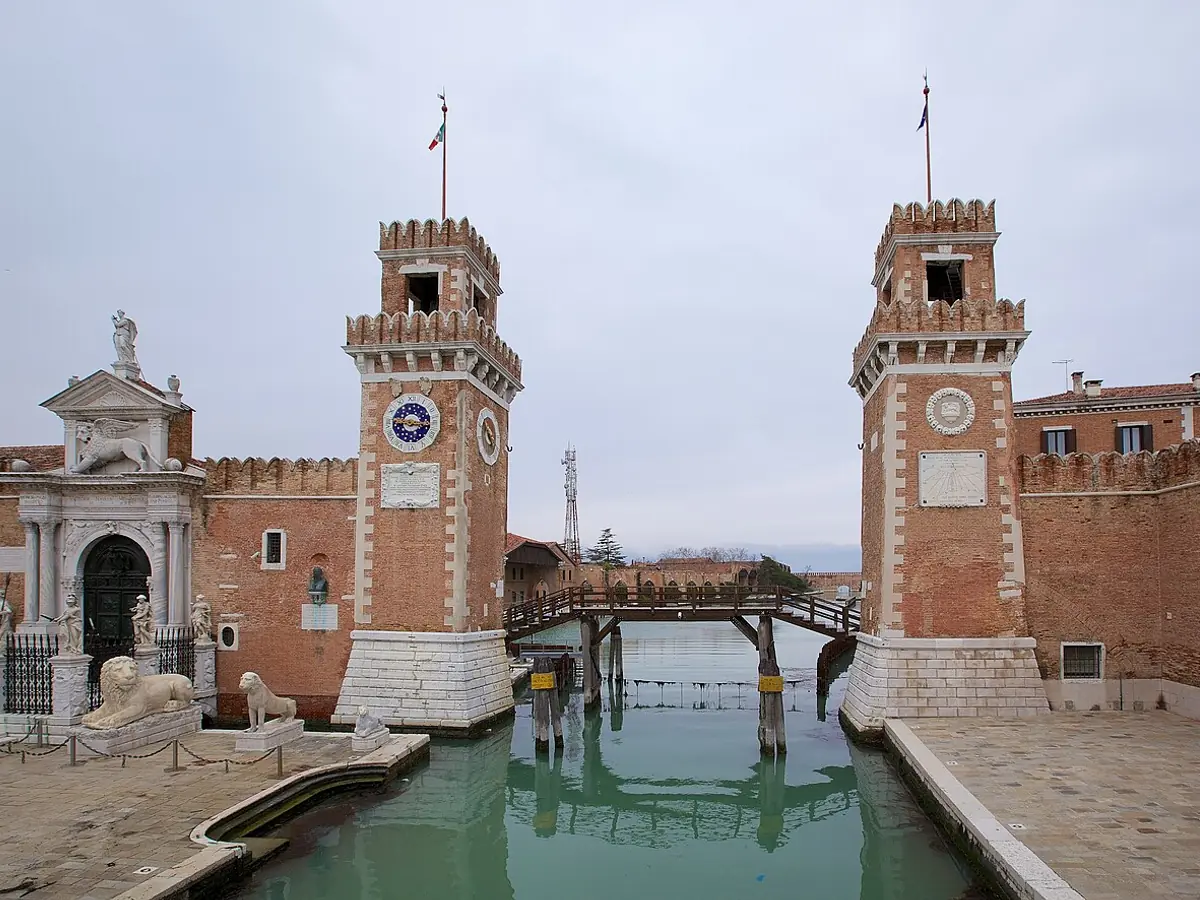
Arsenale di Venezia, Venice
The Venetian Arsenal is a vast complex of shipyards and armories, enclosed behind substantial walls. Its work powered much of the Venetian Republic’s navy from the Late Middle Ages into the early modern period, and its scale made it one of history’s earliest large industrial enterprises. The monumental entrance you can see is the Porta Magna, built between 1457 and 1460 and attributed probably to Antonio Gambello.
Its design follows a Roman triumphal arch, while marble columns and fragments from Byzantium give the gateway a richly assembled appearance. Beside the entrance stand four stone lions added in 1687; the lion from Piraeus carries runic marks linked to Scandinavian mercenaries. Behind this gateway, the Arsenal once organized shipbuilding through specialized stages and standardized parts.
At its height, about 16,000 people worked here, and a fully equipped galley could be produced in about a day. The rope-making halls known as the Corderie were rebuilt from 1579 to 1585 after an earlier structure dating to 1303. Antonio da Ponte designed that rebuilding.
The long hall measures about 317 metres and is divided by rows of masonry columns into three aisles. Today, parts of the complex serve as a research centre, exhibition venue, and historic boat preservation centre, while the Arsenal’s maritime identity remains written into its walls, gateways, and working spaces.