Kraków
Top 5 Attractions in Kraków
Kraków survived the Second World War almost entirely intact, which means its Old Town still reads the way it did five centuries ago: a walled royal capital built around one enormous market square, with a fortified hill rising at its southern edge. That survival is not a small detail — most of Poland's other historic city centers were leveled during the war and rebuilt afterward, sometimes faithfully and sometimes not, while Kraków's medieval and Renaissance fabric simply kept standing. Five stops cover the spine of that history and give you a full afternoon of walking, whether you're threading them together yourself or letting Guided build the route for you.
None of these five require an entrance fee to appreciate from the outside, and all five sit inside a compact, walkable core — you could see the exteriors of all of them in under two hours if you moved quickly, though each one rewards slowing down considerably more than that.
1. Wawel Castle and Cathedral
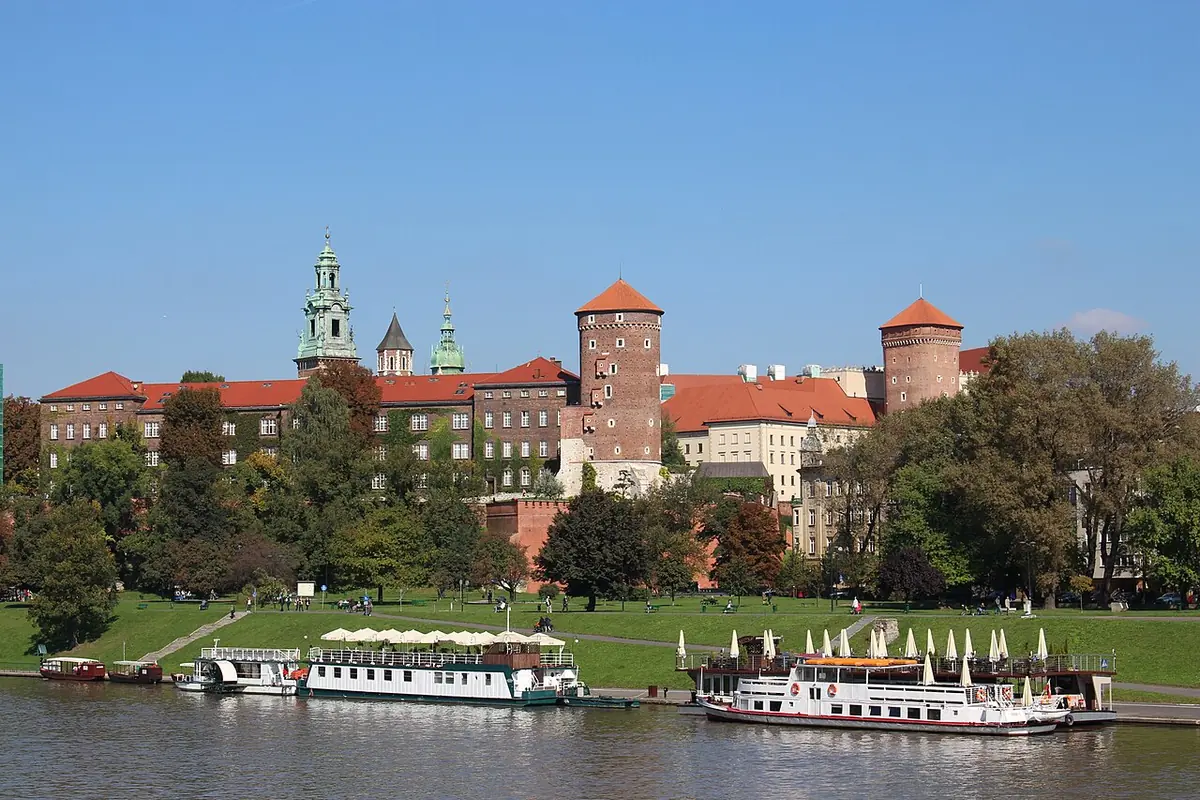
Wawel Castle sits on a limestone hill above the Vistula, and some of the stone structures on the hill reach back to about the year 970 — centuries before the castle you see today. The present building dates from the fourteenth century, when a medieval stronghold began its long transformation into a Renaissance palace, and it was repeatedly enlarged afterward. For most of the Middle Ages and the Renaissance, Polish kings lived here, and Wawel also housed the national government and the Diet, Poland's assembly, until the capital itself moved to Warsaw in 1596.
The rebuilding that gives Wawel its present look was often dramatic and rarely finished by the person who started it. The architect Franciszek Florentczyk began reshaping the castle's western wing in 1504; after his death, Bartolommeo Berrecci and Benedykt of Sandomierz carried the work forward, which is why the arcaded courtyard at the castle's heart — three tiers of Renaissance loggias wrapped around an open square — feels like the work of one confident hand even though it wasn't. A fire in 1595 then damaged the northern and eastern wings badly enough that Giovanni Trevano was brought in to direct their repair, finishing in 1603 and introducing the earliest Roman Baroque interiors anywhere in the city.
Since 1930 the castle has functioned as an art museum, and its holdings are broader than most first-time visitors expect: Italian Renaissance painting, a set of royal tapestries commissioned specifically for the state rooms, arms and furniture, and — a genuine surprise to most visitors — Europe's largest collection of Ottoman tents, captured or gifted over centuries of contact between Poland and the Ottoman world. Beside the castle stands Wawel Cathedral, where Polish monarchs were both crowned and buried, which is why the hill functions less like a single museum and more like the physical record of the country's monarchy in one place.
2. Rynek Główny, the Main Market Square
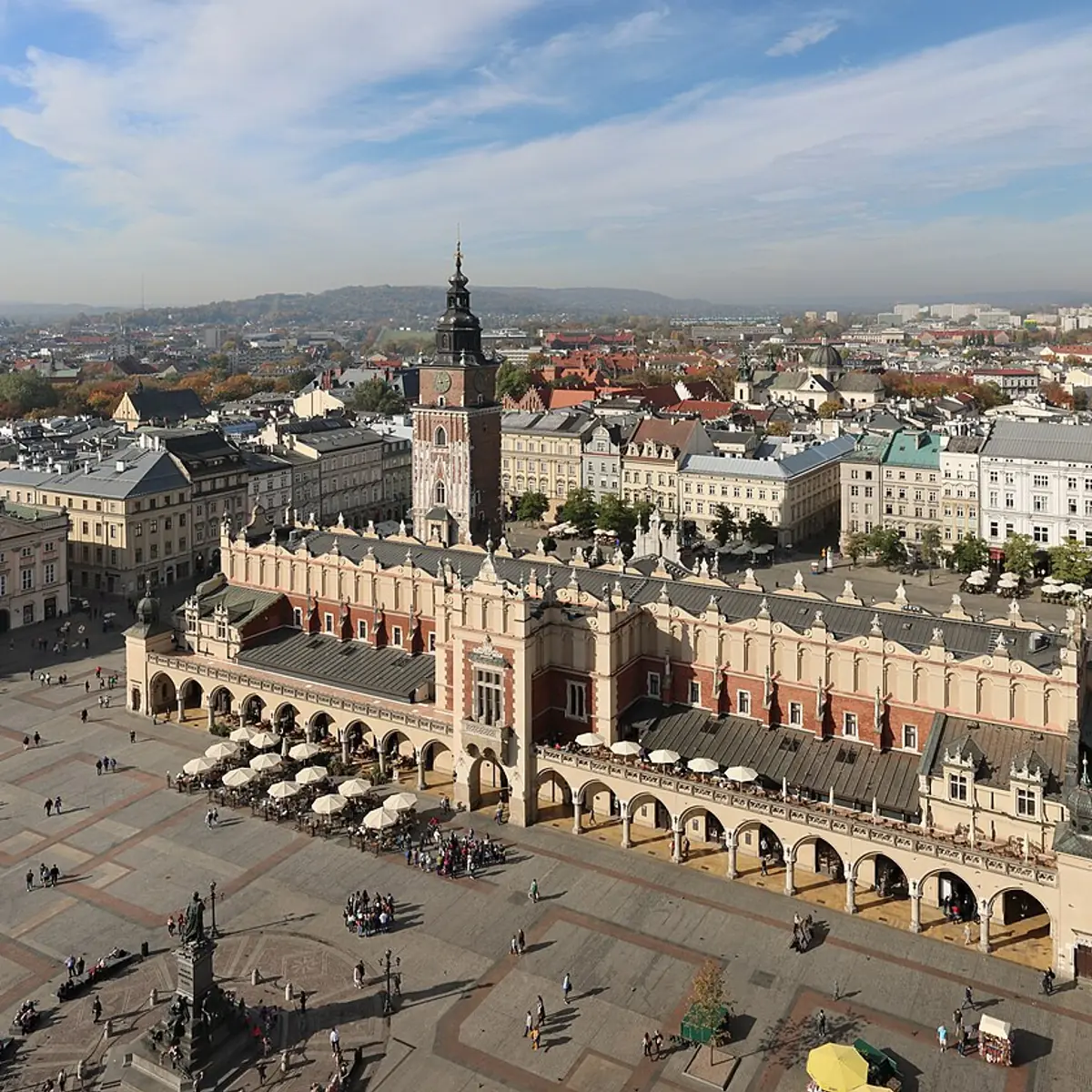
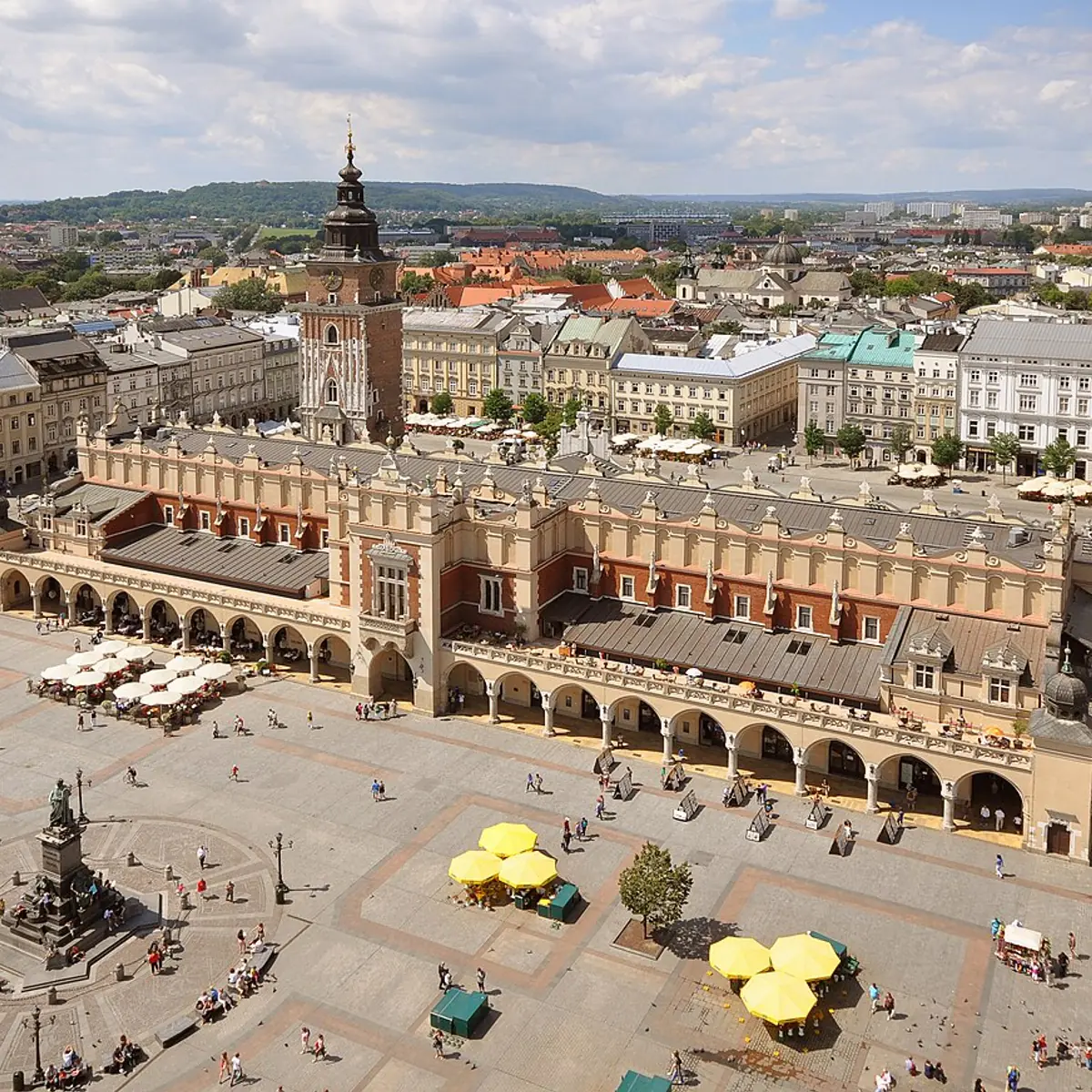
Walk down from the castle and the streets funnel you toward Rynek Główny, first laid out in 1257 as the newly chartered city's commercial heart. At almost four hectares, it's one of the largest medieval market squares still standing anywhere in Europe, and it has stayed a working public square rather than becoming a purely ceremonial one — cafés line every side today, and the whole space stays busy well into the evening.
The square has carried real history, not just foot traffic. In 1525, Duke Albert of Prussia made his formal submission to King Sigismund the Old here — the event usually called the Prussian Homage, later the subject of Jan Matejko's enormous painting that now hangs inside the Cloth Hall a few steps away. On the 24th of March 1794, Tadeusz Kościuszko launched the uprising that bears his name from this same square. During the Nazi occupation it was renamed Adolf Hitler Square and the Mickiewicz monument at its center was torn down; the monument was restored after the war, and since 1978 the square has formed part of Kraków's UNESCO-listed Old Town.
Two smaller landmarks are easy to miss if you're only looking at the Cloth Hall. The Town Hall Tower, standing alone near the square's southwestern corner, is all that survives of an actual town hall that was demolished in 1820 — the tower was simply left standing. And St Adalbert's Church, a small stone building tucked near the Cloth Hall's southern end, predates the square itself; it was already there when Duke Bolesław the Chaste chartered the city around it.
3. The Cloth Hall
Running down the center of the square is Sukiennice, the Cloth Hall — and what looks today like the square's fixed centerpiece actually began as rows of ordinary cloth stalls. In 1257, the same charter that created the square promised the city stone-built shops to replace them, and by about 1300 the stalls had been given a roofed central passage, turning a line of open-air trading tables into a genuine covered market hall. King Casimir the Great commissioned a full Gothic replacement before 1358, but that building burned down in the great fire of 1555, and the Renaissance hall standing today is the rebuild that followed.
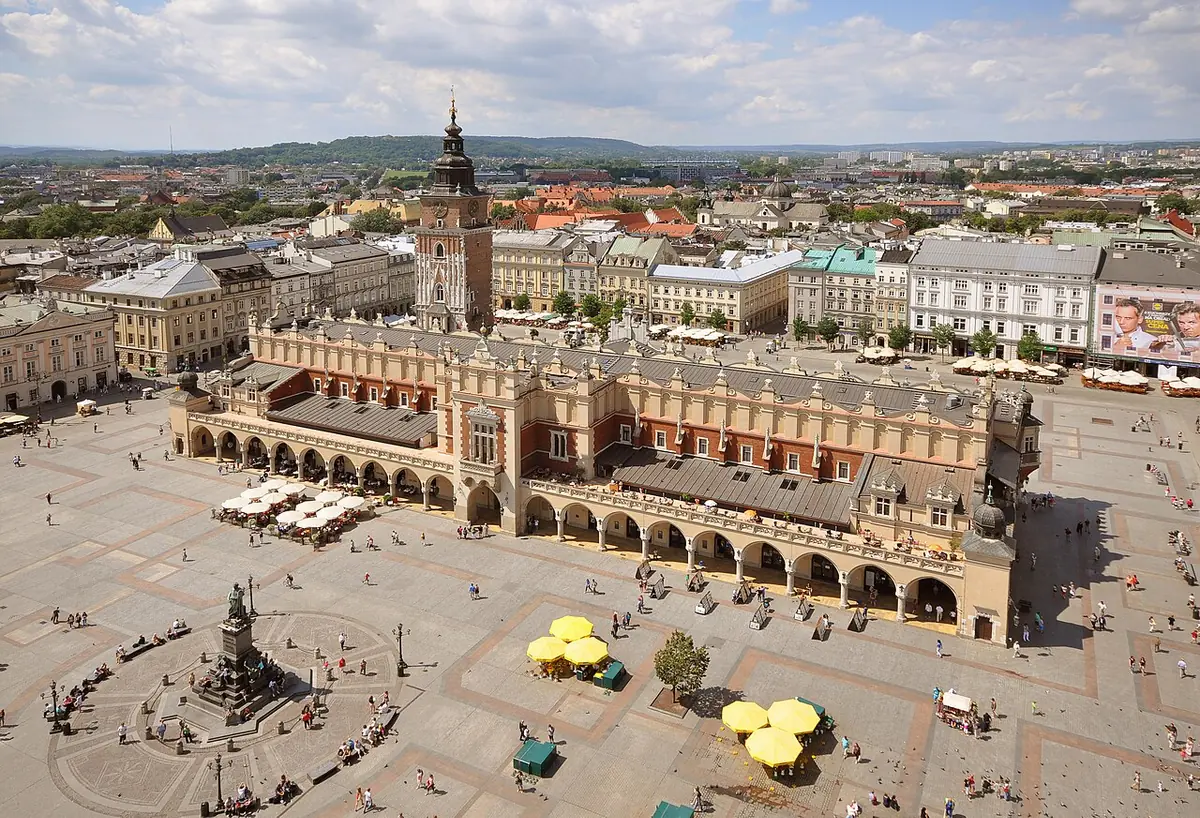
That rebuild is worth looking at closely. Master Pankracy vaulted the great hall itself, Jan Maria Padovano designed the columned arcades running along both long sides, and Santi Gucci designed the decorative parapet running along the roofline — a row of grotesque carved masks, an unusually playful flourish for a building whose whole purpose was trade. In the fifteenth century, merchants here exchanged eastern spices, silk, leather, and wax for what Kraków itself sent out: cloth, lead, and salt hauled up from the mines at nearby Wieliczka. Commerce still happens on the ground floor today, just shifted toward jewelry, amber, and handicrafts rather than raw cloth and salt. Upstairs, the National Museum's gallery holds nineteenth-century Polish painting and sculpture, including Matejko's Prussian Homage — the same 1525 ceremony the square itself once staged, now hanging a few meters above where it happened.
4. Wawel Dragon's statue
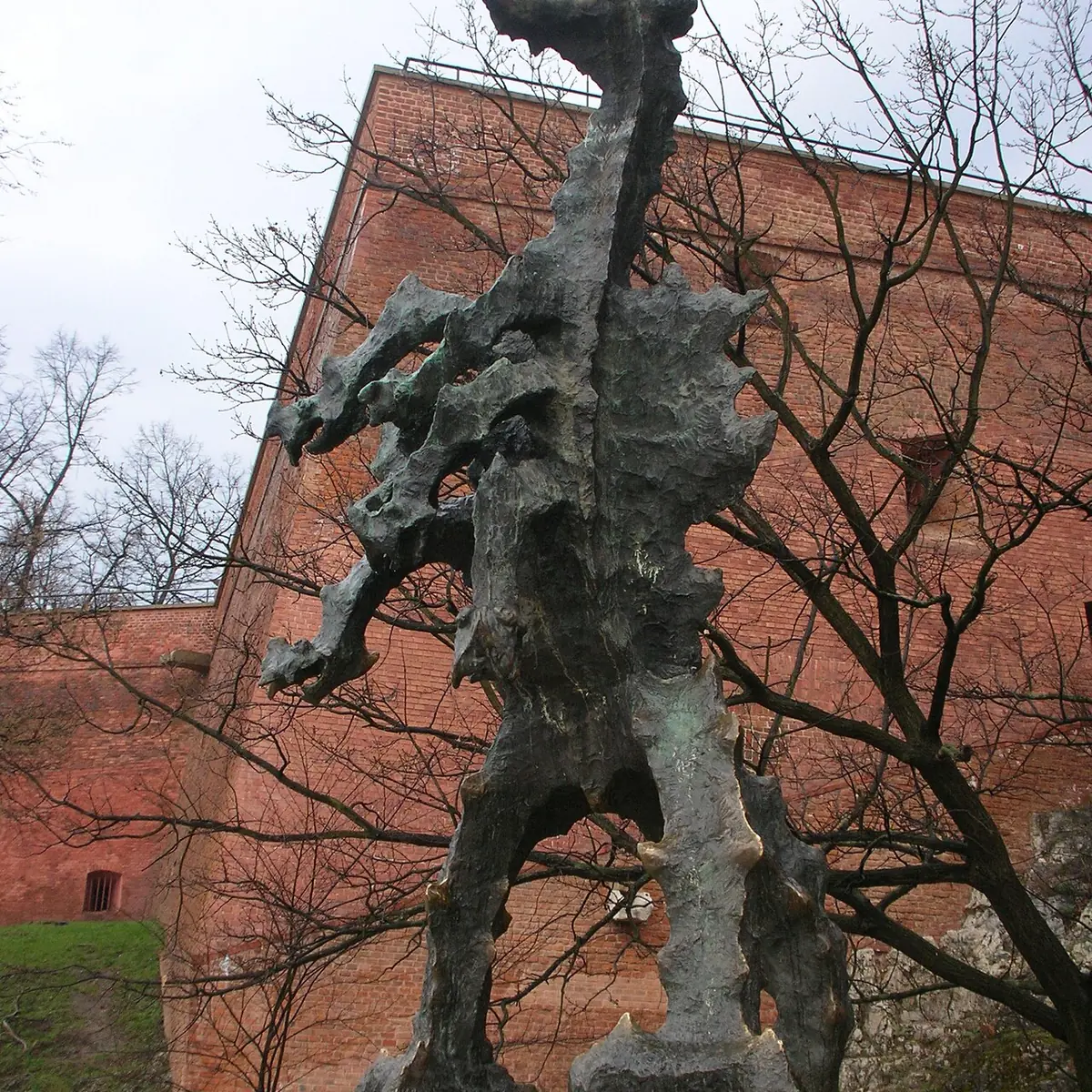
At the foot of the castle hill, beside the exit from the Dragon's Den, stands the bronze statue of the Wawel Dragon — a six-meter figure perched on a limestone boulder above the Vistula that periodically breathes real fire, to the reliable delight of anyone standing nearby with a camera ready. Sculptor Bronisław Chromy finished the piece in 1969 and it was installed here in 1972; an early plan would have set it partly in the river itself, but engineers realized driftwood and debris carried by the current would collect against it, so the riverside boulder became its permanent home instead. The fire-breathing mechanism came a year later — in spring 1973, Feliks Prochownik fitted a gas-and-electric system inside the dragon's open mouth, and it still runs on natural gas today, occasionally triggered by a text message sent to the statue itself.
The dragon is Kraków's best-known legend, and it's worth being clear that it's legend, not history: the story goes that a creature lived in a cave beneath Wawel and preyed on the townspeople, until a cobbler named Skuba tricked it with a sulfur-stuffed lamb — the dragon ate it, drank so much Vistula water trying to cool the burning in its stomach that it burst. That's the version most people know today, but it isn't the oldest one on record: the earliest surviving written account, from the twelfth century, credits the victory instead to Krakus II and Lech II, sons of the legendary King Krak, fighting the dragon directly rather than outwitting it. Either way, nothing about the story is meant to be taken as record rather than tale — a separate article on the dragon itself goes into both versions in full.
Because the statue sits right at the base of Wawel, it's a natural bookend to a castle visit rather than a separate errand — most people see it on the way down from the hill rather than making a dedicated trip.
5. Plac Mariacki
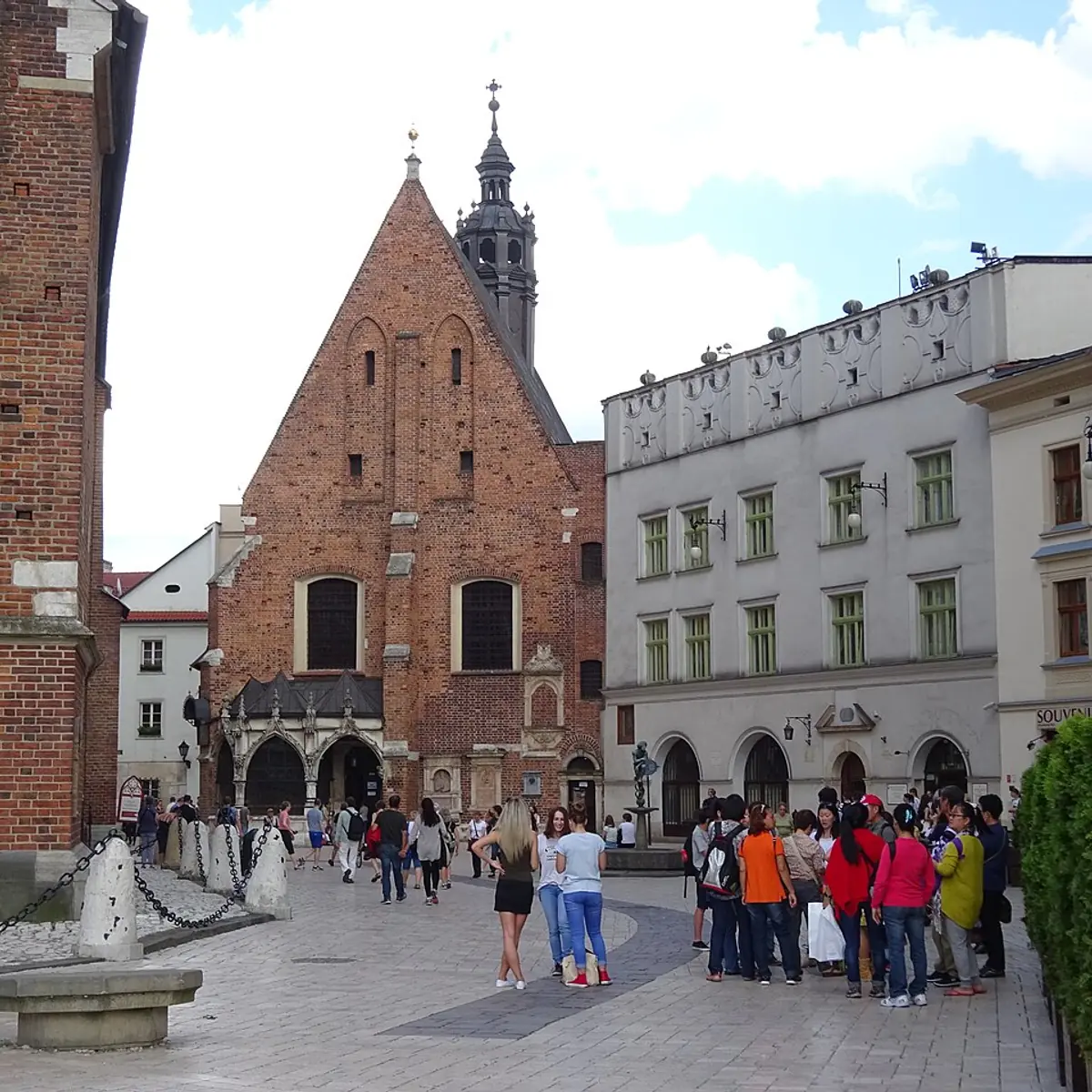
Tucked immediately behind St. Mary's Basilica is Plac Mariacki — a small plaza that's easy to walk past quickly and rewards a slower pace. The pale paving underfoot marks ground that was once the parish cemetery serving the basilica; the cemetery was cleared after 1802 and the square itself was created in its place, which is part of why it feels calmer and more residential than the market square a few steps away.
At its southern end stands a small fountain-monument shaped like a robed scholar — a 1958 gift from Kraków's craft guilds, designed by Jan Budziło with the figure itself made by Franciszek Kalfas. It's an enlarged copy of one of the prophet figures carved into the frame of Veit Stoss's altarpiece inside St. Mary's, which means the square is quietly quoting the basilica's own most famous artwork in miniature, outdoors, for anyone who never steps inside to see the original.
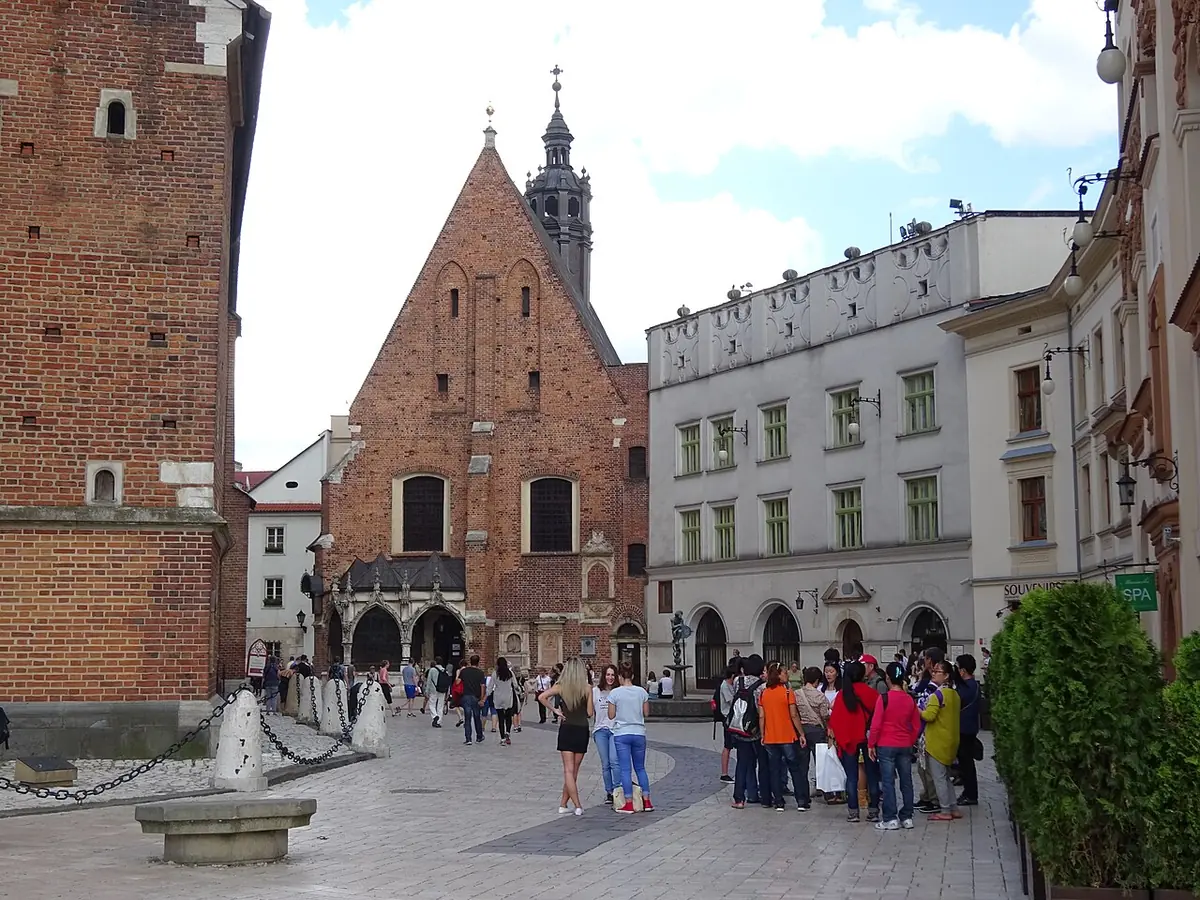
The townhouses ringing the square carry their own layered history. House number three, known as the Hipolit House and named for the Italian merchant family that once lived there, still shows Gothic, Renaissance, and Baroque doorways stacked across its different rebuildings, along with painted ceilings and eighteenth-century wall paintings inside. At number nine, a plaque marks where the playwright and painter Stanisław Wyspiański lived and worked — among the pieces he wrote in that house were his play The Wedding and the drama Legion, both now central texts of Polish literature. A single small square, in other words, carrying a cemetery, a church, a craft guild's gift, and a major writer's home all at once.
Walking it as a route
These five stops sit within about a fifteen-minute walk of each other at the outside, which is what makes them a natural loop rather than five separate outings: down from Wawel, across to the square, through the Cloth Hall, and out to Plac Mariacki before heading back. The order above is also a reasonable walking order for a first visit — it moves you steadily downhill from the castle toward the square rather than backtracking, and it saves the dragon statue, which most people photograph rather than linger at, for a natural stop along the way down rather than a special detour.
If you have more than an afternoon, each of these five is also a starting point for something deeper nearby: Wawel's cathedral crypts hold the tombs of the country's kings and its most celebrated poets in one place; the underground museum beneath the market square's eastern side reveals eleventh-century streets under the paving stones you're standing on; and the Cloth Hall's upstairs gallery is worth a return visit on its own for Matejko's paintings alone. None of that is required to enjoy the five stops above at street level, but it's there if a first pass through Kraków leaves you wanting more than a single afternoon can hold.
If you'd rather not plan the order yourself, Guided builds a walking route through Kraków's places automatically, based on how much time you have and what you're interested in, and narrates each stop with GPS-triggered audio as you arrive — hands-free, and working fully offline once the tour is downloaded.
Places in this story
See everything in Kraków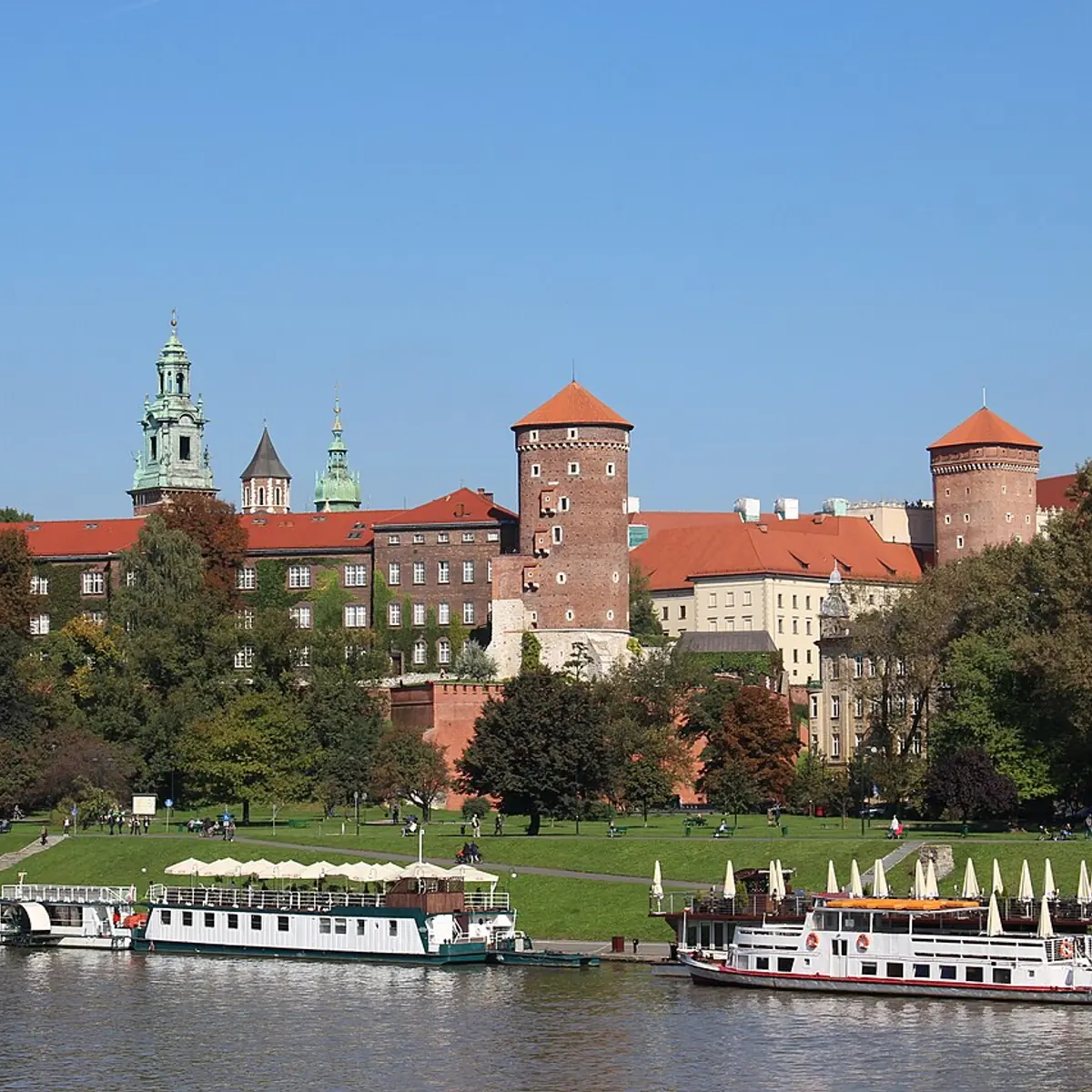


Walk Kraków with an audio guide in your pocket
Join the beta and this story becomes a route you can actually walk.