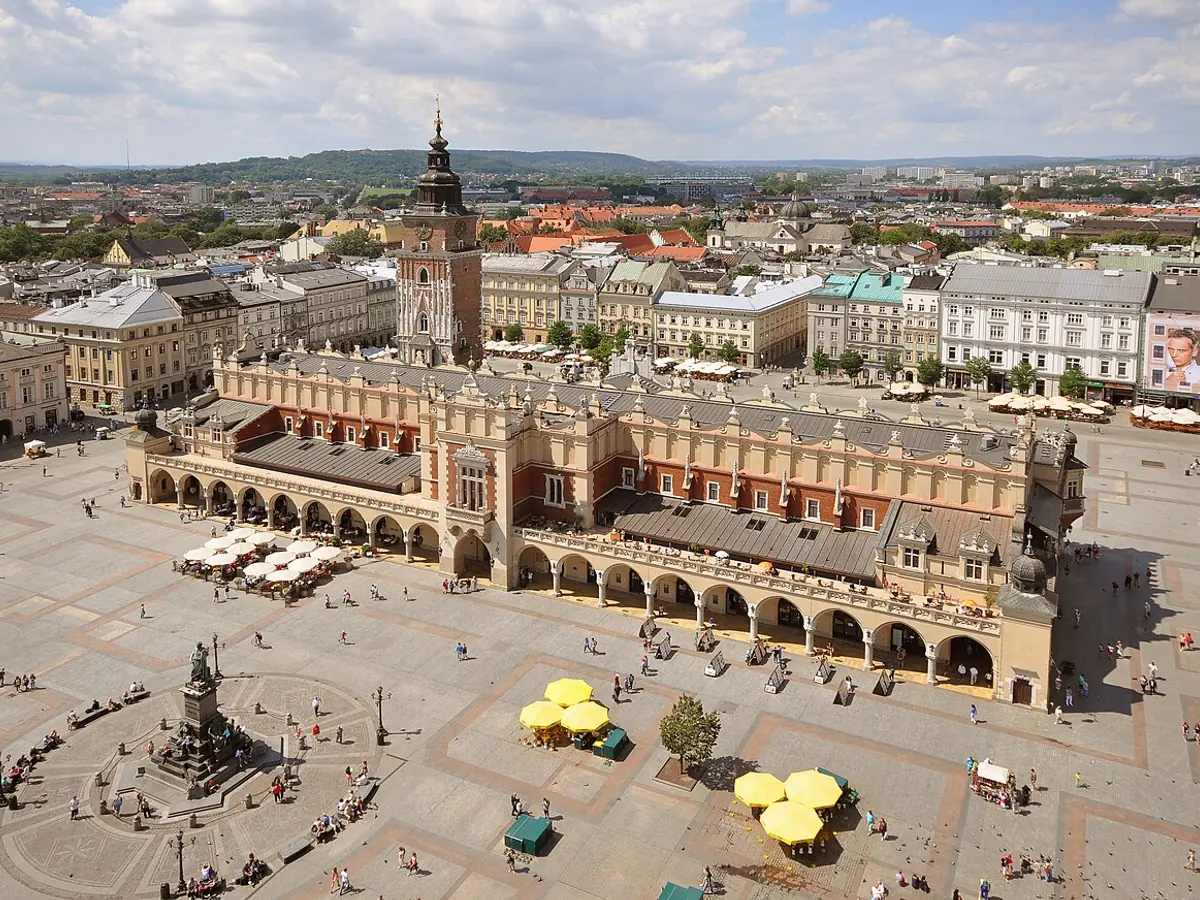
Sukiennice, Kraków
Updated
Listen to how the story begins
0:00 / 0:45
Sukiennice is Kraków’s Cloth Hall, the long historic market building planted at the heart of the Main Market Square. What now feels like the square’s fixed centre began as rows of cloth stalls: in 1257, Duke Bolesław the Chaste promised stone-built shops for the newly chartered city. By about 1300, their central passage had acquired a roof, turning a line of stalls into a covered trading hall.
King Casimir the Great commissioned a Gothic replacement before 1358, but that building burned in 1555. The rebuilding that followed gave Sukiennice its Renaissance character. Master Pankracy vaulted the great hall, Santi Gucci designed the decorative parapet with its arcade pattern and grotesque masks, and Jan Maria Padovano designed the columned loggias.
Notice those masks along the upper edge: they are an unusually playful finish for a place built for trade. In the fifteenth century, merchants here exchanged eastern spices, silk, leather, and wax, while Kraków sent out cloth, lead, and salt from Wieliczka. Commerce still occupies the ground floor, now through stalls selling jewellery, souvenirs, and handicrafts. Upstairs, the National Museum’s gallery presents nineteenth-century Polish painting and sculpture, including Jan Matejko’s monumental Prussian Homage.