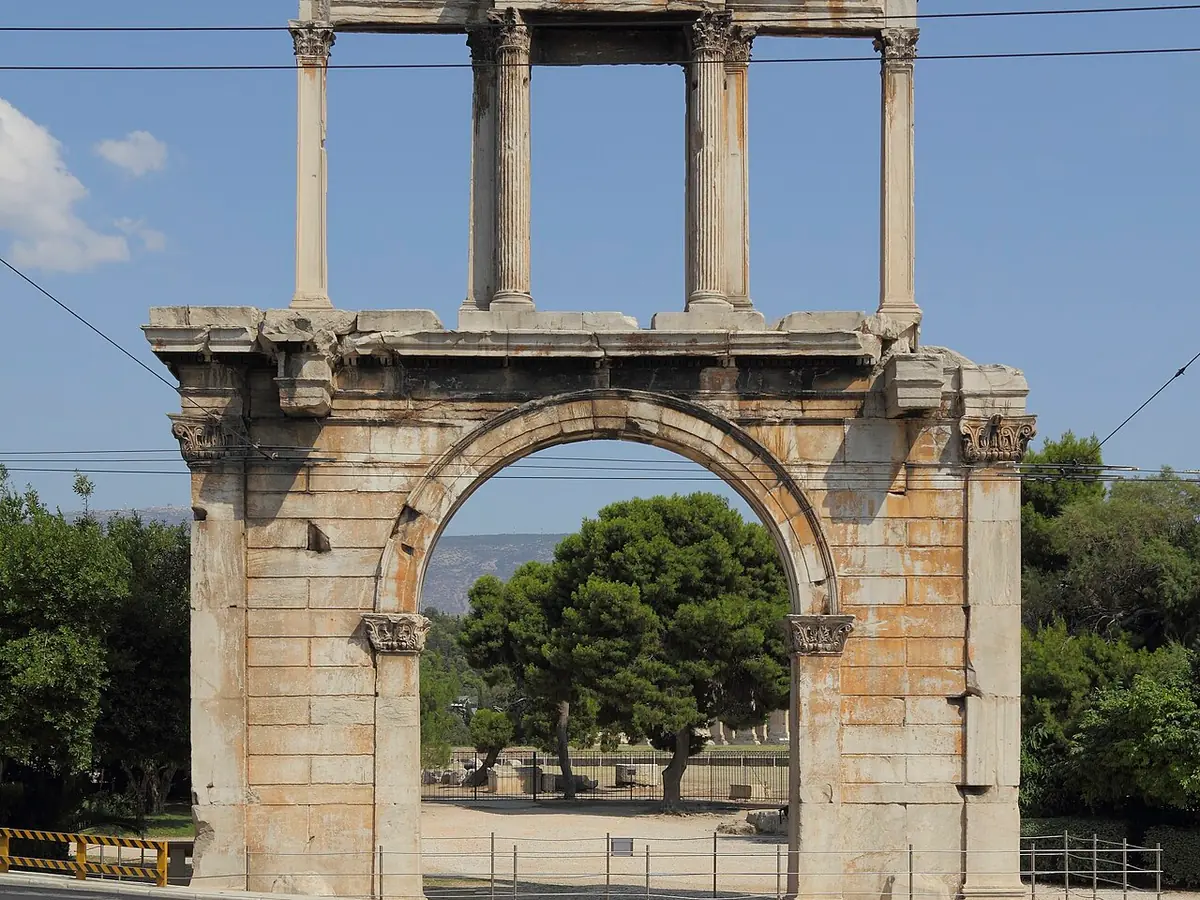
Arch of Hadrian, Athens
Updated
Listen to how the story begins
0:00 / 0:45
The Arch of Hadrian is a monumental gateway linking the ancient route between Athens and the eastern complex that included the Temple of Olympian Zeus. Its name honours the emperor Hadrian, and its form belongs to ancient Roman architecture. The entire structure is carved from Pentelic marble and assembled without mortar, with clamps joining the cut blocks.
It stands about 18 metres high, 14 metres wide, and 2 metres deep, with matching design on every face. Notice the broad arched passage and the Corinthian supports framing it; above them, a more delicate tier is divided by columns and pilasters. This restrained upper arrangement differs from the heavy, statue-filled attic often associated with Roman triumphal arches.
The passage once carried the road between Athens and the eastern temple complex, making the gateway part of the city’s movement as well as its monumentality. Above the passage, the architrave bears inscriptions that set Theseus and Hadrian into a claim about Athens: one presents the city as Theseus’s earlier city, while the other presents it as Hadrian’s city rather than Theseus’s. The arch was built in 131 or 132 AD for Hadrian’s arrival and to honour his benefactions to Athens, though its commissioner is uncertain.