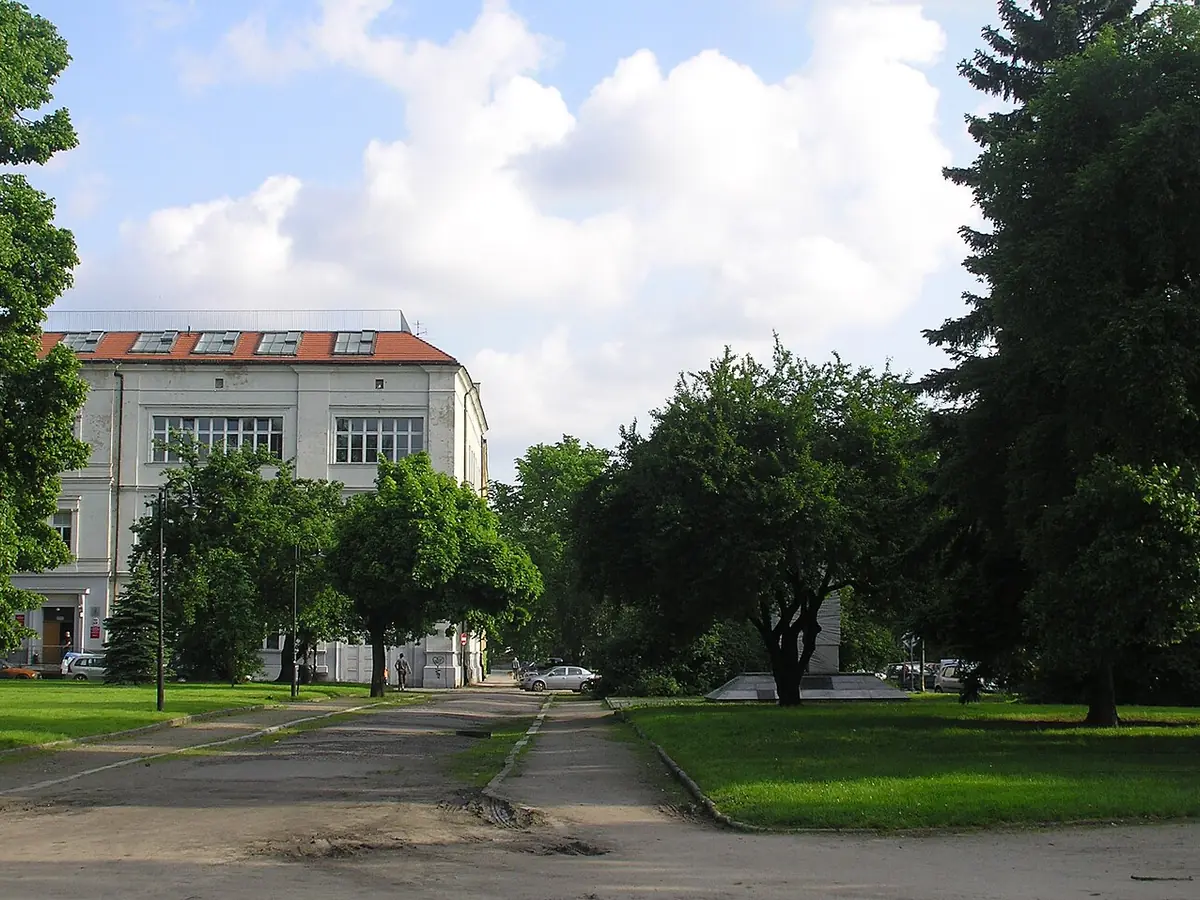
plac Polski, Wrocław
Plac Polski takes the form of a short street beside a planted square, where the Old Town Promenade reaches Wrocław’s New Town district. The open green is a reminder that this was once part of the city’s defences: the fortifications were removed in eighteen oh seven, allowing this corner to become parkland. In eighteen seventy-four, the centre received a Victory Monument designed by A.
Langer; only its traces remain on the grass today. At the eastern end, Polish Hill rises from the remains of the former Brick Bastion, a defensive work dating from the sixteenth through eighteenth centuries. Along the southern frontage stands the historic Eugeniusz Geppert Academy of Fine Arts building, begun for the State Academy of Art and Artistic Crafts in eighteen sixty-six and eighteen sixty-seven, then enlarged in nineteen oh five.
Among the outdoor sculptures, seek out Xawery Dunikowski’s Worker’s Head. Made in nineteen forty-six for the Exhibition of the Recovered Territories, it was reconstructed in nineteen eighty-two and installed beside the Academy. The green also includes a memorial to people murdered in the Eastern Borderlands by UON and UPA.