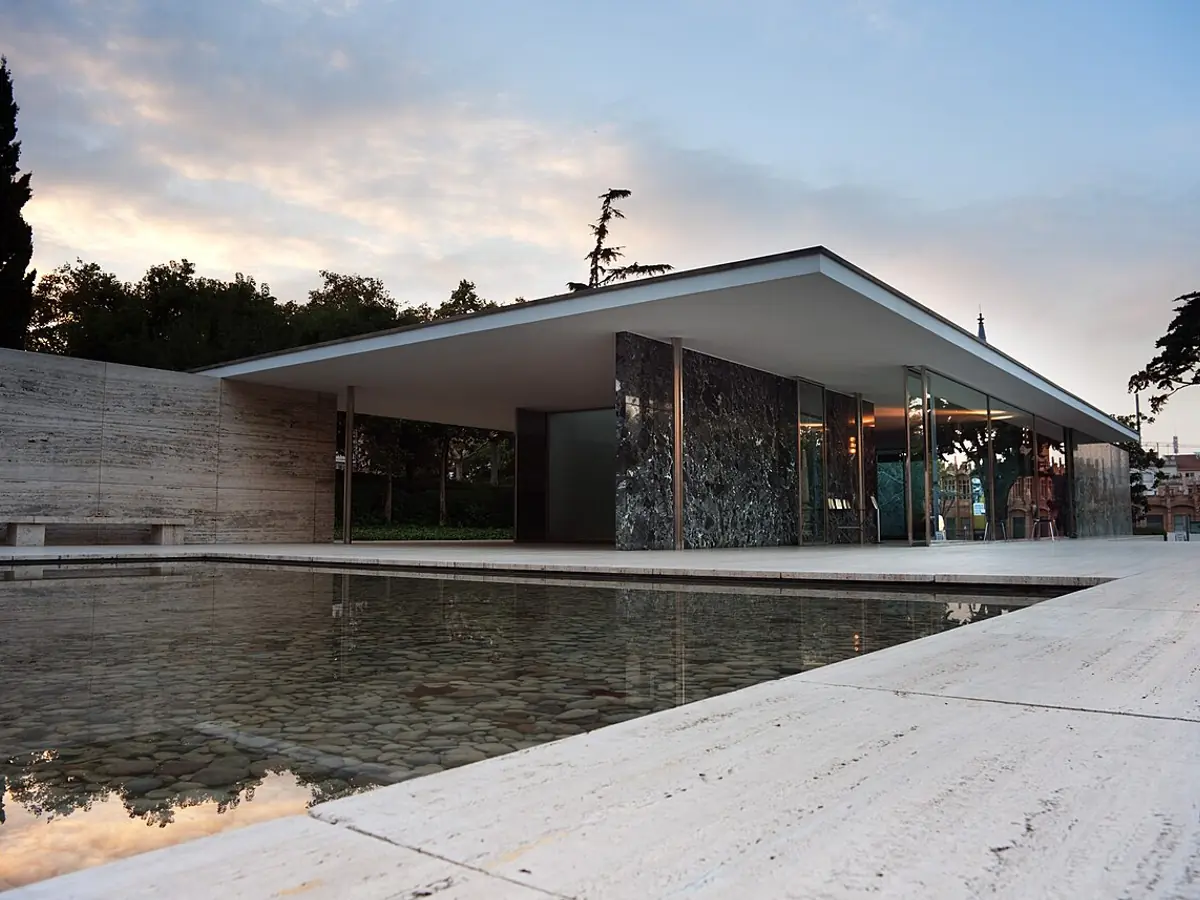
Pavelló Mies van der Rohe, Barcelona
The Pavelló Mies van der Rohe is an architectural work designed by Ludwig Mies van der Rohe and Lilly Reich for the German section of Barcelona’s 1929 International Exposition. Its original life was brief: the pavilion was dismantled in 1930, then rebuilt on this site in 1986 using, as far as possible, the original materials and techniques. Look at the low travertine platform, the broad water basin, and the walls that seem to slide past each other.
The building has no conventional exhibition display; its space is the exhibit. Mies and Reich shaped your route through changing widths and repeated turns, making the boundary between interior and exterior feel continuous. The roof appears to hover above slender cruciform columns, while stone panels and tinted glass divide the space without making it feel closed.
The pavilion is especially known for its costly materials, including marble, onyx, travertine, and glass. The Barcelona Chair was designed specifically for this building by Mies and remains in production. In the smaller basin, the figure is a reconstruction of Georg Kolbe’s Morgen, or Alba.
Its curved body meets the hard geometry of the pavilion and the reflective surfaces, so the sculpture enters the architecture through changing views. This is why the building itself became the spectacle: a calm, carefully composed space that helped define modern architecture.