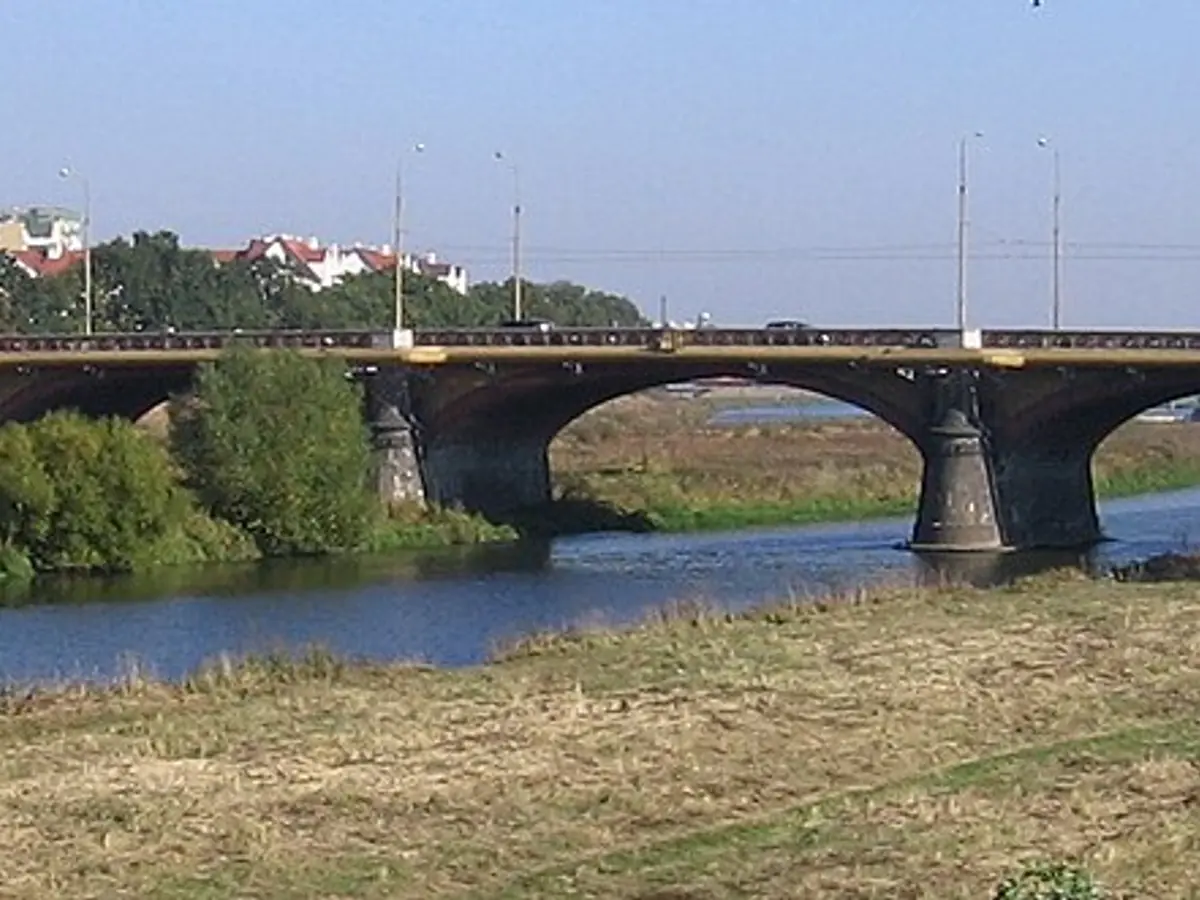
most Osobowicki, Wrocław
Most Osobowicki is a paired crossing completed in 1897, when Wrocław was rebuilding its river transport system. The southern section is a single span over the canal leading to the lock and river port, while the northern section has eight spans. Along that northern stretch, clinker-brick arches carry the route across both the Oder and its floodplain.
Granite piers support them, and shaped granite slabs finish the brick parapets. This bridge replaced a wooden crossing about seven hundred metres downstream. The earlier bridge began as private access to an Osobowice brickyard, then became public in 1812.
Cart drivers paid one silver groschen and pedestrians two pfennigs; that small pedestrian charge gave the old crossing its German nickname, Gröschelbrücke. The new route was made wider than immediate traffic required, anticipating the enlarged municipal cemetery and planned tram and narrow-gauge rail lines. It opened in early December 1897.
After the Second World War, its decorative small towers were removed and pipelines were attached along the parapets. The bridge entered the heritage register on the fifteenth of October 1976.