Most Burzowy, Wrocław
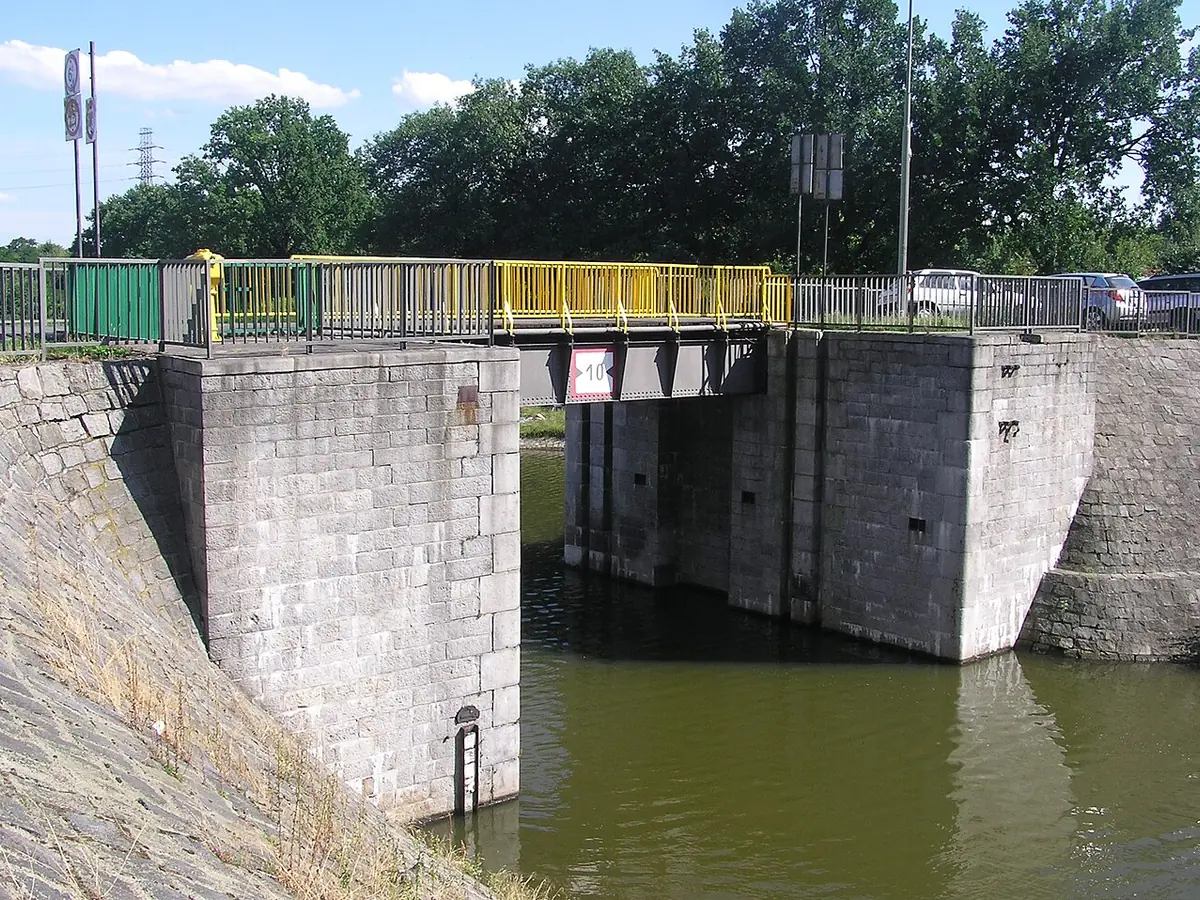
At Most Burzowy, the timber deck and steel railings belong to a working piece of river engineering, not merely a crossing. Spanning the City Canal in Ołbin, it links the neighbourhood to the embankment between the City Canal and the Old Odra, whose crest carries Pasterska Street. The bridge shares its abutments with a flood-control lock.
Its central task is to support the rails of a steel flood gate. Tracks running lengthwise allow the gate to be drawn into a recess in the abutment when the lock opens; short transverse tracks let it be braced for water pressing from either direction. That ingenious arrangement makes this a local pedestrian and cycle link as well as a service crossing for the flood gate and the Psie Pole weir.
Notice the riveted steel construction: plates and structural sections are joined by rivets rather than welding. The Psie Pole water-control complex was built between 1892 and 1897 as part of Wrocław’s new major navigation route. Under normal impounded-water conditions, the opening beneath the bridge is 4.34 metres high; at the highest level, it is 3.80 metres.