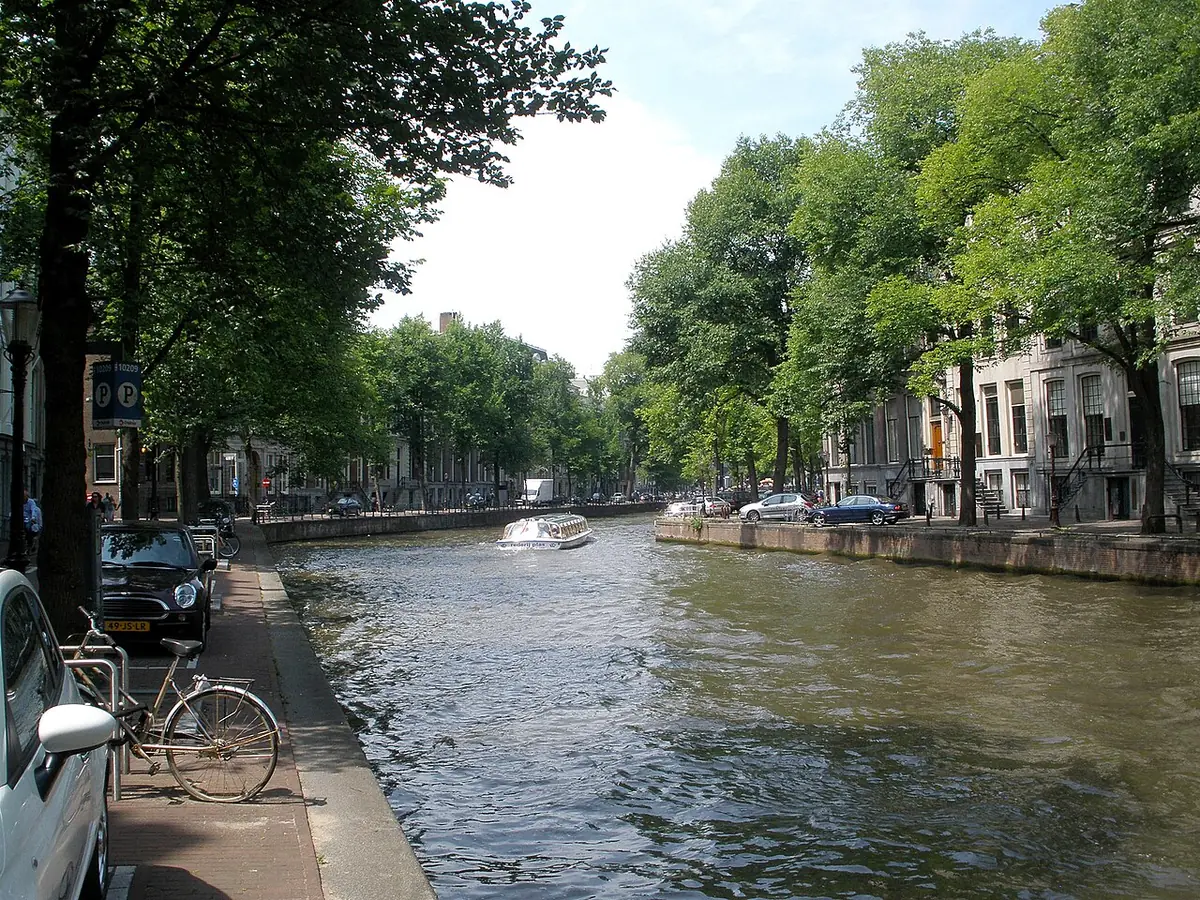
Gouden Bocht, Amsterdam
Gouden Bocht is the celebrated curve of the Herengracht, the canal section between Leidsestraat and Vijzelstraat. The canal widens visually here as the façades follow its bend, giving you a clear sense of why this stretch became Amsterdam’s most prestigious address. The section took shape during the city’s expansion after 1663, when the Herengracht was extended toward the Amstel.
Buyers were encouraged to join adjoining plots, creating unusually broad and deep sites for grand town houses. Wealthy residents filled them with formal façades, plaster ceilings and gardens that opened to the public once a year. Around Nieuwe Spiegelstraat lived Amsterdam’s richest citizens, and that bend acquired its famous nickname in modern times.
At Herengracht 446 stands Huis van der Graeff, built in 1672 for burgomaster Andries de Graeff. Herengracht 475 and 476 form the De Neufville house, dating from 1731 and celebrated for its façades. The corner building at Herengracht 466 was designed by Philip Vingboons and housed the Dutch Trade Society from 1858 to 1926.
Today, banks and financial institutions occupy many of these historic buildings, alongside cultural institutions and the Kattenkabinet at Herengracht 497. The impressive point is the combination: a canal curve engineered for spacious plots, now lined with houses that still display the ambition of Amsterdam’s wealthy past.