
Wrocław
Wrocław — City of a Thousand Bridges
Wrocław is built across a delta where the Oder river splits into several channels, threading around a string of islands before rejoining downstream. That geography is why the city is sometimes nicknamed the "city of a hundred bridges" — the real count of crossings, footbridges, and pedestrian links spanning the various channels genuinely runs into the hundreds, spread across every era of the city's history from medieval toll crossings to twenty-first-century cable-stayed engineering. Five of them, walked in sequence, trace that whole span of history in a single afternoon.
Unlike a city where the river is a single, fixed line you cross once and forget, Wrocław's delta geography means the river is a constant, repeated presence — you cross it, or a branch of it, again and again just moving between ordinary neighborhoods. That repetition is exactly why the city has needed so many bridges for so long, and why so many different eras of engineering are still standing side by side rather than one style simply replacing the last: a medieval toll crossing and a Victorian tram bridge and a twenty-first-century motorway span all still do genuinely different jobs for genuinely different parts of the city, so none of them has ever become fully obsolete.
Most Tumski, the cathedral crossing
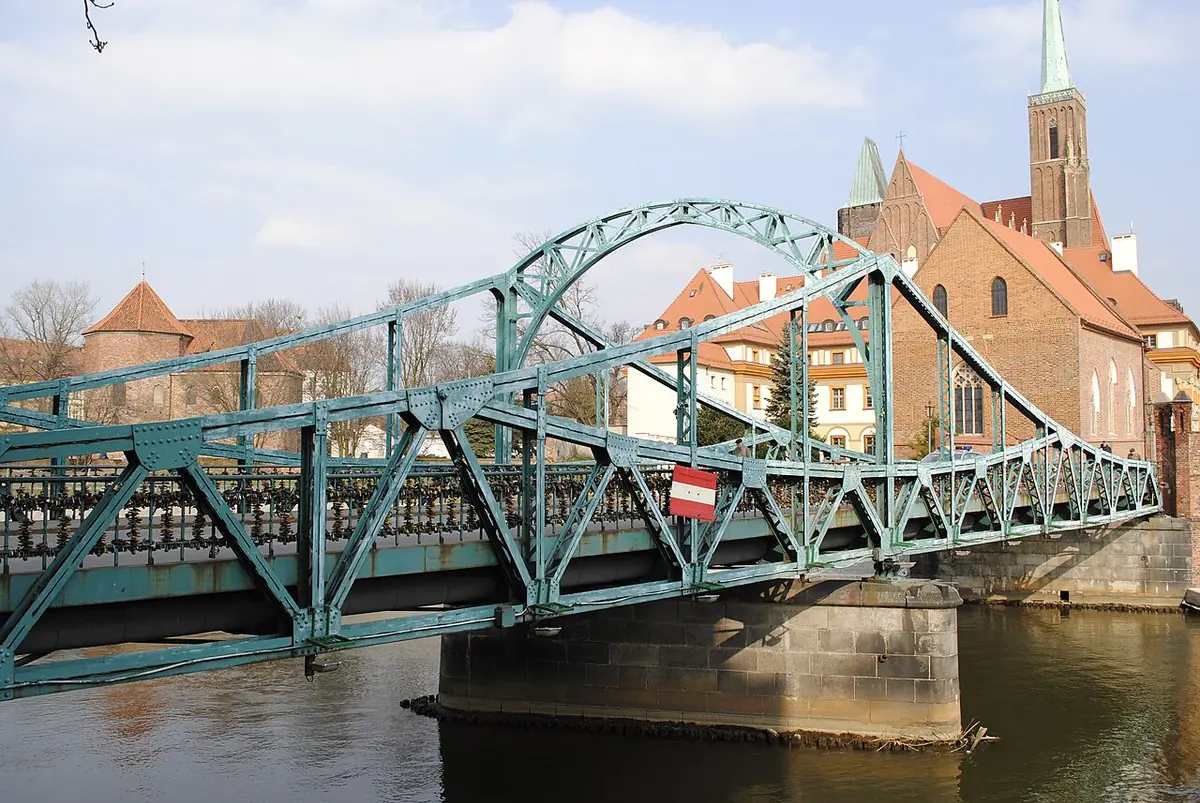
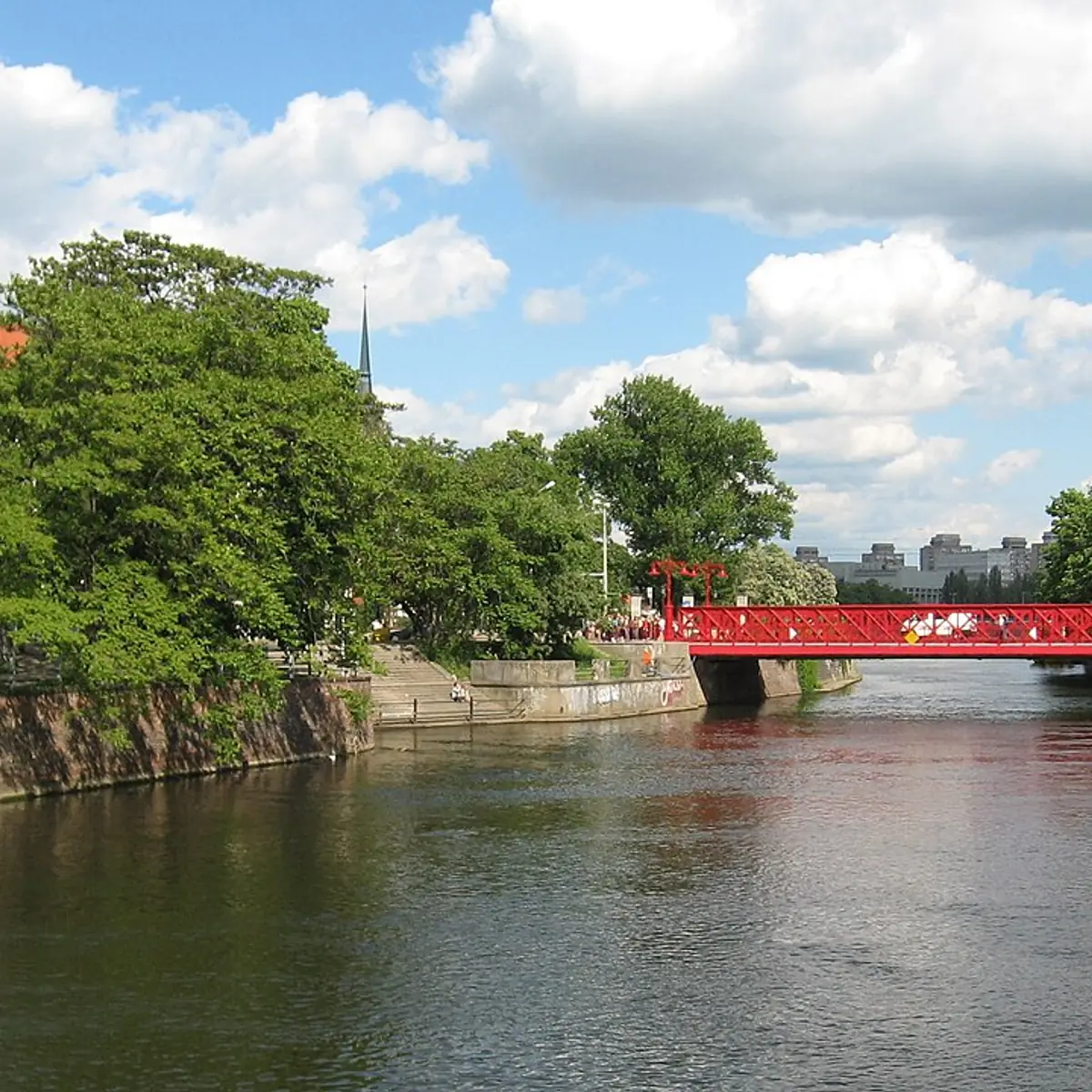
The most storied of the city's bridges is Most Tumski — Cathedral Bridge — an 1889 riveted-steel span with two sections, crossing the Oder's northern branch between Cathedral Island and Sand Island, on a route where crossings reach back at least to the twelfth century. That long history matters here in a specific way: this exact spot once marked the boundary between the city's own civic authority on Sand Island and the Church's authority on Cathedral Island, which is part of why a bridge has stood here, in one form or another, for the better part of a thousand years. It hasn't always been safe to cross — in 1423, a Palm Sunday procession moving across an earlier bridge here suffered a collapse.
The bridge carried a different name for most of its life: it was called Dombrücke until 1945, and damage from the siege of Festung Breslau at the end of the Second World War was repaired afterward, though traces of gunfire and shrapnel are still visible on some of its ironwork if you know to look. Two sandstone figures — Saint Hedwig and Saint John the Baptist — have stood near the Sand Island end since 1893, and the bridge is still lit by working, hand-operated historic gas lamps rather than electric ones. More recently, the bridge picked up its own modern ritual: from 2009, couples began fastening padlocks engraved with their names to its railings and throwing the keys into the Oder below. The tradition grew heavy in a very literal sense — during a 2019 overhaul, seventeen tonnes of accumulated love locks were removed from the structure, because the sheer weight had become a genuine burden on a bridge that's now well over a century old. New locks are removed as they appear today, for the same structural reason.
Most Piaskowy, the sand bridge
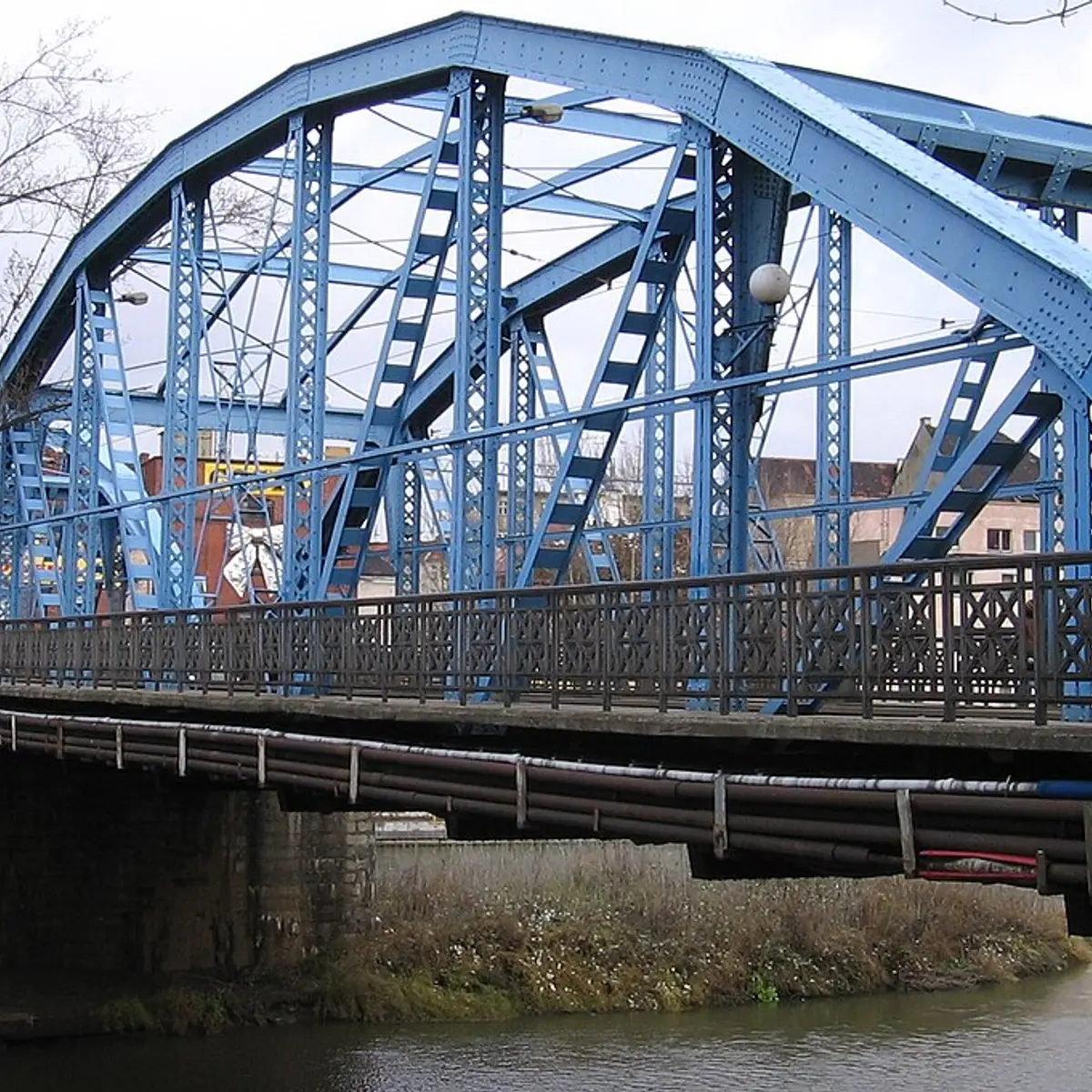
Just upstream sits Most Piaskowy, Wrocław's oldest surviving iron bridge and the southern section of the city's oldest Oder crossing. The present single-span structure dates from 1861, designed by Ernst Uber and built by Gustav Ruffer's metalworks — and it's a genuinely tight fit for what it carries: the carriageway is less than six and a half meters wide, yet it still handles two-way traffic and a two-way tram route, with the footways pushed outside the main girders to make room.
This crossing was important centuries before the current bridge existed. In 1149, the Augustinian canons who owned Piasek Island were already charging a toll here, on a wooden predecessor bridge built in several spans with a drawbridge section — a structure that collapsed and was rebuilt more than once over the centuries it stood. Electric trams began crossing in 1893. During the 1945 siege, German defenders mined the bridge outright, and Soviet artillery fire triggered the explosives late that April; it was hastily patched together to stay usable during the siege itself, then properly rebuilt afterward while preserving its historic main trusses. One more detail ties the bridge to the wider city in an unexpected way: Wrocław's own official "mile" — a distance of 6,700 meters — was measured starting from this crossing, from the former Sand Gate out toward Psie Pole. The bridge entered the national heritage register on the 15th of October 1976.
Most Sikorskiego, the Victorian workhorse
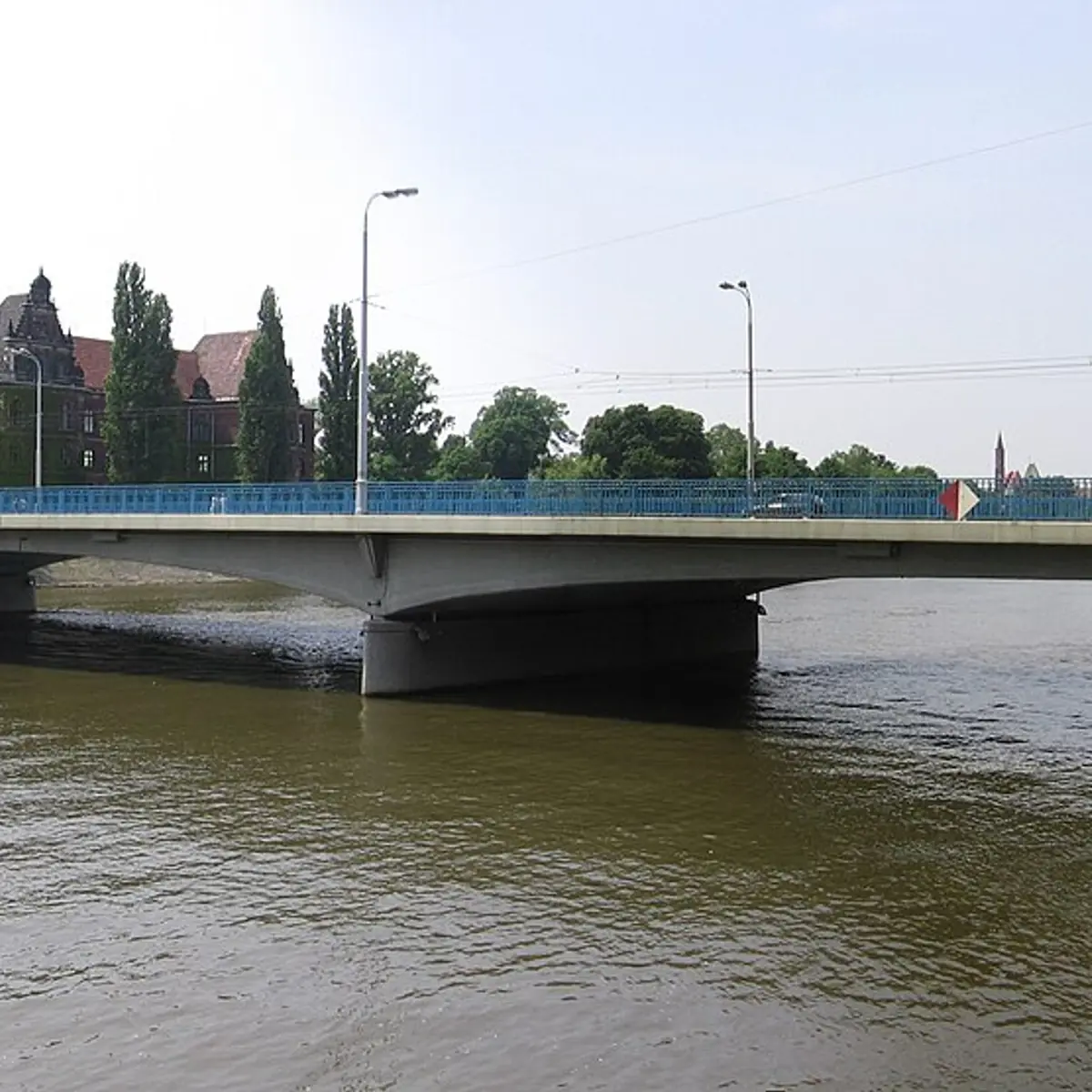
A short way downstream stands Most Władysława Sikorskiego, a protected nineteenth-century steel bridge carrying the line of Podwale across the Southern Oder to Kępa Mieszczańska. Built in 1875, it's among the oldest bridges in the city still standing, and its two steel spans rest on a single pier set on a small island in the current. Look closely at the truss and you'll notice its upper edge arches gently, almost parabolically, while the deck stiffens the lower members and cross-connections bind the upper ones together — and parts of the hangers and diagonal braces are cut into decorative openwork patterns, the kind of visible structural craftsmanship later, plainer bridge designs mostly abandoned.
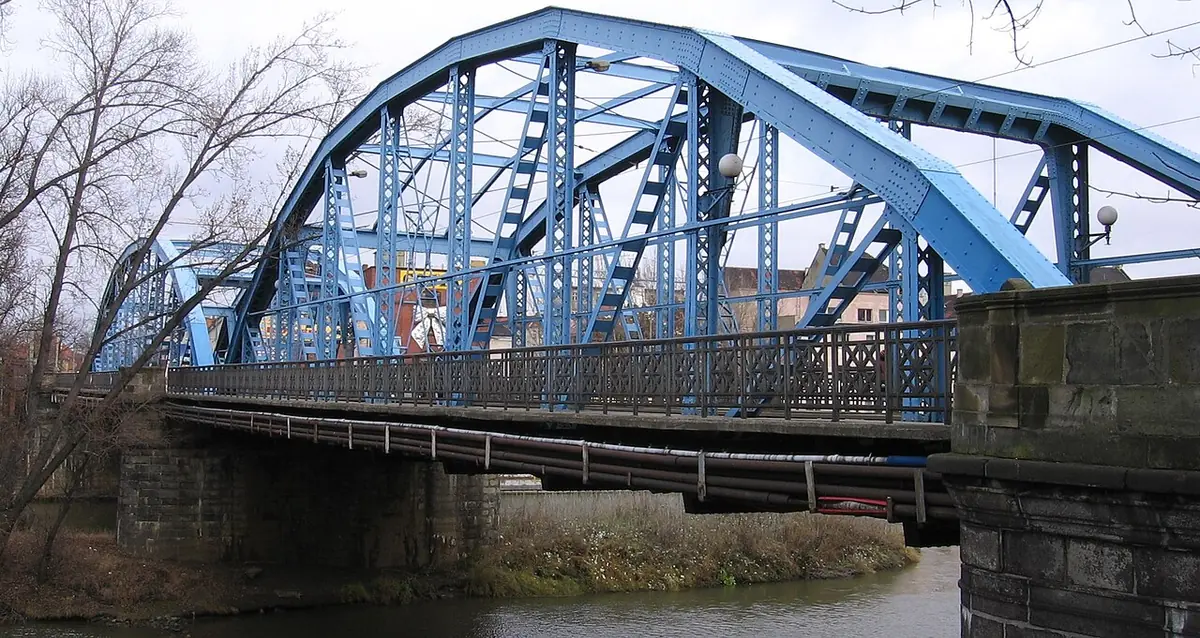

Two tram tracks have run across it since the late nineteenth century, making it part of the city's daily transit for well over a hundred years continuously. It opened under the name Königsbrücke — Royal Bridge — and briefly became Lignicki Bridge in the first years after the war, before finally taking the name of General Władysław Sikorski. A major 1986 rebuild replaced its older cast-iron road supports and the granite paving beneath its pavements with reinforced-concrete slabs; road and tram surfaces were renewed again in 2001, and the steelwork itself received fresh anti-corrosion protection in 2008 and 2009. It's protected today as an immovable heritage monument, which is a formal way of saying the city has committed to keeping this particular piece of Victorian-era ironwork standing indefinitely.
Most Pokoju, the bridge of peace
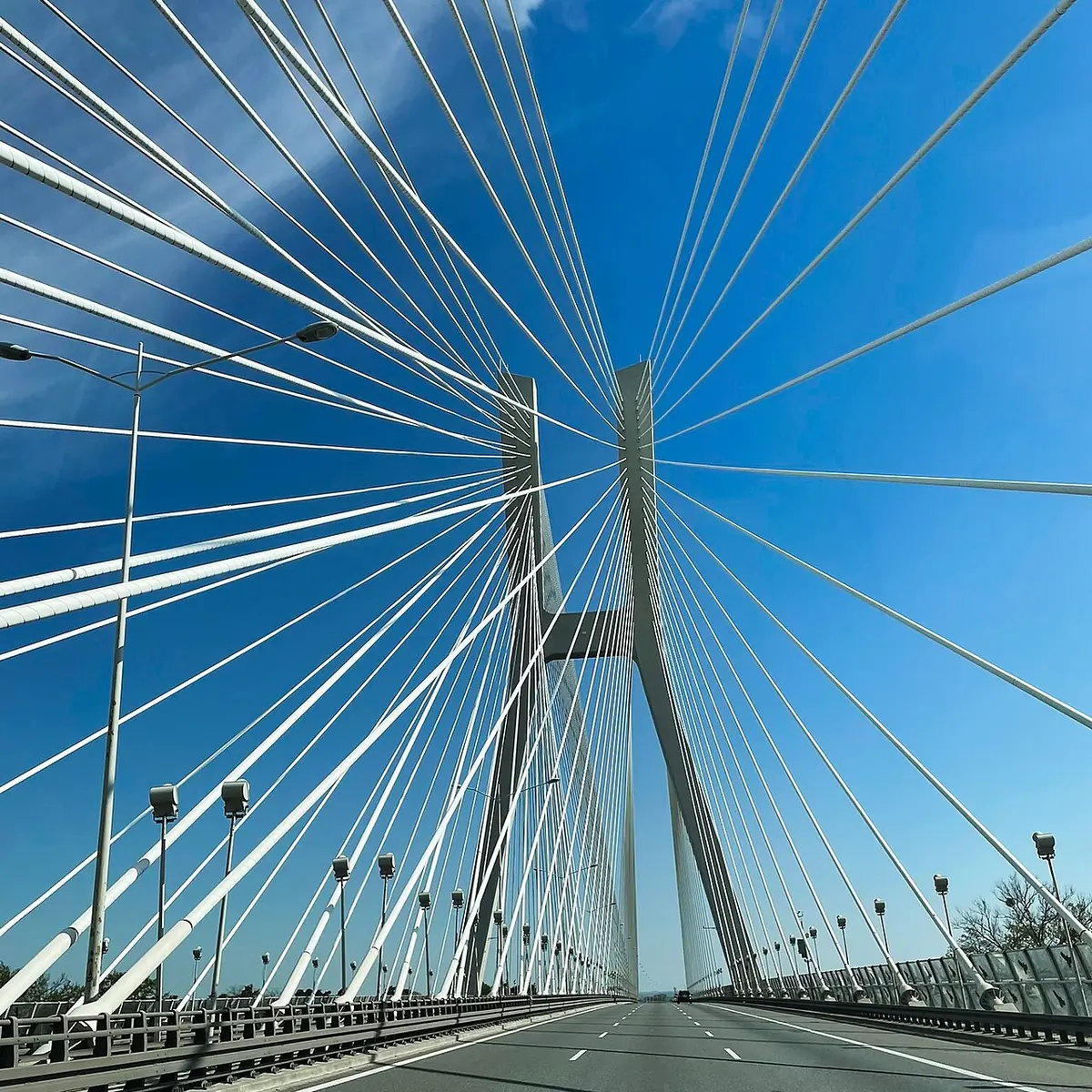
Most Pokoju — the Bridge of Peace — spans the Oder's main channel on a crossing rebuilt entirely after the Second World War, where the earlier Lessing Bridge once stood. That predecessor had its own century of history: a four-span steel truss bridge designed by Alexander Kaumann, opened in 1875 and named for the Enlightenment dramatist Gotthold Ephraim Lessing, replacing an even older link between the timber market on the river's south bank and the Sand Suburb to the north. The Lessing Bridge was damaged so severely during the 1945 siege of Festung Breslau that rebuilding it was abandoned outright.
The bridge that replaced it opened in 1959 under the name Wojewódzki Bridge, and was renamed Most Pokoju in 1966. Its three spans stretch 125.3 meters altogether, carrying broad road lanes, pedestrian pavements, and a double tram line — and during a 2003 reconstruction, the tram tracks running through its center were actually relocated between the carriageways, a reminder that even a mid-twentieth-century bridge keeps getting adjusted as the city's transit needs shift. At its northern end, a granite plaque is the only trace of a monument that was planned but never actually built, meant to celebrate the return of Poland's western and northern territories after the war — a small, slightly melancholy footnote on a bridge that otherwise reads as pure postwar functional reconstruction.
Most Rędziński, the record-setter
At the western edge of the city stands Most Rędziński, the A8 motorway's cable-stayed crossing of the Oder, carrying ring-road traffic around the city center rather than through it. Its single pylon rises 122 meters, and 160 cables — 25 kilometers of cable in total — hold up the reinforced-concrete deck below. The bridge crosses Rędzin Island as well as the river itself, which is where the builders' working name for the project, the Rędzin Bridge, originally came from.
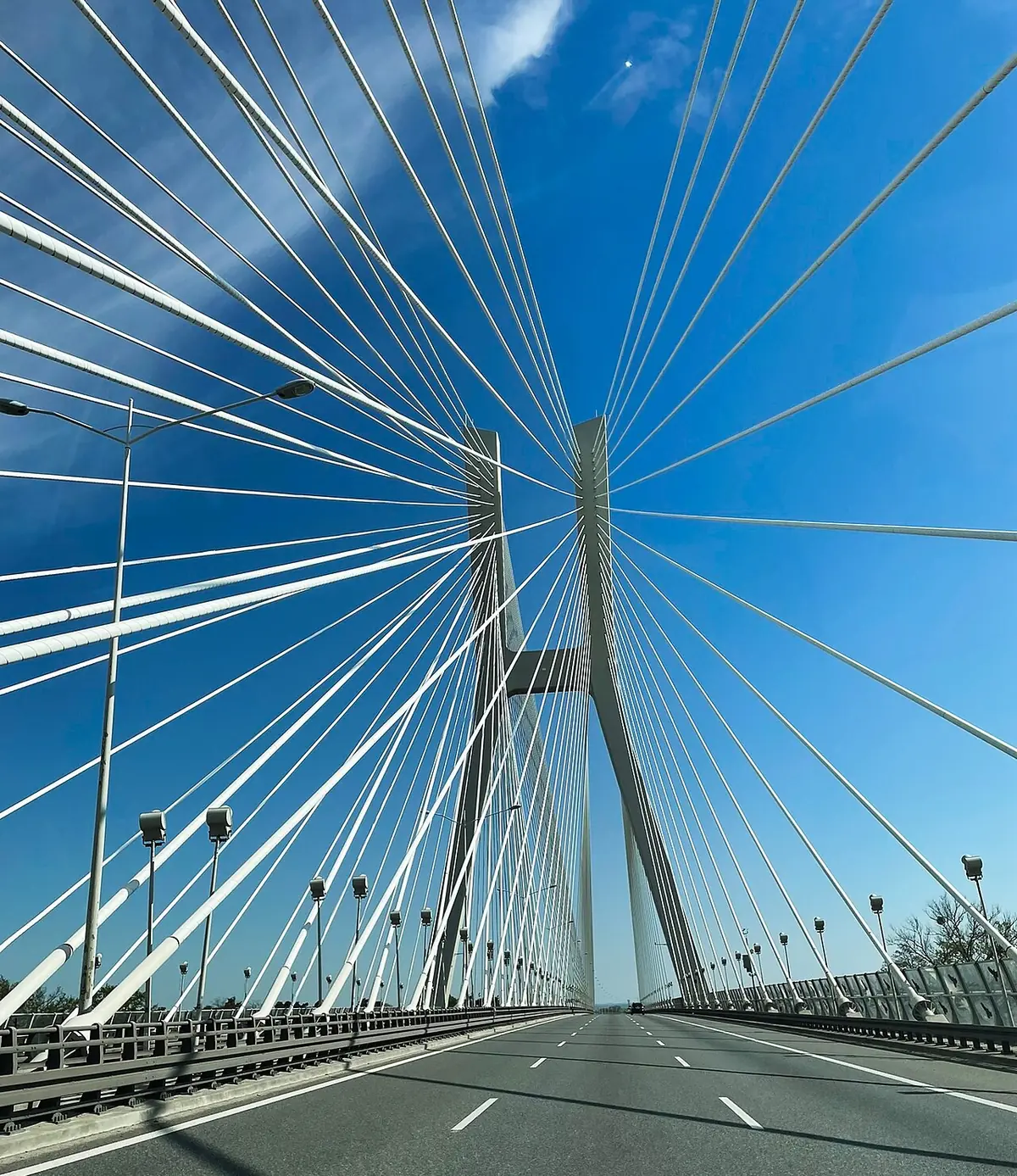

Professor Jan Biliszczuk led the design team, while the construction firms Mostostal Warszawa and Acciona Infraestructuras built it under a contract signed on the 20th of May 2008. The project wasn't without incident: in May 2010, floodwater from the Oder inundated the construction site and delayed the work by more than a month, though the partially built structure itself came through unharmed. Construction finished in August 2011, and the public actually chose the bridge's familiar name in a competition held that same month, with "Rędziński" winning 55.38 percent of the vote. Traffic began crossing on the 31st of August 2011. Its cable-supported central section measures 512 meters, split into two 256-meter spans, which makes it Poland's longest cable-stayed bridge supported by a single pylon — the newest and most overtly engineered of the five crossings covered here, a very long way, architecturally and chronologically, from the riveted ironwork at Most Tumski and Most Piaskowy.
Walking the river
None of these five bridges require a car or a boat to see — they're all reachable on foot or by tram from the Old Town, and walking from the cathedral island out toward the newer crossings gives a genuine sense of how the city's bridge-building has changed across more than a century and a half, all within a single afternoon: medieval toll crossings and Victorian ironwork giving way, step by step, to postwar functional rebuilding and finally to a modern cable-stayed record-holder, without the river or the reasons to cross it ever really changing at all.
A practical note if you're planning the walk yourself: Most Tumski and Most Piaskowy sit close enough together, both anchored to the cathedral district, that they're easily covered on foot in under half an hour including time to actually look at the ironwork and the sandstone figures rather than just cross and move on. Most Sikorskiego and Most Pokoju are a longer walk from that pair, and Most Rędziński, out at the city's western edge, realistically needs a tram ride rather than a walk if you want to see it up close rather than glimpse it from a distance — it's a working motorway crossing, not a pedestrian promenade, and it rewards a deliberate visit rather than an opportunistic one. Treat the five as two natural outings rather than one long walk if your time is limited: an Old Town cathedral-district loop covering the oldest crossings, and a separate trip out to the newest one.
Guided can route a walk through Wrocław's bridges and islands based on how much time you have, narrating each one with GPS-triggered audio as you arrive — hands-free, and it keeps working even without a signal once the tour is downloaded.
Places in this story
See everything in Wrocław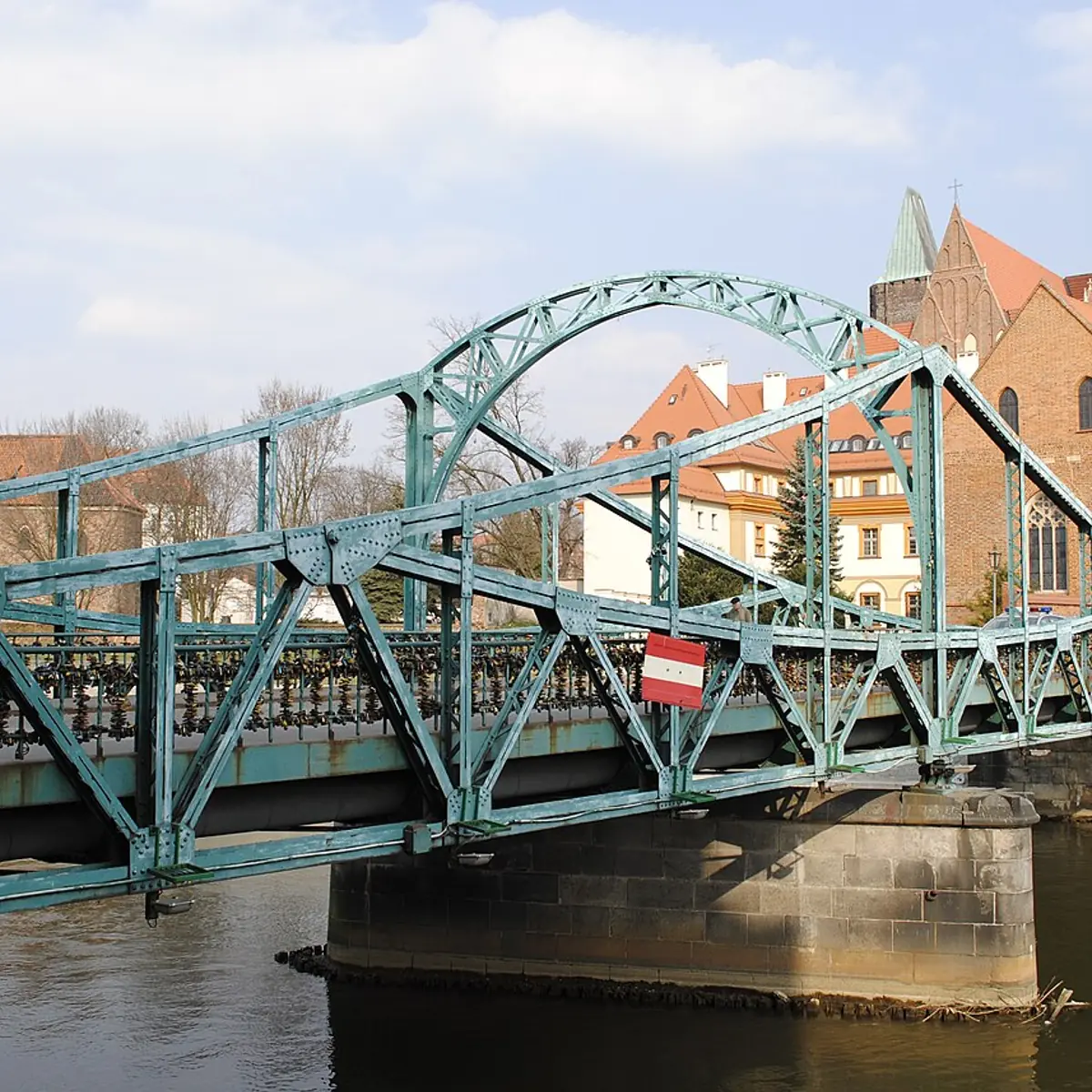
iDaviidos (CC BY-SA 4.0) Most Tumski
history
iMichał460 (Public domain) Most Piaskowy
history
iNo machine-readable author provided. Julo assumed (based on copyright claims). (Public domain) most Władysława Sikorskiego
history
iJulo (Public domain) Most Pokoju
history
iOlgierd Rudak (CC BY-SA 2.0) most Rędziński
architecture
Walk Wrocław with an audio guide in your pocket
Join the beta and this story becomes a route you can actually walk.