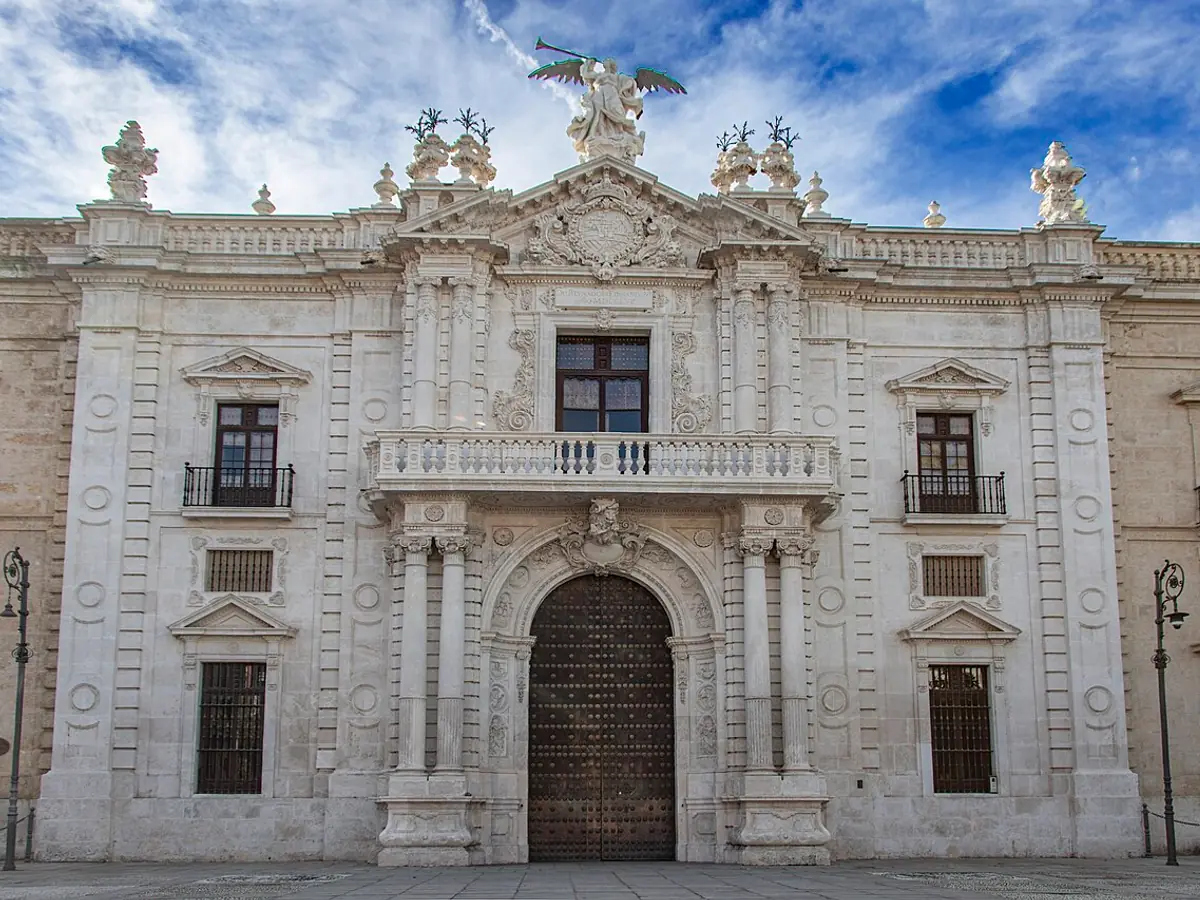
Real Fábrica de Tabacos, Seville
The Real Fábrica de Tabacos is the vast stone former tobacco factory surrounding you, now used by the University of Seville. Its scale is startling: the building covers about 185 by 147 metres, making it smaller in area in Spain only than El Escorial. Construction began in 1728 and ended in 1770, after work led by military engineers from Spain and the Low Countries, with Sebastián Van der Borcht as the principal figure in the building phase.
Look at the main entrance, where paired columns support a balustraded balcony and a pediment carrying royal emblems. Above it rises a figure of Fame, with lily-bearing vases; Cayetano de Acosta made these features, along with the marble fountains in the courtyards and the pinnacles at the corners. A ditch surrounds much of the complex, a defensive feature of its former position beyond Seville’s walls.
Production began in 1758. At its busiest, the factory employed a thousand men, two hundred horses and 170 tobacco mills. Later, women cigar makers became inseparable from its story: their work inspired paintings by Gonzalo Bilbao and the heroine of Bizet’s opera Carmen. Since the 1950s, this former industrial giant has housed the university rectorate.