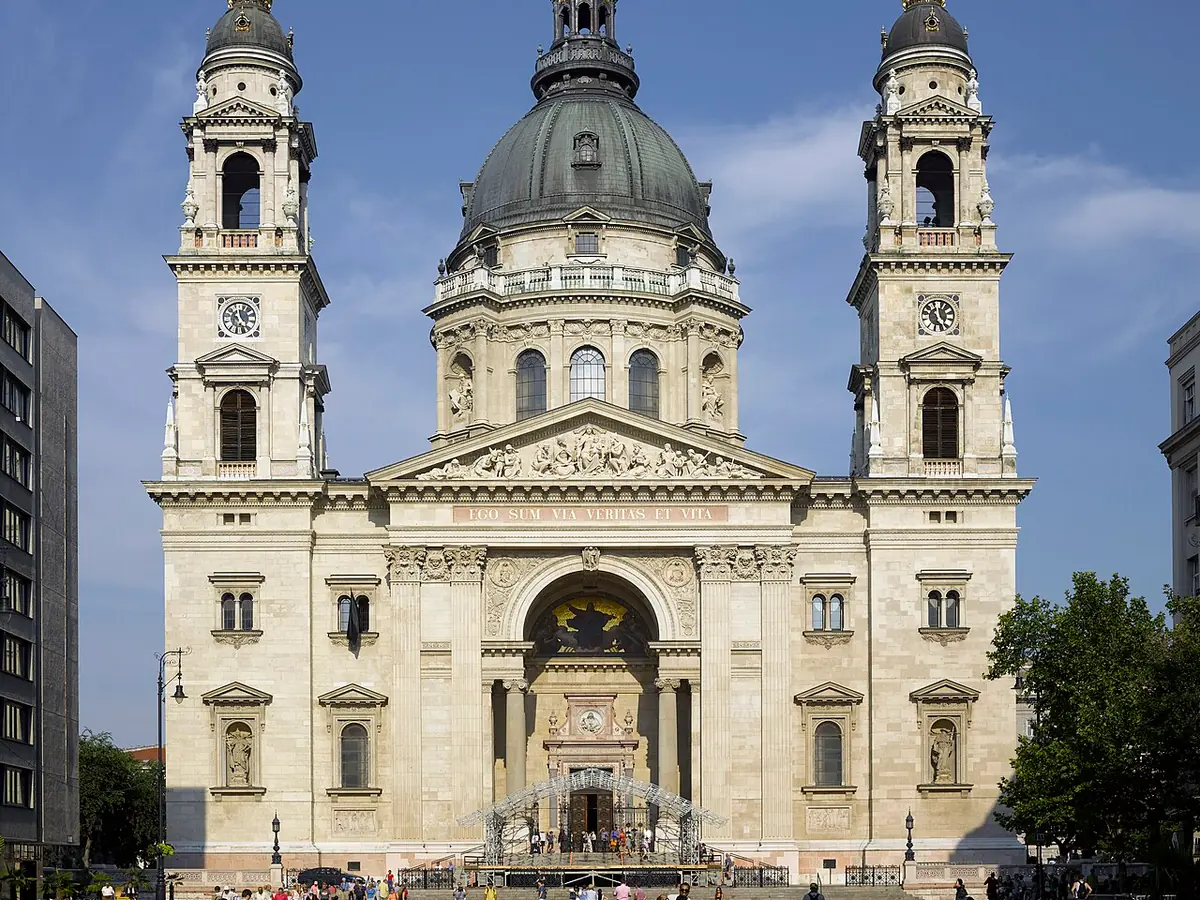
Szent István-bazilika, Budapest
St. Stephen’s Basilica is the Roman Catholic church rising before you, with a broad façade, twin towers, and a great dome. It honours Stephen, Hungary’s founding king, and preserves his right hand as a sacred relic.
The church’s unusual story begins with the flood of 1838: people escaped the water on this elevated ground, then donated toward a permanent church here. József Hild designed the building, Miklós Ybl reshaped the project after the dome collapsed during construction, and József Kauser brought the work to completion in 1905. Its neo-classical conception and later neo-Renaissance revisions produced a structure 96 metres high, 87.4 metres long, and 55 metres wide.
Look at the inscription beneath the entrance pediment: it gives Christ’s words, “EGO SUM VIA, VERITAS ET VITA.” Inside, the Greek-cross plan gathers mosaics, frescoes, reliefs, and a canopy altar carrying a statue of Saint Stephen. The sanctuary dome presents God, while the surrounding surfaces show Christ, prophets, and evangelists.
The building also houses Hungary’s heaviest bell, weighing 9250 kilograms and hanging in the southern tower. This is a church shaped by devotion, catastrophe, and an ambitious rebuilding project.