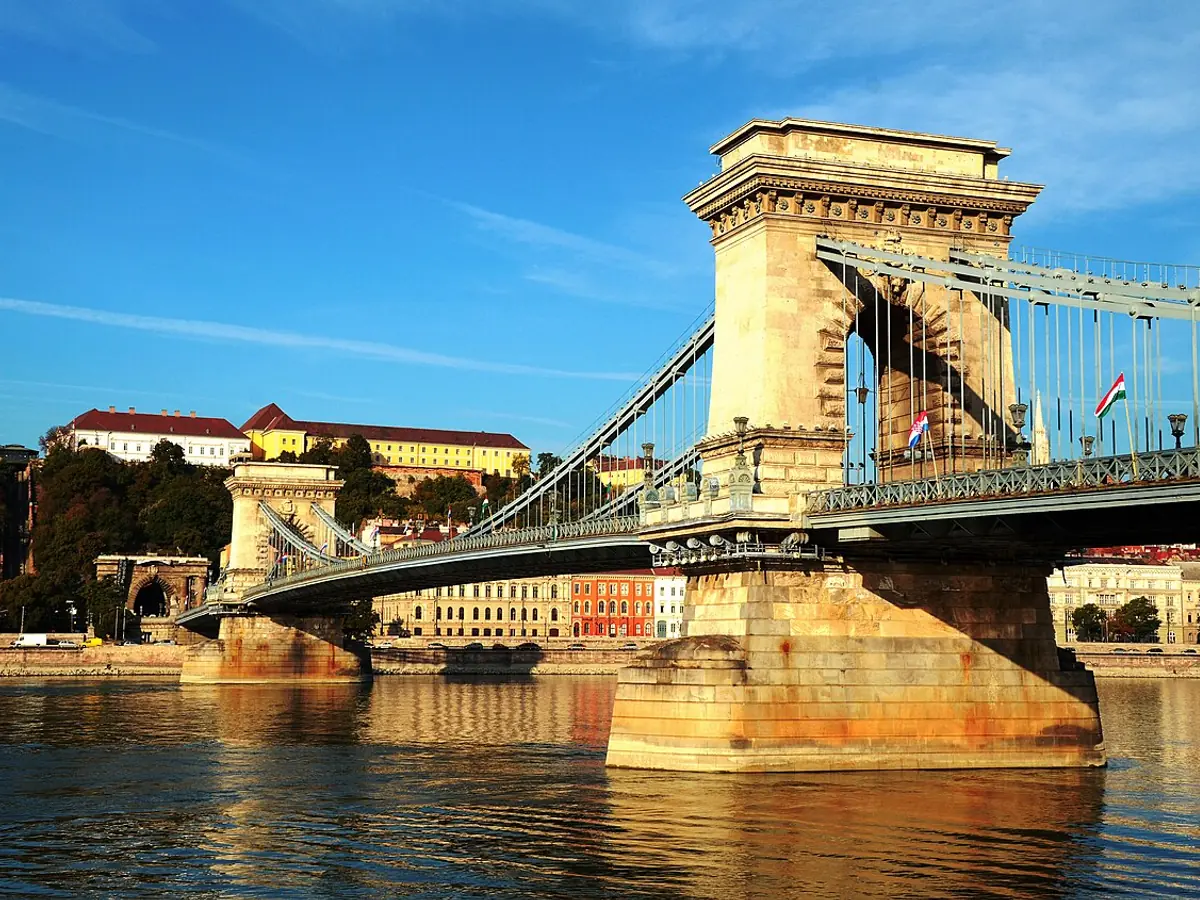
Széchenyi lánchíd, Budapest
The Széchenyi Chain Bridge is the permanent crossing linking Buda and Pest over the Danube. It opened in 1849, and it was Hungary’s first permanent bridge across the river. The design came from English engineer William Tierney Clark, while Scottish engineer Adam Clark directed construction.
The bridge’s name honours István Széchenyi, whose initiative drove the project forward. Look at the stone lions guarding the abutments: sculptor János Marschalkó made them, and they were installed in 1852. Their apparently missing tongues belong to a local legend, not to the actual sculpture; the tongues are present but difficult to see.
The bridge itself is built as a chain bridge, with cast-iron decoration, and its central span measures 202 metres, a remarkable engineering achievement when it opened. The bridge was destroyed during the Second World War, when retreating German forces blew it up on 18 January 1945. It was rebuilt and reopened in 1949. Today, the heavy stone entrances, suspended chains, and watchful lions make the bridge’s history tangible at every step.