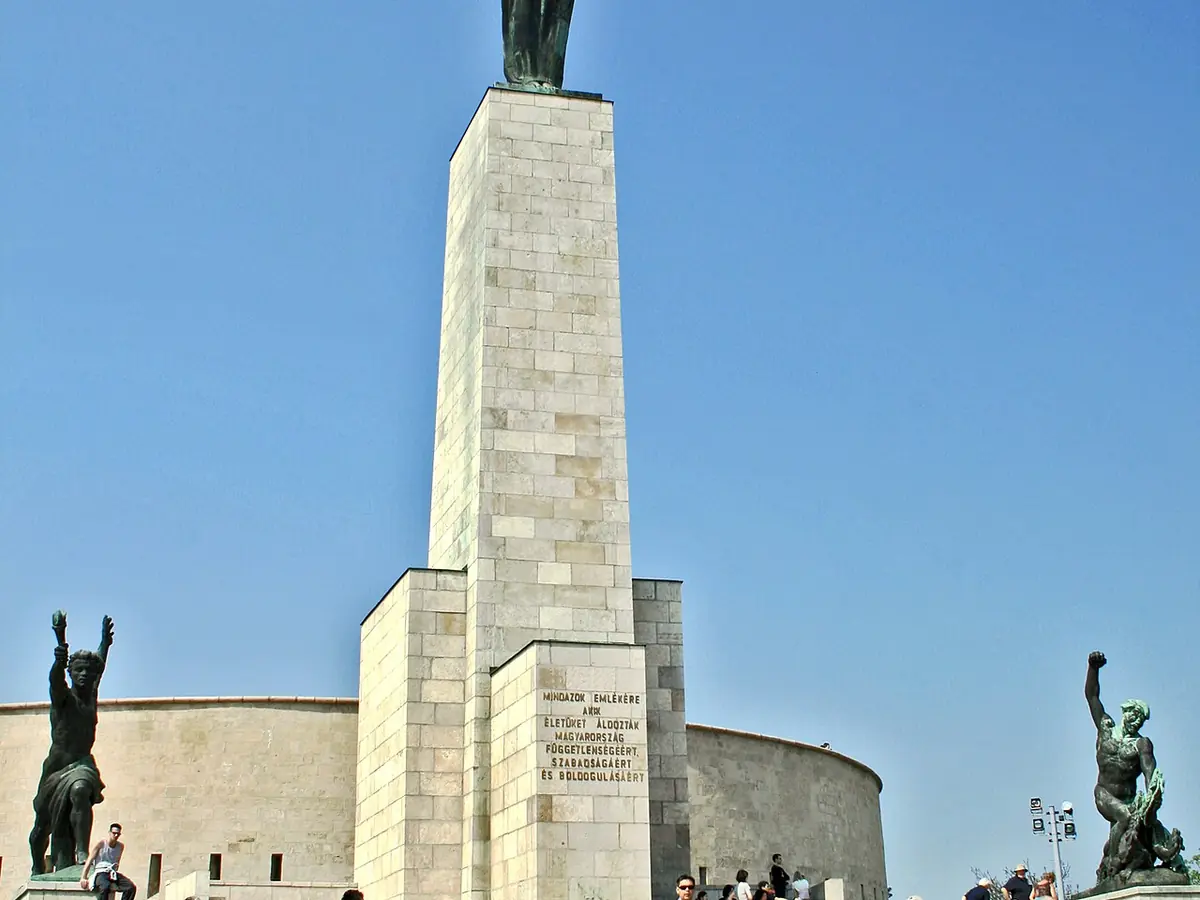
Szabadság-szobor, Budapest
The Liberty Statue is the monumental woman holding a palm branch above the Citadella on Gellért Hill. Designed by Zsigmond Kisfaludi Strobl, it commemorates people who gave their lives for Hungary’s independence, freedom, and prosperity. The figure rises 14 metres above a 26-metre pedestal, making the entire monument about 40 metres high.
Its palm branch carries the meanings of victory and peace, while the statue’s elevated setting makes it a powerful feature of Budapest’s skyline. Its history is more complicated than its serene silhouette suggests. The monument was completed in 1947 to honour Soviet troops who had driven Nazi forces from Budapest.
The original composition included military figures and inscriptions expressing gratitude to the Soviet heroes. Those references changed after Hungary’s transition from communist rule: the Soviet soldier was removed and transferred to Memento Park, and the inscription was replaced with a dedication to everyone who sacrificed their life for Hungary’s independence, freedom, and prosperity. Read the inscription on the pedestal as the key to the monument’s present meaning.
It no longer honours a single army. Instead, the woman with the palm branch stands for a broader idea of freedom, while the surviving form preserves the difficult history that gave this Budapest landmark its significance.