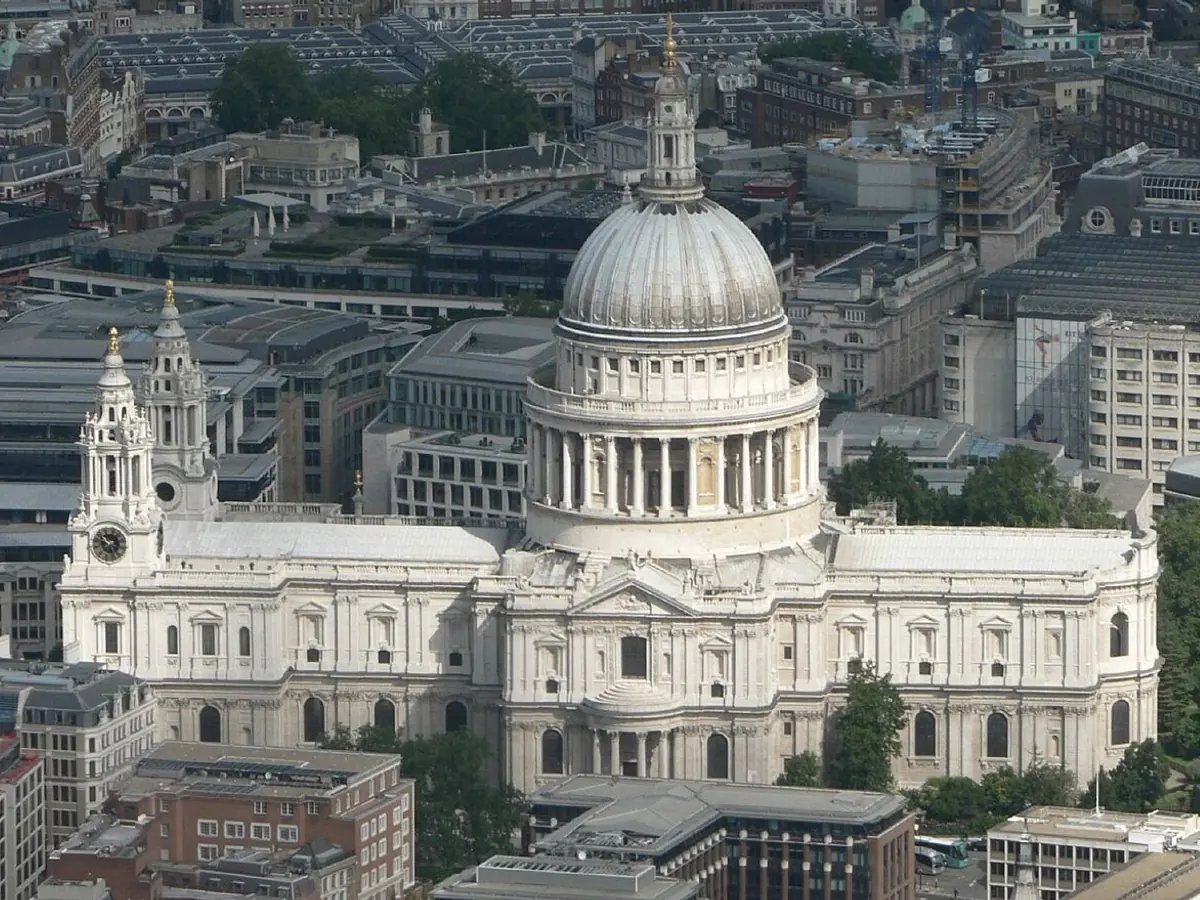
St Paul's Cathedral, London
St Paul's Cathedral rises before you as an Anglican cathedral, recognisable by its immense dome and broad stone mass. The present building was created after the Great Fire of London, replacing an earlier cathedral that was largely destroyed in that disaster. Christopher Wren designed it in the English Baroque style, and the completed cathedral opened in 1710.
Its dome reaches 365 ft, or 111 m, making it a powerful presence in the City skyline. The building is dedicated to Paul the Apostle, continuing a dedication associated with a church on this site since AD 604. It is also a Grade I listed building.
Look at the dome as a single architectural composition: its swelling curve, lantern, and surrounding structure give the cathedral its unmistakable profile. This is not simply a historic shell; it remains a working church, with prayer offered hourly and services held each day. The rebuilding after the Great Fire turned a site with medieval roots into Wren's great statement in stone, while preserving its connection with London's long Christian history. From the cathedral's massive exterior to the calm geometry of the dome, the building makes its story visible through scale, permanence, and carefully controlled form.
.jpg)