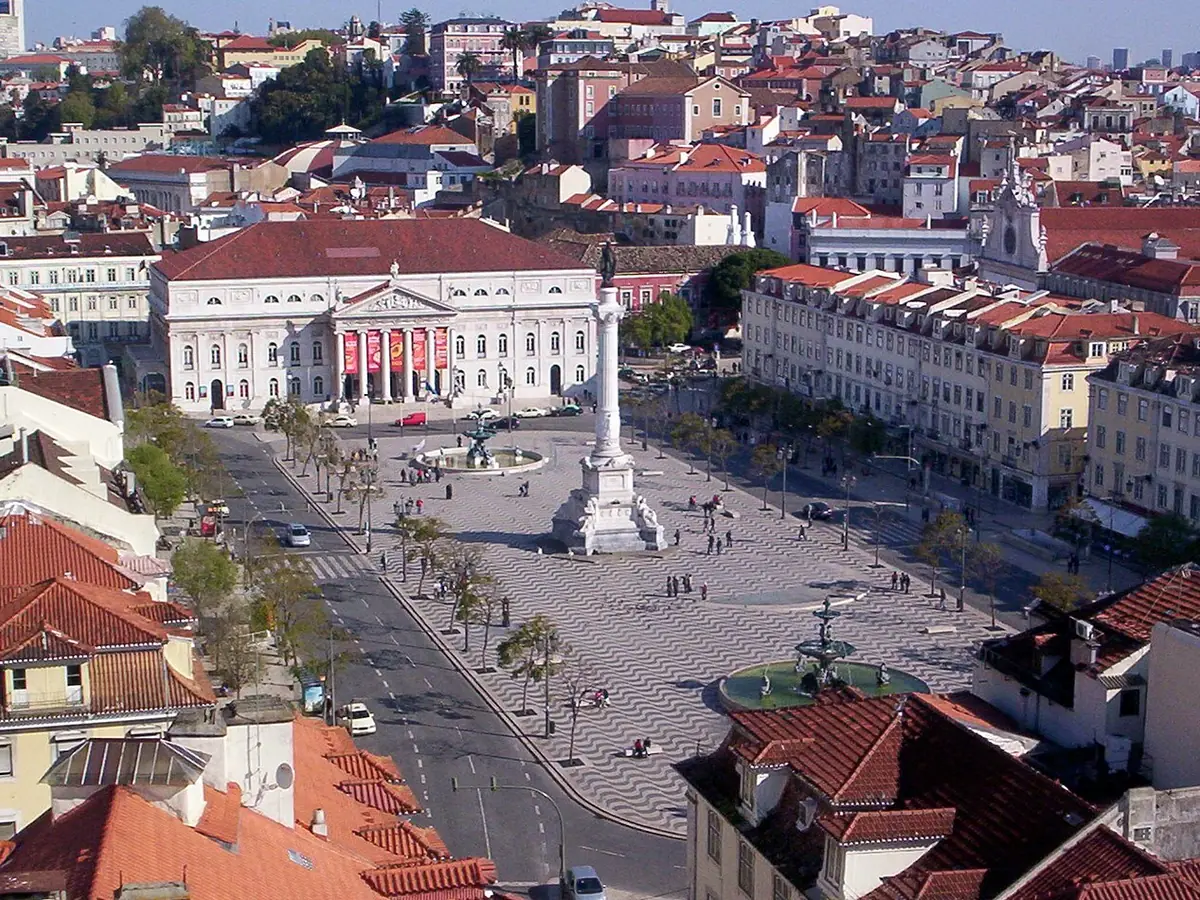
Praça Dom Pedro IV, Lisbon
Praça Dom Pedro IV is the broad Lisbon square that most people call Rossio, a civic space with roots reaching back to the Middle Ages. Its lasting role is wonderfully dramatic: this has been a setting for celebrations, revolts, bullfights, public executions, and everyday meetings between residents and visitors. The monument rising from the paving honours King Pedro IV.
Look at its tall column and the figure above it: the statue shows the king as a general beneath a royal cloak, holding the Constitutional Charter. At the monument’s base, allegorical female figures represent Justice, Prudence, Fortitude, and Moderation, while the column carries reliefs of Fame. The work was inaugurated in 1870; Élias Robert made the statue, Germano José de Salles designed the pedestal, and Jean Davioud supplied the architectural design.
The square’s patterned Portuguese pavement dates from 1848 and was among the earliest city pavements decorated in this manner. Around you, the rebuilt buildings belong largely to the reconstruction that followed the earthquake of 1755. The theatre on the north side occupies the site of the former Inquisition Palace, destroyed by fire in 1836. Rossio is therefore both a meeting place and a compact record of Lisbon’s public life, with the king’s monument still giving the square its name and focus.
.jpg)