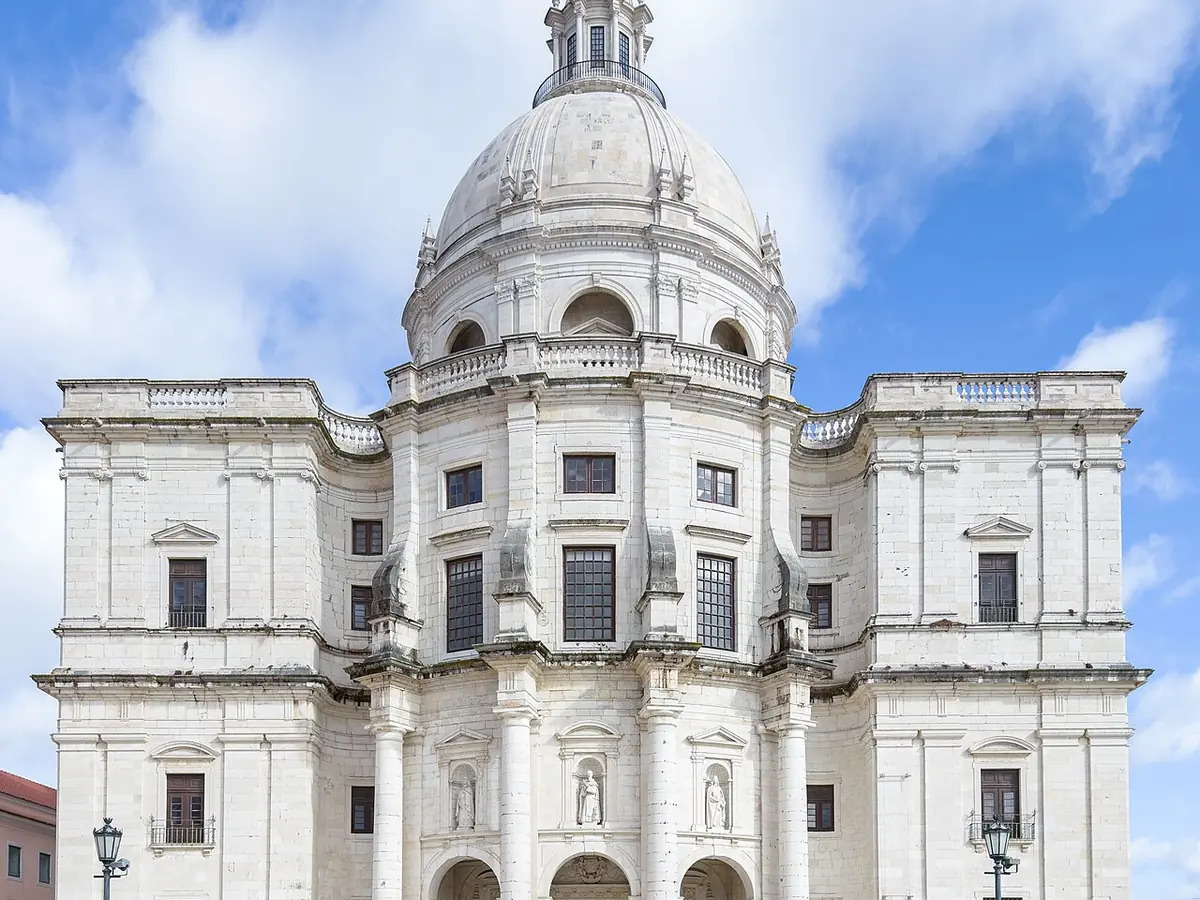
Panteão Nacional, Lisbon
Panteão Nacional is the former Church of Santa Engrácia, now a national mausoleum where prominent Portuguese figures are buried. Its sweeping façade and immense dome belong to a building whose present form began in 1682, under the design of João Antunes, a royal architect associated with Portuguese baroque architecture. The project endured for centuries: construction began after earlier structures collapsed, and the church was not completed until 1966.
That drawn-out history gave rise to “obras de Santa Engrácia,” a Portuguese expression for work that seems never to finish. Look at the entrance portal, where two angels support Portugal’s coat of arms. Beyond it, the interior is shaped by curved spaces and richly patterned marble.
The building became the National Pantheon in 1916. Its burials and memorials honour presidents, writers, Amália Rodrigues, and Eusébio; cenotaphs also commemorate figures including Luís de Camões and Vasco da Gama. The dome was completed only in the twentieth century, turning this long-delayed church into the monumental memorial you see today.