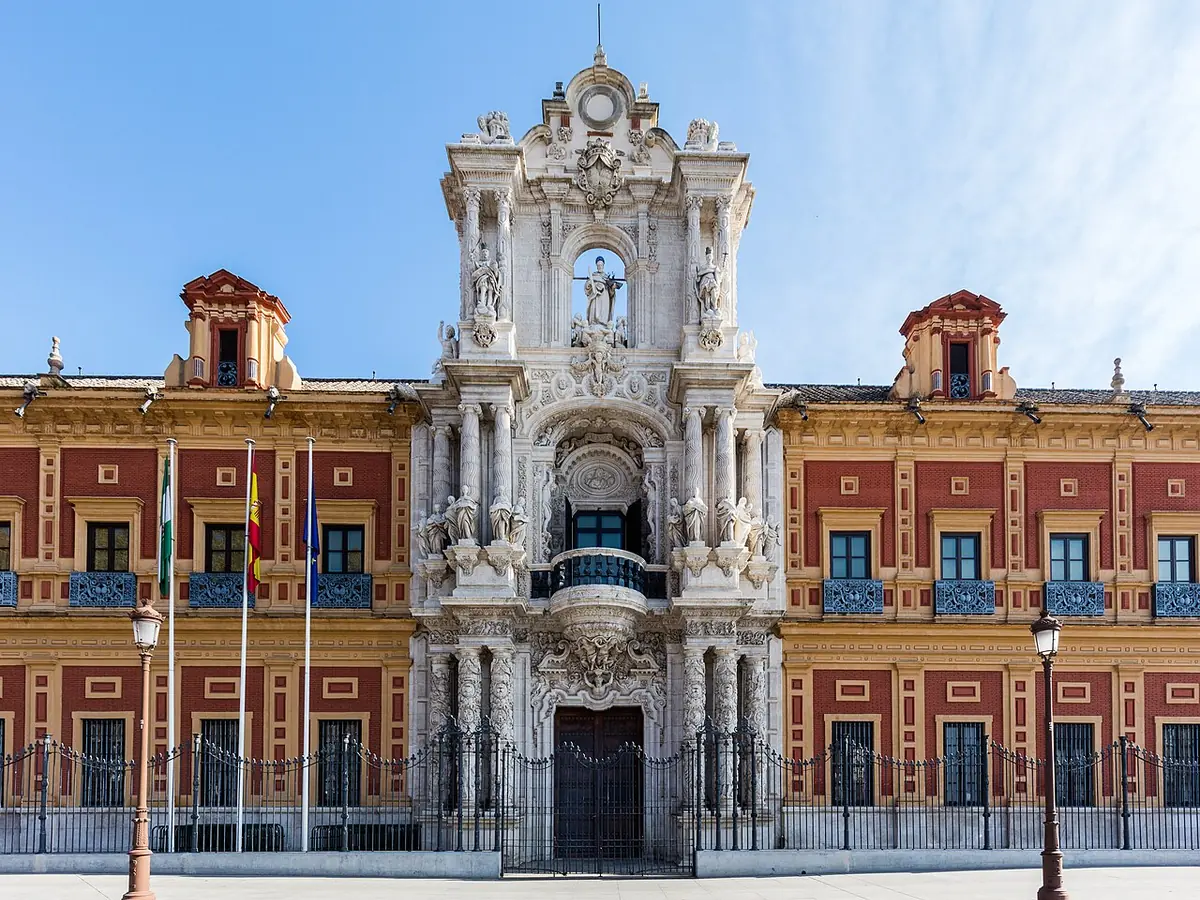
Palacio de San Telmo, Seville
Palacio de San Telmo is a palace whose theatrical entrance tells you something unexpected about its original purpose: this was created for a school of navigation, where orphaned children learned the skills of sailors. Construction began in 1682, and the building now serves as the seat of the Andalusian government’s presidency. The façade belongs to Sevillian Baroque architecture, and Leonardo de Figueroa is its architect.
Let your attention settle on the main entrance: sculpted male figures support the balcony, while allegorical female figures represent nautical arts and sciences. Above them, Saint Telmo appears with Saint Ferdinand and Saint Hermenegild. That maritime imagery is not decorative detail added by chance; it reflects the institution that occupied the palace when it was built.
Inside, the complex contains courtyards, towers, a chapel and gardens. The chapel was designed by Leonardo de Figueroa, and its principal devotional image is an early 17th-century statue of Our Lady of Good Air. The palace later became the residence of the Duke of Montpensier and Infanta María Luisa, then a diocesan seminary during the 20th century. Its long change of purpose is written into the building itself: a grand residence of power still carries the symbols of a school made for young navigators.