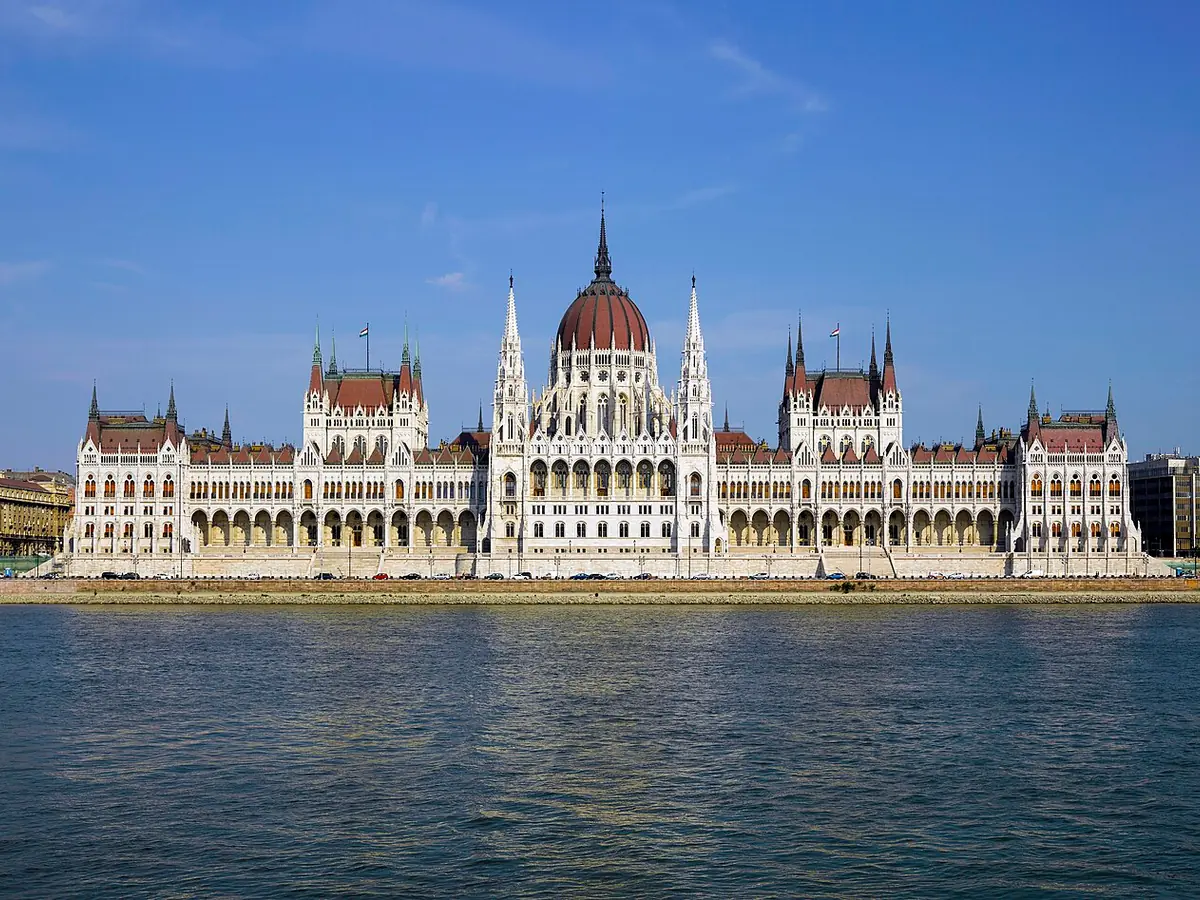
Országház, Budapest
Országház is the Hungarian Parliament Building, a working seat of Hungary’s National Assembly and a landmark on Kossuth Square beside the Danube. Imre Steindl created its design in a neo-Gothic manner, and the building opened in 1902. Its long façade is richly populated with sculpture: the walls carry figures of Hungarian rulers, Transylvanian leaders, and celebrated military figures.
At the eastern staircase, lions accompany the ceremonial approach. Construction ran from 1885 to 1904, using 40 million bricks, half a million decorative stones, and 40 kg of gold. The scale is striking: the building measures 268 m in length and 123 m in width, with 96 m reaching into the Budapest skyline.
Inside are 691 rooms, ten courtyards, 27 gates, and 29 staircases. Look for the sixteen-sided central hall, where the Holy Crown of Hungary has been displayed since 2000. The two parliamentary halls mirror each other because the building was created for a bicameral legislature; today, the Lower House hosts parliamentary sessions, while its counterpart serves ceremonies, conferences, and tours. Steindl did not live to see the completed building: he became blind and died before the work ended.