Neue Synagoge, Berlin
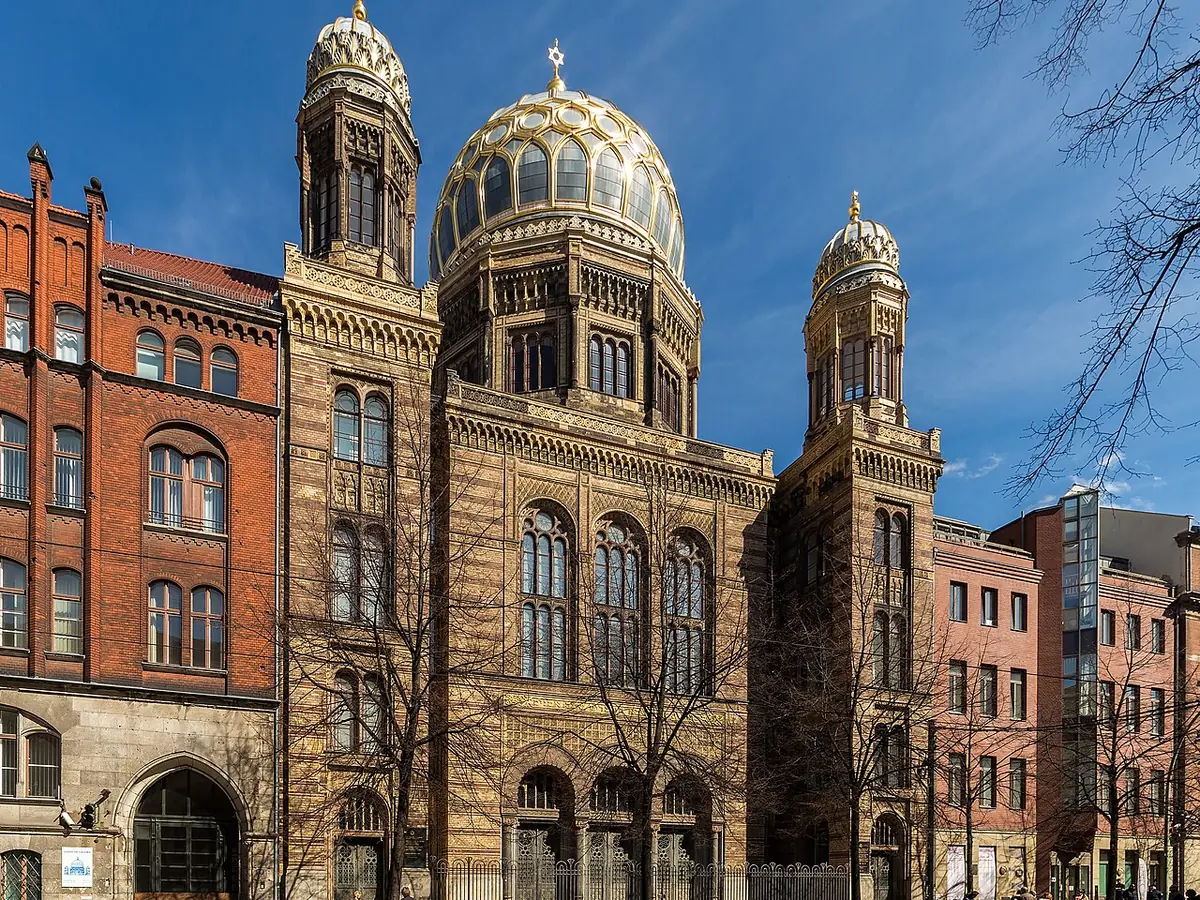
The Neue Synagoge is a synagogue whose surviving street frontage gives you a glimpse of a building created for Berlin’s growing Jewish community. Its design belongs to an orientalist architectural tradition, and Eduard Knoblauch and Friedrich August Stüler are the architects associated with it. Notice the façade’s patterned brickwork, terracotta decoration, and glazed tiles, then trace the rounded forms gathered around the entrance and dome.
The building was begun in 1859 and inaugurated in 1866. At that time, the main hall could accommodate over 3,000 worshippers, making this the city’s largest Jewish house of worship. Its great dome carries gilded ribs, while smaller pavilion-like domes frame it.
The design drew inspiration from the Alhambra, giving the synagogue an appearance that stood out in its Prussian surroundings. The building survived the November pogrom of 1938 after a police officer ordered the attackers away and enabled firefighters to extinguish the blaze. War damage later destroyed much of the complex.
What you see today is a reconstruction of the damaged street frontage, with the entrance, dome, towers, and only a few rooms behind it. After restoration, the surviving ensemble reopened in 1995 as a cultural centre known as the Centrum Judaicum.