Neue Nationalgalerie, Berlin
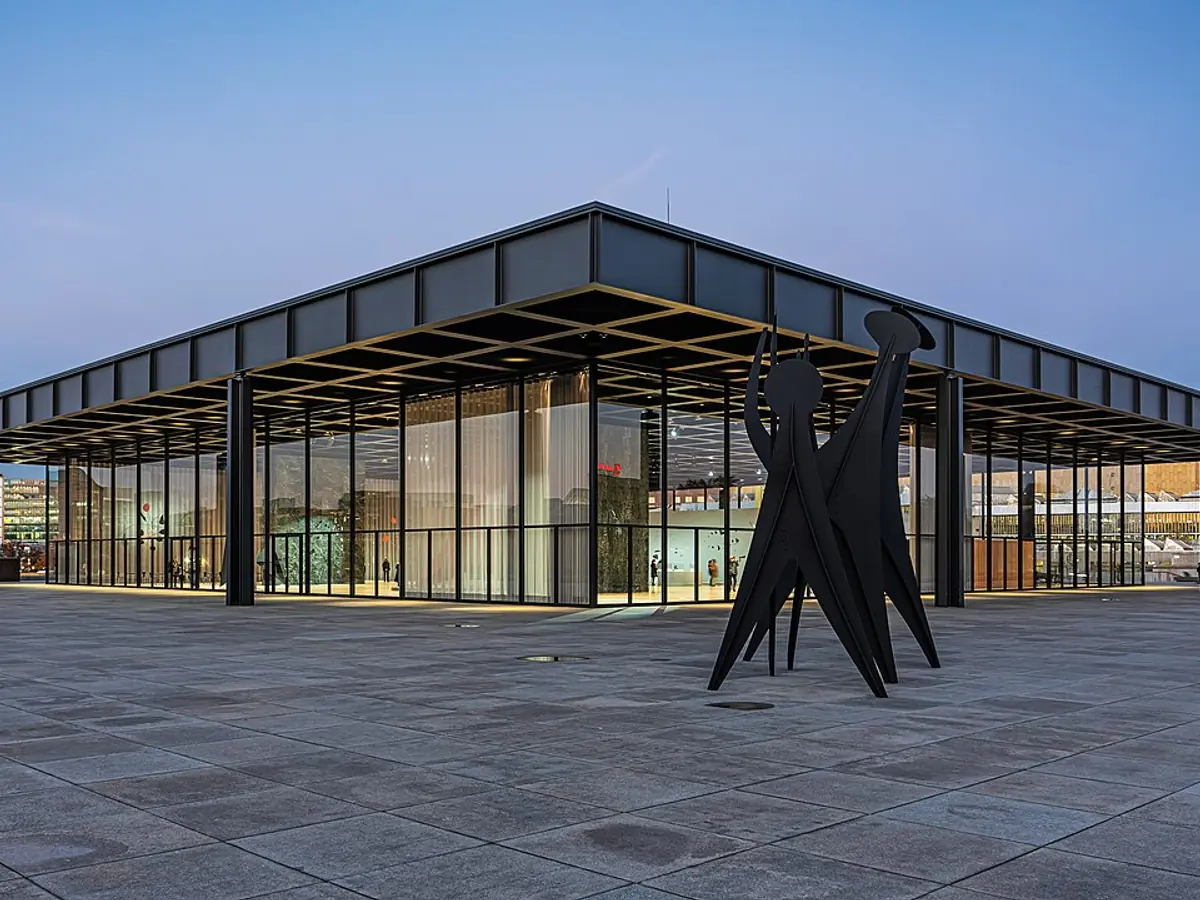
The Neue Nationalgalerie is the glass-and-steel museum pavilion before you, designed by Ludwig Mies van der Rohe for twentieth-century art. Its broad roof appears to float above the glazed walls, while the open hall beneath is kept free of interior columns. The building opened in 1968 and belongs to Berlin’s National Gallery.
The roof rests on eight steel supports, and the upper gallery covers about 2,683 square metres. Its spaciousness is deliberate: Mies developed the building as a universal room that can accommodate changing exhibition layouts rather than impose a fixed sequence of galleries. Look at the roof edge and the supports set back from the glass; together they create the impression of a shelter hovering over an uninterrupted hall.
The lower level contains the permanent collection, with a sculpture garden adjoining it. On the terrace, Henry Moore’s sculpture Three Way Piece No. 2: Archer adds a powerful sculptural presence to the otherwise severe composition. Extensive renovation closed the museum from 2015 to 2021, and it reopened in August 2021 with an exhibition by Alexander Calder.