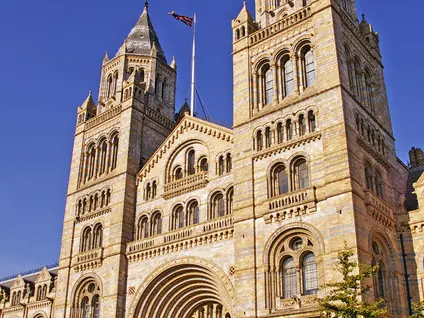
Natural History Museum, London
The Natural History Museum is the grand terracotta-clad building before you, created by architect Alfred Waterhouse in Romanesque Revival architecture. Its main frontage is on Cromwell Road, while the building itself belongs to the museum in South Kensington. Inside, the collections bring together about 80 million specimens across five areas: botany, entomology, mineralogy, palaeontology and zoology.
This is not merely a display venue: it is a major research institution devoted to identifying, classifying and conserving the natural world, with historically important material including specimens gathered by Charles Darwin. The museum is especially known for its dinosaur skeletons and its dramatic vaulted hall. A blue whale skeleton now hangs from the ceiling there, replacing the large Diplodocus cast that occupied the hall until 2017.
Waterhouse’s building opened in 1881, and its elaborate terracotta surfaces carry sculpted plants and animals, both living and extinct. The building is a Grade I listed building, but its strongest impression remains physical: a vast, richly ornamented setting where scientific collections become architecture.