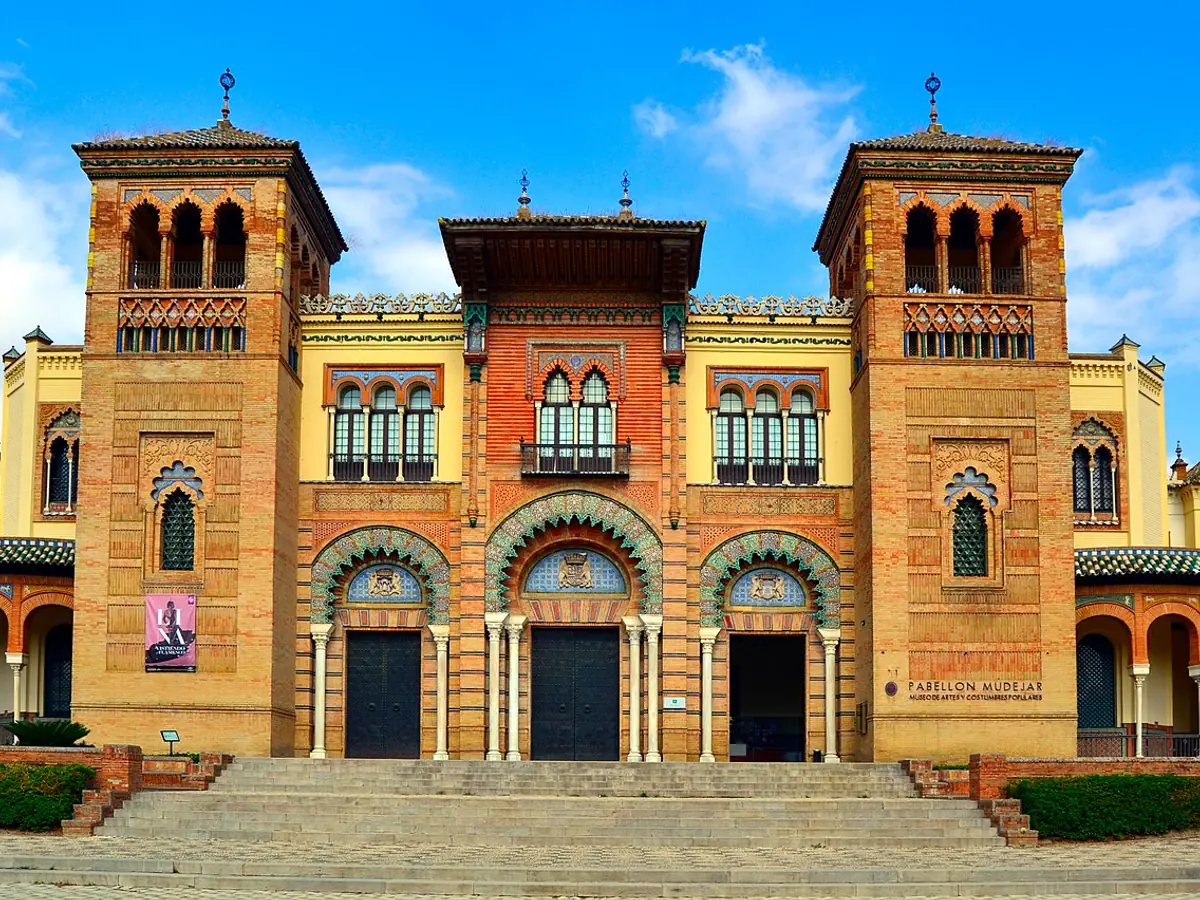
Museo de Artes y Costumbres Populares, Seville
The Museum of Arts and Popular Customs occupies a distinctive pavilion in María Luisa Park, beside Plaza de América. Its brick walls carry a skin of ceramic decoration, and three entrances are framed with bands of glazed tiles. Aníbal González designed the building, which was completed in 1914 and later served as the Ancient Art Pavilion during the Ibero-American Exposition of 1929.
That earlier exhibition role gives this museum an unusual double identity: it is both a place for everyday Andalusian culture and a surviving exhibition building. The museum opened to visitors on 4 March 1973, after being created as part of Seville’s Museum of Fine Arts. Its collections bring together embroidery, lace, domestic objects, agricultural tools, musical instruments, ceramics, furniture, religious objects, and traditional workshops.
The Díaz Velázquez legacy is especially remarkable: nearly 6,000 pieces of embroidery and lace entered the museum through a donation made in 1979. The building itself also carries a story of adaptation. A huge interior chamber was divided by an added level, and a grand spiral staircase later joined the floors for museum use. Look at the glazed tilework around the entrances: it is the detail that most clearly links the museum’s present purpose with its exhibition past.
.jpg)