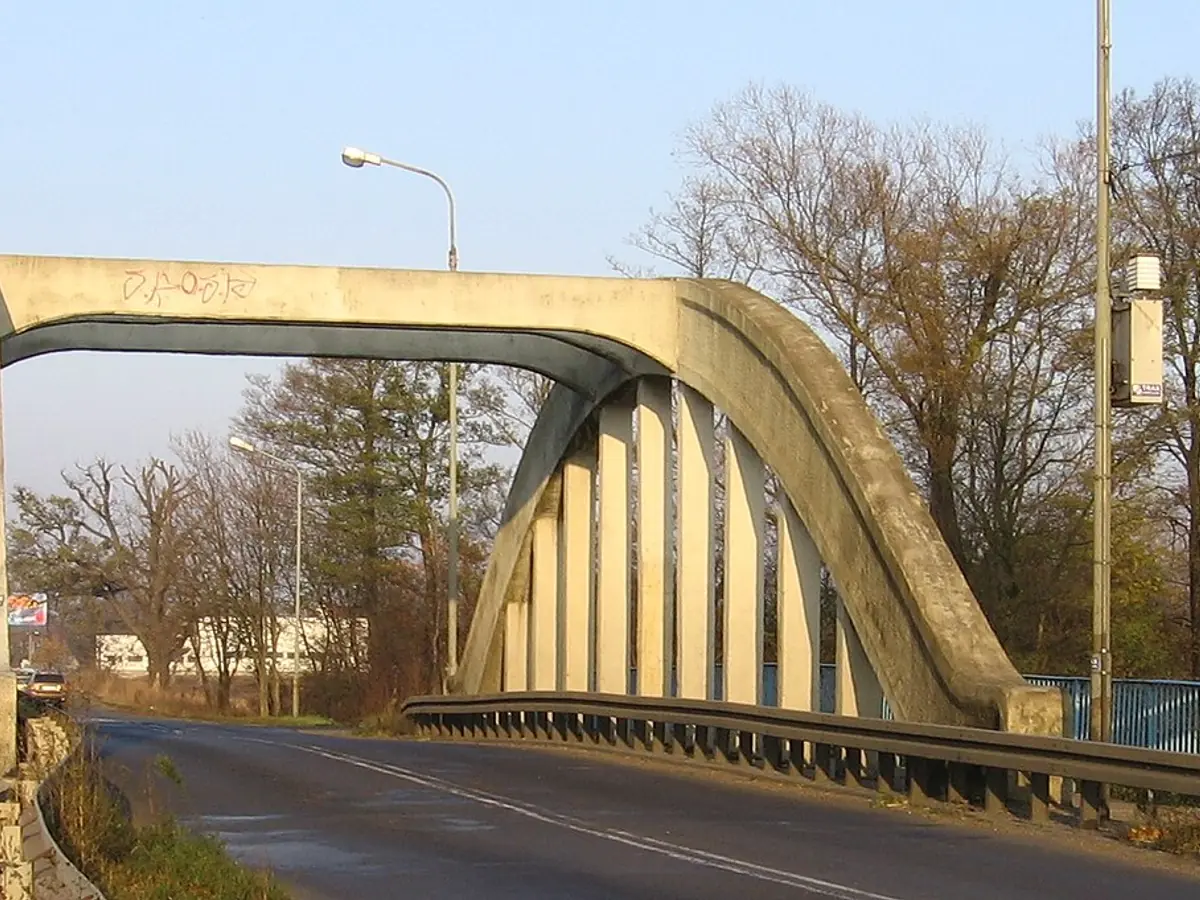
Most Widawski, Wrocław
Most Widawski carries Sułowska Street across the Widawa in Wrocław’s Widawa district. The bridge you see now was built in 1951 from reinforced concrete. Its structure is a single-span tied arch: the curved arch and its horizontal tie do the work of carrying the road.
The crossing leads toward an island made by separate arms of the river. There is an older transport story here as well. Near the road bridge, surviving abutments are the remains of a narrow-gauge railway bridge on the Wrocław–Trzebnica line.
Even earlier, this spot had a wooden bridge. From 1266, tolls collected here went first to Władysław, Archbishop of Salzburg, then to Henry III the White, and later to Henry IV the Just. For many years this was part of National Road Five and European Route E261, until those routes were shifted onto a new alignment toward Poznań on the twenty-second of December 2017.
A thorough renovation followed between 2012 and 2017, with traffic using a nearby temporary crossing during the works. Since December 2020, Most Widawski has formed part of Voivodeship Road 359.