most Oławski, Wrocław
Updated
Listen to how the story begins
0:00 / 0:45
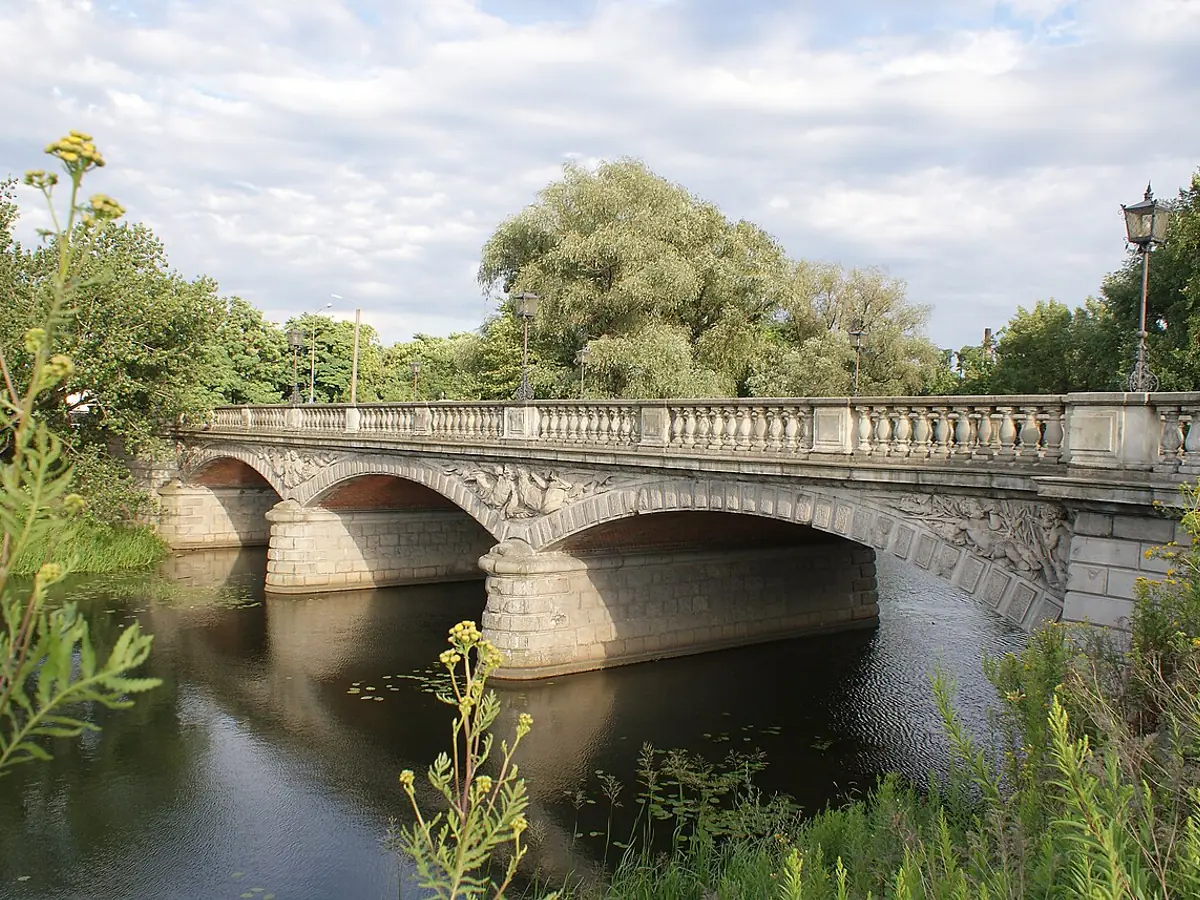
Most Oławski is the road bridge carrying Walońska and Na Grobli streets across the Oława River. It was built between April eighteen eighty-two and November eighteen eighty-three, replacing a simple crossing with a much more ambitious piece of city engineering. Alexander Kaumann designed it with a team of engineers, while specialist artists supplied its sculpture and metalwork.
Notice the three brick arch spans beneath the roadway and the dressed stone facing of the supports. The bridge extends just under seventy-four metres, but it rewards a closer look: its sandstone balustrades borrow the turned, ornament-rich vocabulary of Baroque architecture, and decorative lamps are attached to them. Granite blocks pave the roadway overhead.
Its earlier predecessor had a very practical job. Cattle were taken over a footbridge here to pasture on the far bank, which gave the crossing the temporary name Wygonowy, or Cattle-Drive Bridge. Before the Second World War, trams also crossed here; the rails disappeared during later work.
Major renovations in nineteen sixty-two and nineteen ninety helped preserve this compact nineteenth-century landmark. About two hundred metres downstream, the Oława joins the Oder.