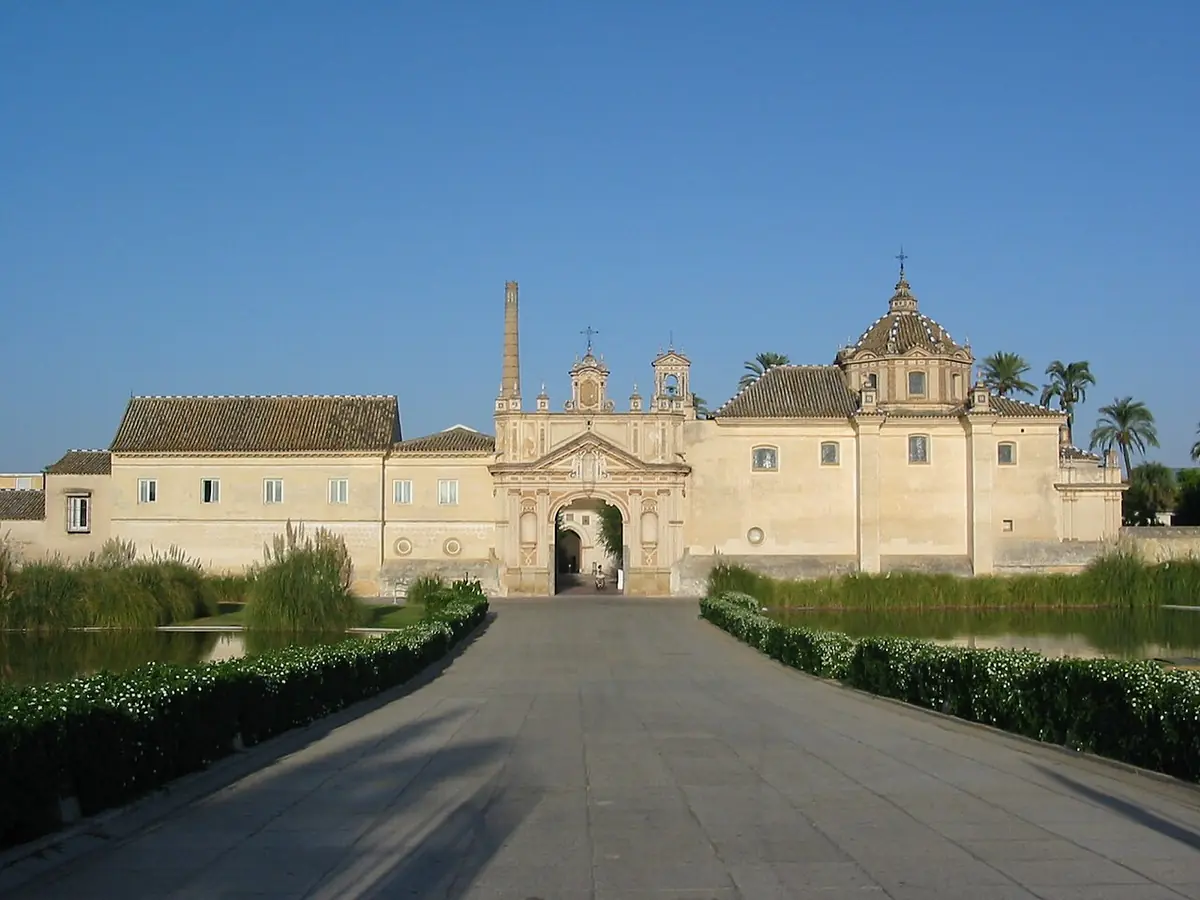
Monasterio de Santa María de las Cuevas, Seville
The Monastery of Santa María de las Cuevas is a religious building whose grounds now accommodate the Andalusian Contemporary Art Center, or CAAC. Its architectural style is Gothic, but its story extends well beyond monastic life. The Carthusian monks occupied this place, and Christopher Columbus’s remains were interred here before being transferred to Santo Domingo in 1542.
During the Napoleonic invasion, the monastery was stripped and converted into military barracks; the church became a food store, while other sacred rooms served practical military uses. A later transformation began when Charles Pickman acquired the former monastery in 1839 and opened a ceramics factory here in 1841. Production continued until 1984, leaving behind the distinctive bottle-shaped kilns and the tall chimney.
The site now combines historic spaces with contemporary art. The CAAC, established to support research, preservation, and promotion of contemporary art, has occupied the monastery since 1997. Its holdings include works by Louise Bourgeois, Joseph Kosuth, Rebecca Horn, and other artists, while the former monastic grounds retain chapels, cloisters, gardens, orchards, the church, and the refectory. You are looking at a place where religious history, industrial memory, and living art share the same enclosure.