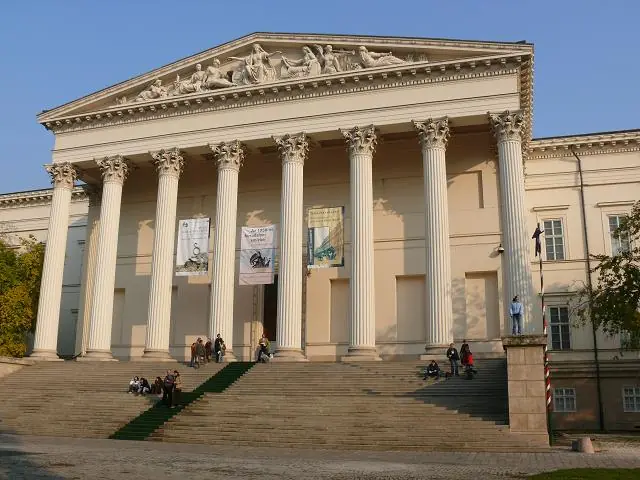
Magyar Nemzeti Múzeum, Budapest
The Hungarian National Museum is the grand building before you, created to preserve Hungary’s history, art, and archaeology. Mihály Pollack designed this Neoclassical landmark, constructed from 1837 to 1847, and its collections reach beyond Hungary’s present borders, including Transylvania. The institution began in 1802, when Count Ferenc Széchényi gave his collection to the nation; his wife’s mineral collection soon broadened its purpose beyond books and documents.
Look at the portico: sculptural figures represent Hungary, science, art, history, and fame, while river figures evoke the Danube and the Drava. Inside, paintings by Károly Lotz and Mór Than have adorned the grand staircase and ceiling since 1875. The building also became a powerful national stage.
As tradition holds, on March 15, 1848, Sándor Petőfi recited the Nemzeti dal before the façade during the revolution. The museum’s displays now range from prehistoric archaeology and medieval stonework to Roman inscriptions, royal history, and the communist era. Its Roman lapidary preserves carved stones, especially gravestones and sarcophagi, that reveal social life and burial customs in ancient Pannonia.