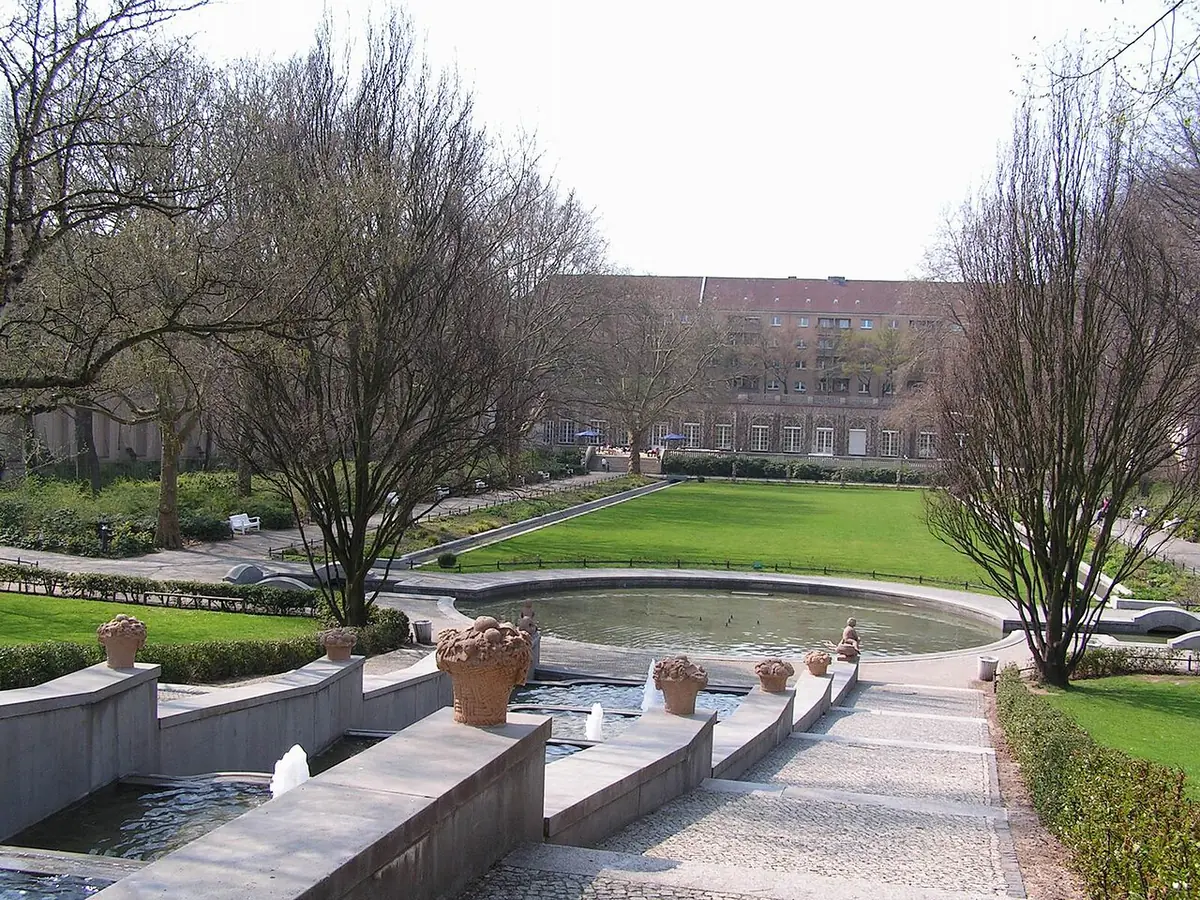
Körnerpark, Berlin
Körnerpark is a sunken park whose terraces give it the air of a palace garden. The grounds lie about five to seven metres below the surrounding streets, held by retaining walls on three sides. Follow the visible watercourse: a cascade and fountains animate the eastern part.
Along the western boundary, the Orangerie Neukölln contains a café and a gallery for changing exhibitions. Its forecourt hosts summer events, while a flower garden fills the northern section. In 1910, Franz Körner donated the old gravel pit to Rixdorf, stipulating that the park bear his name.
Hans Richard Küllenberg is thought to have devised the garden, which was constructed from 1912 to 1916. Its history reaches further back than the landscaping. On 23 January 1912, construction work uncovered an equestrian tomb at the junction of Jonasstraße and Selkestraße.
A man of about 40 had been buried with his horse in a grave 2.50 metres deep, together with a long sword, belt fittings, bronze nails and a clay vessel. So the elegant garden above also marks a site with an unexpectedly deep archaeological past.