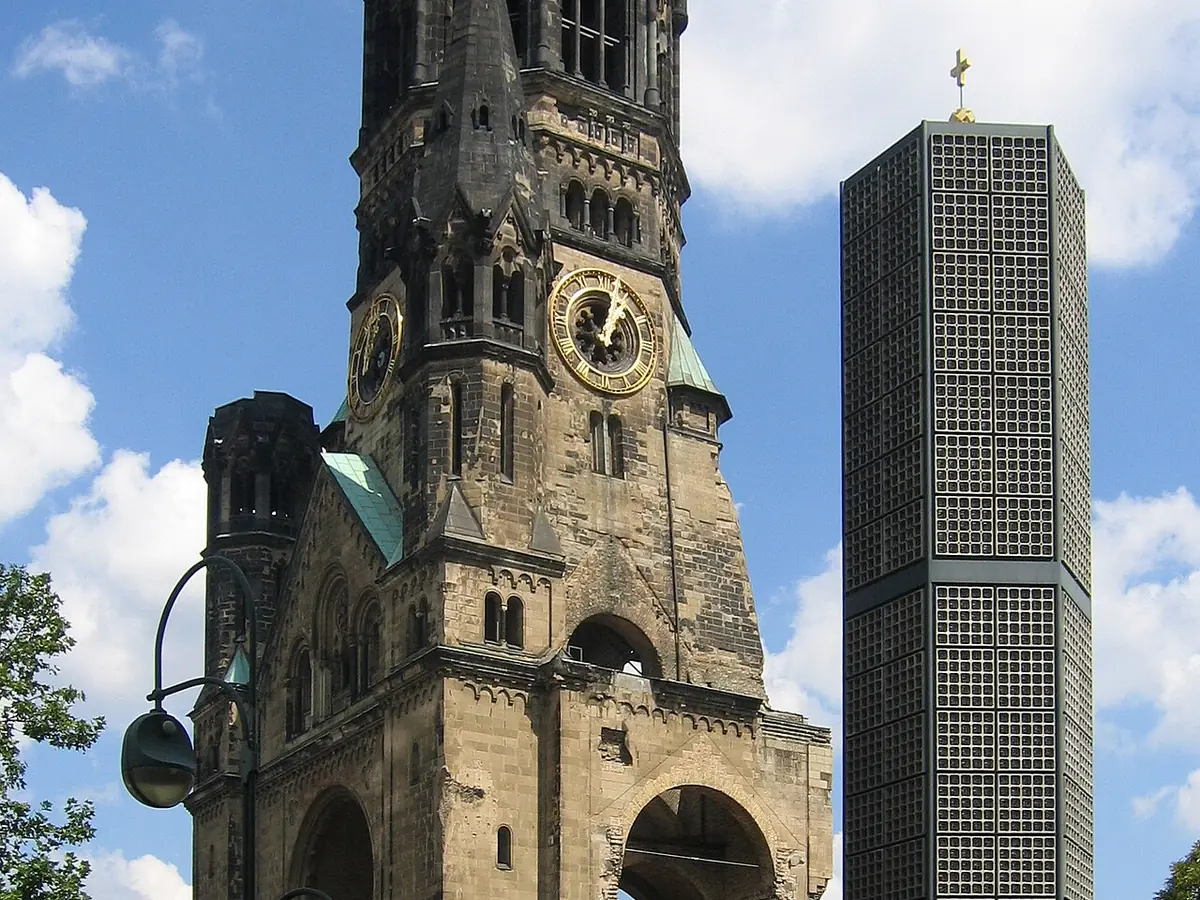
Kaiser-Wilhelm-Gedächtniskirche, Berlin
The Kaiser Wilhelm Memorial Church is a Protestant church that combines a damaged historic tower with a modern church ensemble. Its familiar Berlin nickname, “the hollow tooth,” comes from the appearance of the surviving ruin. The original church was built from 1891 to 1895 by Franz Schwechten, commissioned by Kaiser Wilhelm II as a memorial to his grandfather, Wilhelm I.
Its tower reached 113 metres and was then the highest in Charlottenburg. During an air raid in 1943, the church suffered severe damage. The ruined tower was retained as a warning against war, while the remaining complex was created between 1959 and 1963 by Egon Eiermann.
It comprises the church, tower, chapel and foyer. Look at the tower ruin itself: its broken form is not concealed or rebuilt into a seamless whole, but kept as part of the memorial. A memorial hall has occupied the ruin since 1987.
The modern buildings use concrete, steel and glass; the church walls contain 21,292 stained-glass inlays. That deliberate contrast makes this place memorable: an imperial-era church survives here as a scar, beside architecture shaped by post-war reconstruction.