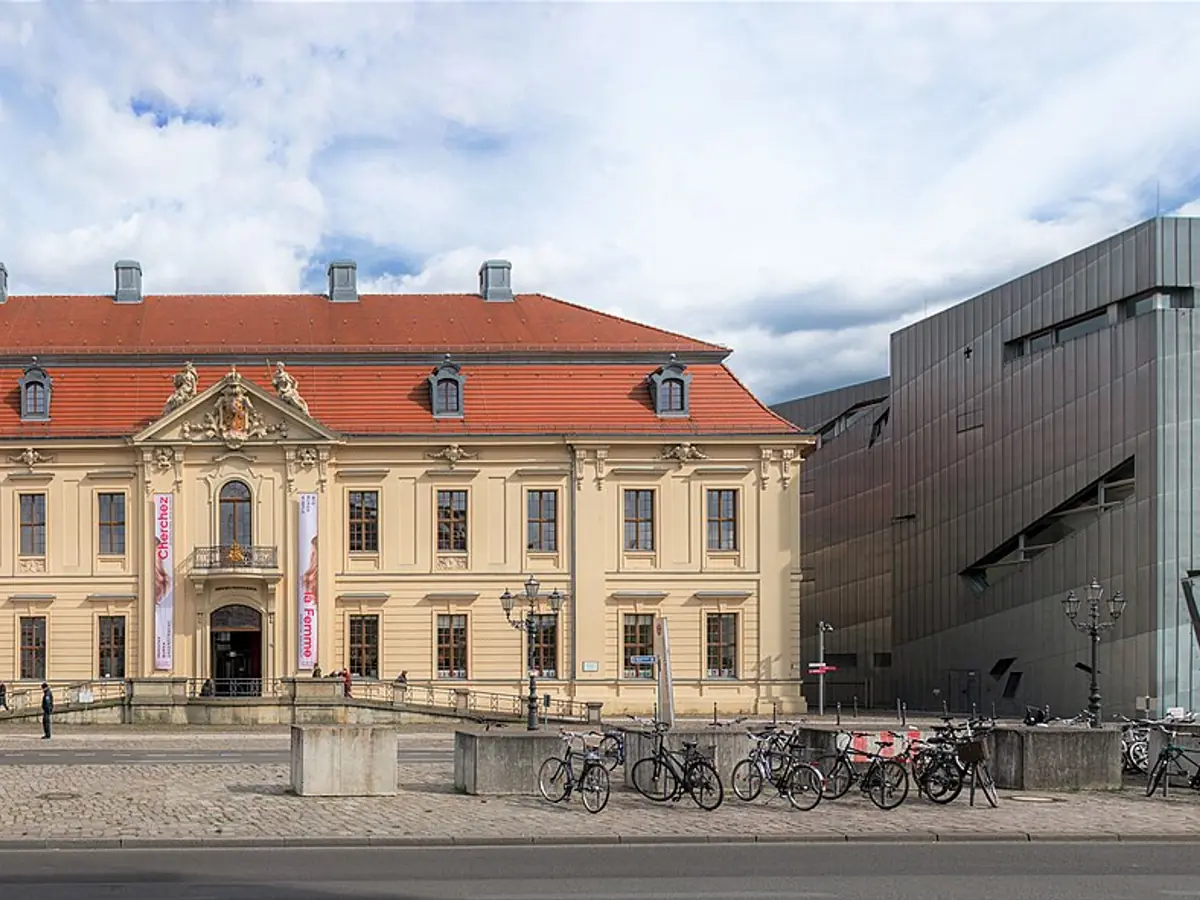
Jüdisches Museum, Berlin
The Jüdisches Museum is a museum ensemble whose angular, zigzag-shaped new building immediately sets it apart. It is Europe’s largest Jewish museum, and Daniel Libeskind designed this striking addition. The ensemble brings together three buildings: the baroque Kollegienhaus, Libeskind’s new structure, and the W.
Michael Blumenthal Academy across Lindenstraße. Above ground, the historic and new buildings remain separate; an underground passage links them. The new building’s form grew from Libeskind’s idea that Jewish life and its disappearance must both shape Berlin’s memory.
Inside, three intersecting corridors represent continuity, emigration, and the Holocaust. One leads towards the Garden of Exile, where an olive tree rises beyond reach from a tilted field of pillars. Another reaches the Holocaust Tower, an empty concrete space about 24 metres high, lit only through a narrow opening in its roof.
The museum opened to the public in September 2001. Its permanent exhibition, opened in 2020, follows 1700 years of Jewish history, culture, and life in Germany, continuing into the present. The building itself turns that history into an experience of interruption, absence, and connection.

.jpg)