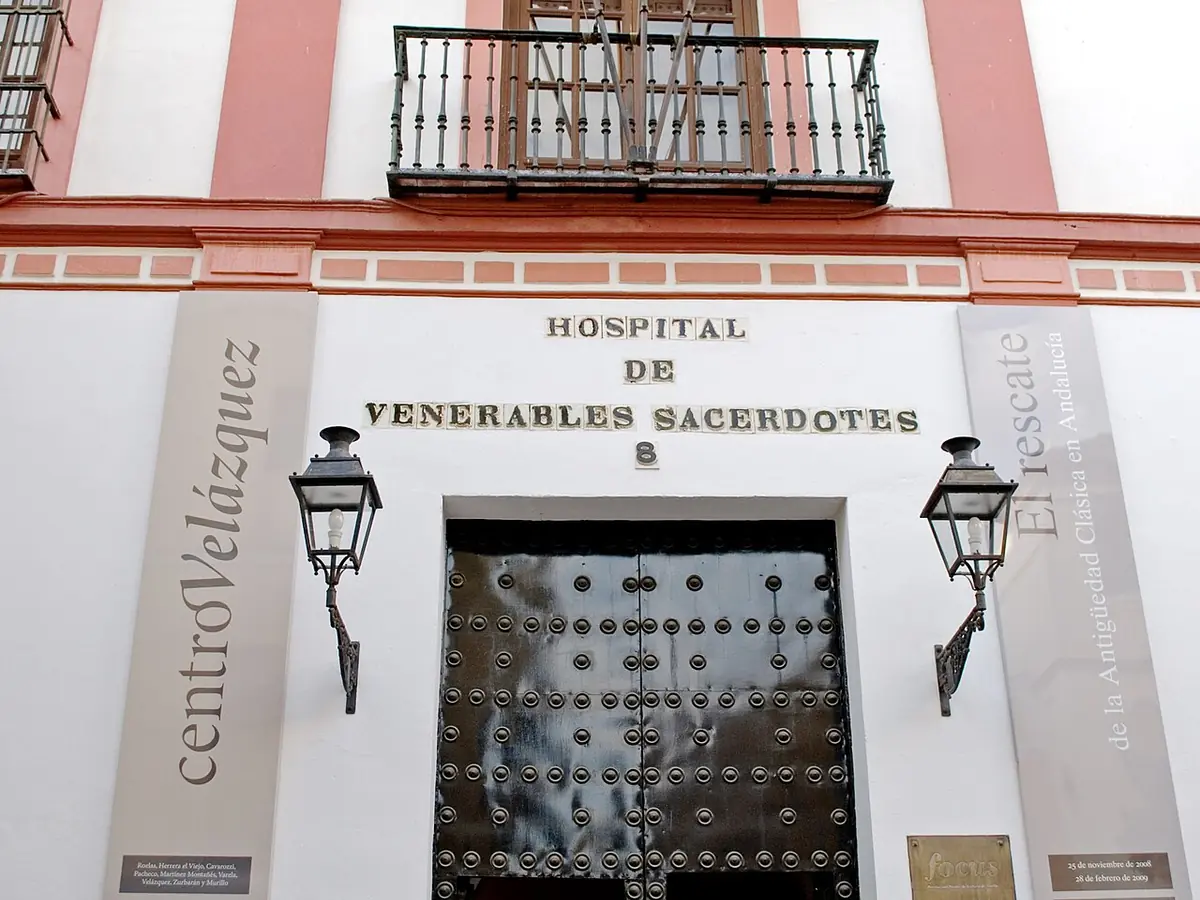
Hospital de los Venerables, Seville
The Hospital de los Venerables is a former residence for priests, and its Baroque architecture still gives this building a distinctive sense of enclosure. It was founded by Canon Justino de Neve in 1675, with construction beginning under Juan Domínguez; Leonardo de Figueroa later took over the project and completed it in 1697. The building served elderly, poor and disabled priests, but its history did not remain purely charitable.
In 1840, it became a textile factory, and the priests moved elsewhere. A Royal Order in 1848 returned the property to their brotherhood, allowing them to come back. The hospital stopped functioning as a residence in the 1970s.
The courtyard is one of the building’s most memorable spaces: a stepped fountain occupies its middle, with circular tiled steps, while galleries run around it on marble columns. The church is dedicated to San Fernando and contains mural paintings by Valdés Leal, along with further works by Lucas de Valdés. Look at the church’s painted surfaces for a setting created through architecture, sculpture and painting together.
Today, the building houses the Velázquez Centre. Its collection includes Santa Rufina, attributed to Diego Velázquez, as well as works connected with Murillo, Francisco Pacheco and other artists. A former refuge for priests now brings you into Seville’s painting of the seventeenth century.