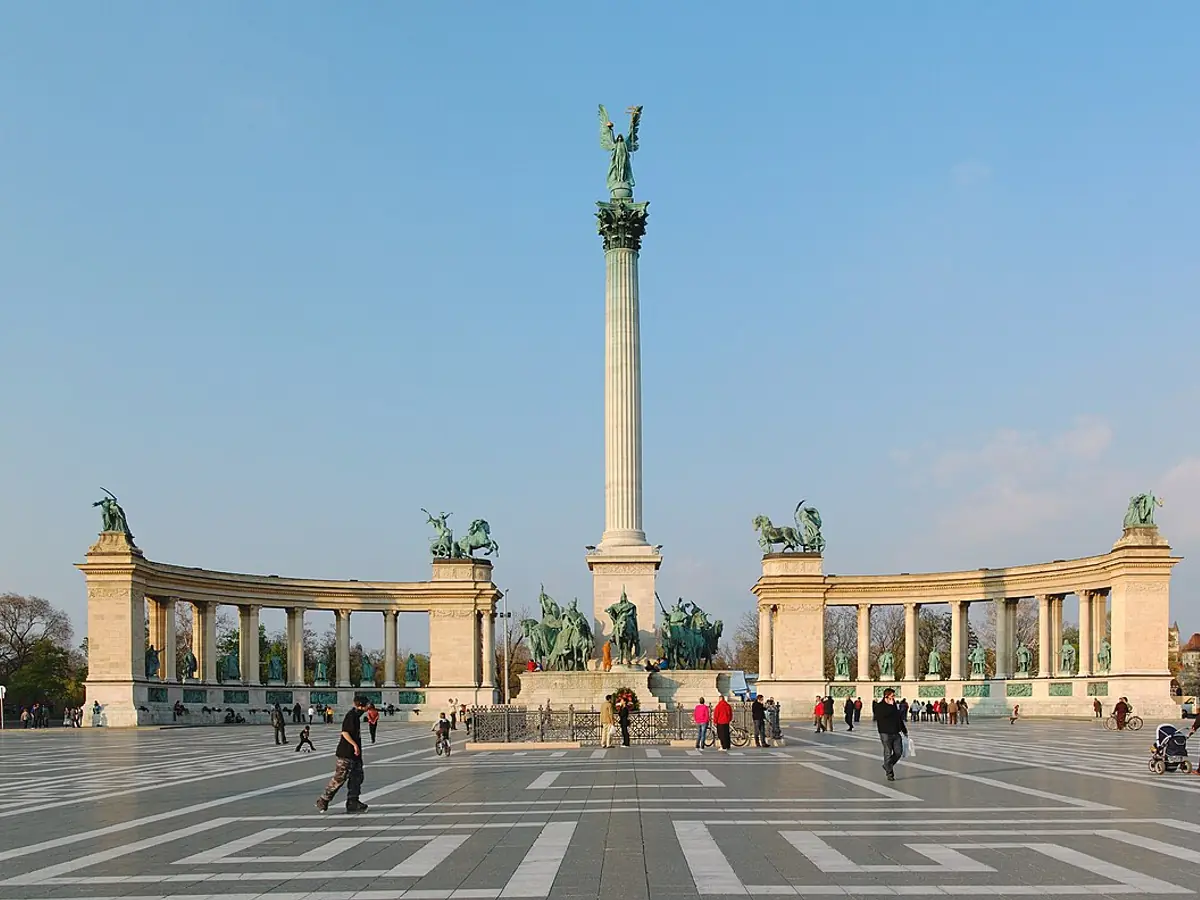
Hősök tere, Budapest
Hősök tere is a Budapest square dominated by the Millennium Monument, a national memorial filled with rulers, leaders, and the Magyar chieftains. The monument took shape from 1896, marking a thousand years since the Hungarian conquest of the Carpathian Basin and the founding of the Hungarian state. At its heart rises a Corinthian column about 36 metres high, carrying a 4.8-metre bronze Archangel Gabriel with the Holy Crown and the Apostolic Double Cross.
At the base, Árpád and the other six chieftains appear on horseback. György Zala created these figures, along with several rulers and allegorical groups. Behind them, the colonnades hold statues drawn from Hungarian history; their contents changed as political power changed.
The square itself has hosted official ceremonies, political gatherings, and the 1989 reburial ceremony for Imre Nagy. In front of the monument, the Memorial Stone of Heroes is often mistaken for a tomb, but it contains no human remains. A metal plate behind it marks an artesian well drilled by Vilmos Zsigmondy; that water later supplied the Széchenyi thermal bath. The Museum of Fine Arts and the Hall of Art frame the square, making the monument feel like a national stage rather than mere decoration.