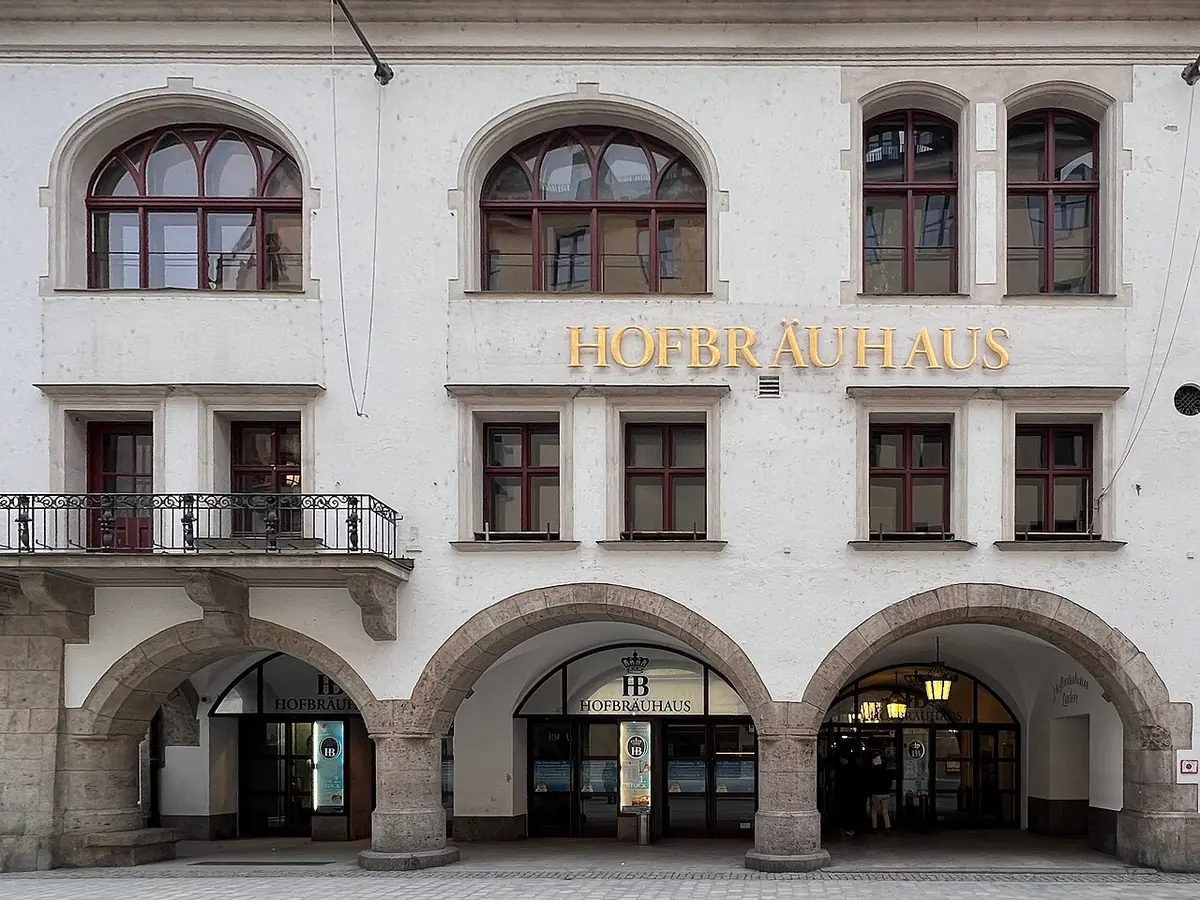
Hofbräuhaus am Platzl, Munich
Hofbräuhaus am Platzl is the historic beer hall filling this lively corner of Munich’s old town. Its present appearance comes from a major redesign completed in 1897 by Max Littmann, when brewing moved away and the hospitality rooms were enlarged. The building’s stepped sections help shape the Platzl, while the broad façades create the setting you see around the square-like street widening.
The room that made this address famous is the Schwemme, a vast beer hall with wooden tables for about 1000 guests. It is the surviving historic part of the building: wartime bombing destroyed the other rooms, and reconstruction concluded with the Festival Hall reopening in 1958. Public dining began here in 1828, after Ludwig I allowed ordinary people to be served.
This place also carries a difficult political history. On 24 February 1920, Adolf Hitler presented the programme of the National Socialist German Workers’ Party here before about 2000 people. Earlier, on 13 April 1919, revolutionary councils proclaimed a Communist Soviet Republic in the Hofbräuhaus. The building you see is therefore both a working beer hall and a reconstructed witness to Munich’s turbulent history.