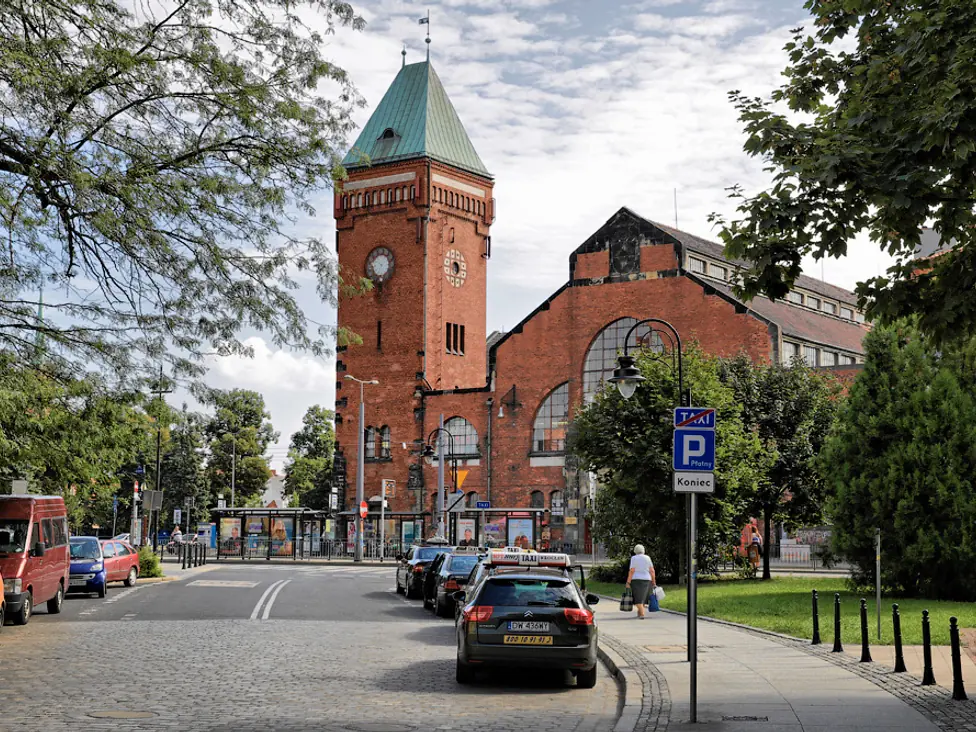
Hala Targowa, Wrocław
Updated
Listen to how the story begins
0:00 / 0:45
Hala Targowa is Wrocław’s great covered food market, built on Piaskowa Street between 1906 and 1908. Its designers, Richard Plüddemann and Heinrich Küster, gave the city a building that turned scattered street trading into an indoor market. Notice the northern face: its two towers deliberately recall the defensive past of this plot.
Before the hall, this was the site of the bishops of Lubusz’s medieval court, later transformed into the Sand Arsenal. During construction, workers uncovered stone cannonballs and set them into the north wall as reminders of that arsenal. The real surprise is inside.
Küster’s roof rests on reinforced-concrete parabolic arches, rising more than seventeen metres and spanning just over twenty metres between supports. At the time, this was a pioneering engineering achievement on a world scale, and reinforced concrete was an unusually bold choice for a market hall. The building survived 1945 without major destruction and returned to its original purpose after repairs. Its near-twin on Kolejowa Street was badly damaged in 1945 and ultimately demolished in 1973, leaving this hall as the survivor—and still one of Wrocław’s largest produce markets.