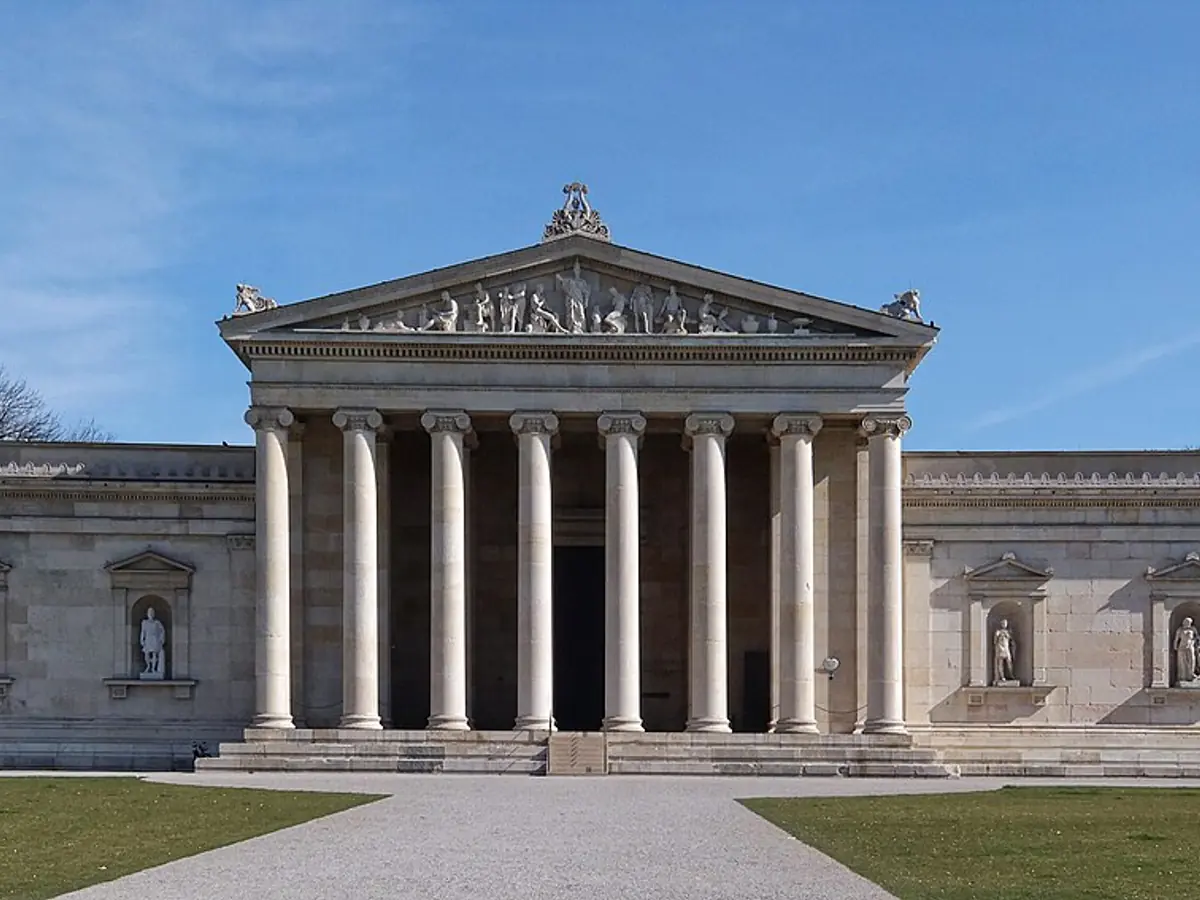
Glyptothek, Munich
The Glyptothek is Munich’s museum for ancient Greek and Roman sculpture, created for King Ludwig I’s collection. Its most famous treasures include the Barberini Faun, the Drunken Woman, the Boy with the Goose, and temple sculptures from Aegina. The collection reaches from about 650 BC to about 550 AD, bringing archaic, classical, Hellenistic, and Roman works together under one roof.
Leo von Klenze designed the building, which was constructed from 1816 to 1830 in the Greek Revival style. Look at the monumental portico: twelve Ionic columns support a pediment group by Johann Martin von Wagner, showing Athena as guardian of sculpture. The outer walls hold sculptures in niches, including Daedalus, Prometheus, Pericles, Phidias, and Hephaestus.
Inside, thirteen rooms of rectangular, square, or round form gather around a courtyard, while the taller vestibule gives the building its commanding interior focus. The museum suffered partial destruction during air raids in April 1944, and reconstruction began in 1947. It reopened in 1972.
The original frescoes by Peter Cornelius were not restored; only fragments remain. The building’s story is therefore inseparable from its collection: ancient sculpture is housed inside a nineteenth-century vision of Greece, shaped by Ludwig’s determined collecting and Klenze’s architecture.