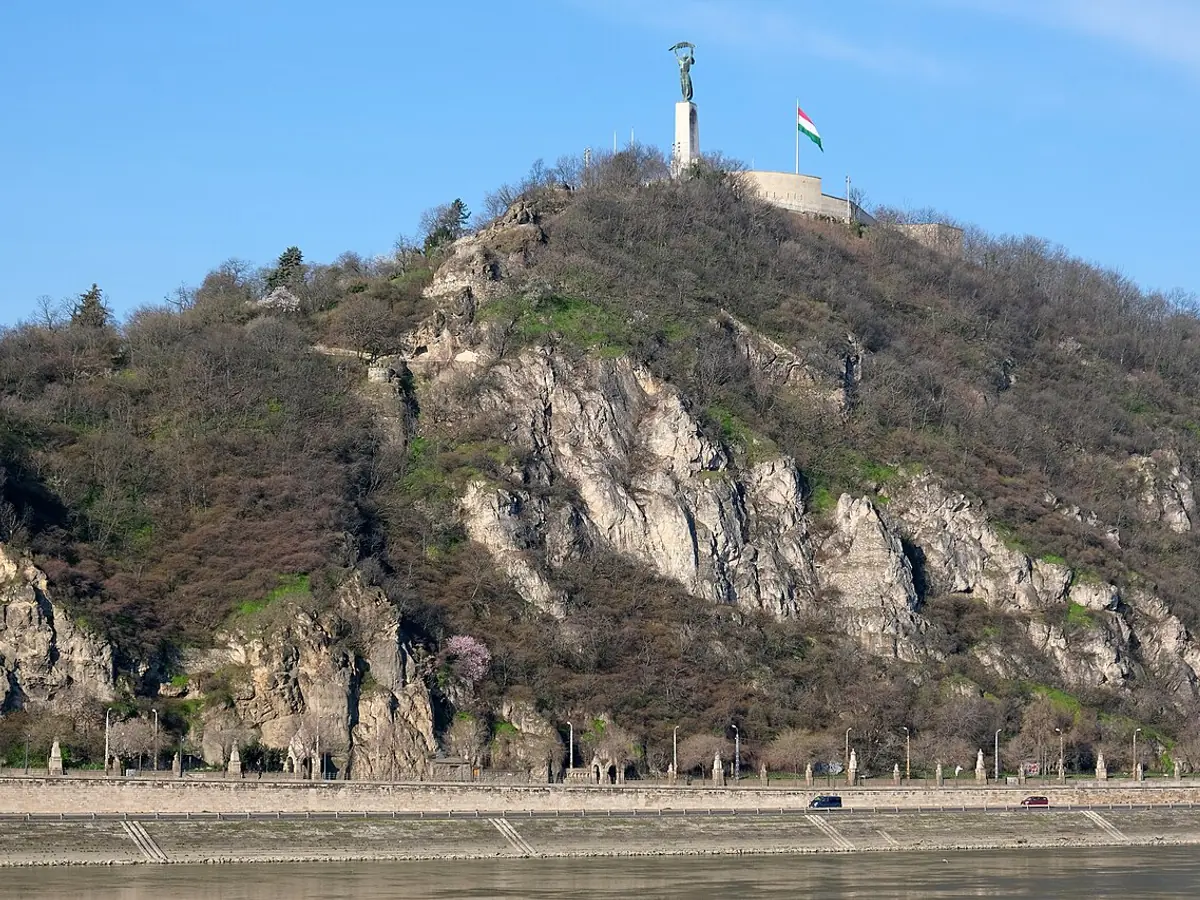
Gellért-hegy, Budapest
Gellért Hill rises as a rocky landmark above the Danube, and the ground beneath you belongs to a hill reaching 235 m in height. Its name recalls Saint Gerard, the bishop connected with a dramatic death during the pagan uprising of 1046: as local legend has it, he was placed in a barrel and sent down the hillside. The hill’s caves are not accidental hollows.
Springs emerging along fractures helped form them, and the most notable cavern contains the Cave Church. At the summit, the Citadella stands about 140 metres above the river, commanding a broad view across Budapest. The fortress arrived after the Hungarian uprising of 1848–49, built by the Habsburg rulers because this height offered a strategic position from which both parts of the city could be shelled during a future revolt.
The hill later became a battlefield in the Second World War and during the Hungarian Revolution of 1956; Soviet tanks fired into the city from here. A military museum occupies part of the Citadella grounds, while the Liberty Statue marks the fortress’s far end. Beneath this historic landscape, a crystal-lined cave discovered in January 2007 measures 60 by 18 m and formed 300,000–500,000 years ago from a vanished thermal spring.