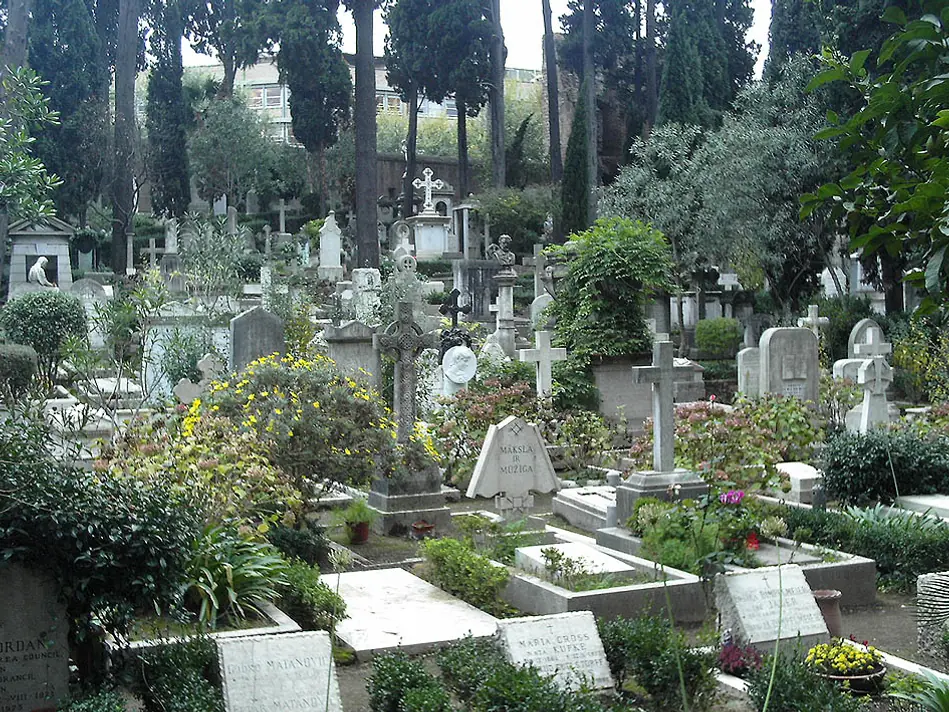
Cimitero acattolico di Roma, Rome
The Non-Catholic Cemetery is a private burial ground in Testaccio, beside the Pyramid of Cestius and close to Porta San Paolo. It welcomes the dead who did not belong to the Catholic faith, without restricting burial to British people or to any single nationality. The earliest documented burial dates to 1716 and belongs to William Arthur, a Protestant doctor from Edinburgh.
In earlier centuries, Catholic rules kept non-Catholics from consecrated ground, so funerals were commonly held at night to avoid hostile religious crowds. The place later acquired walls, a custodian, and a cultivated landscape, but its past began in open countryside where animals grazed. Cypress trees, pomegranates, meadow grass, and cats now accompany the stones.
Look for the graves of John Keats and Percy Bysshe Shelley, two poets whose lives ended in Italy. Keats died here at just 25, and his epitaph says his name was written in water. Shelley’s grave bears the phrase “heart of hearts”; his ashes came to Rome after his death at sea, while his surviving son was also buried here. The cemetery also holds Antonio Gramsci and Giorgio Napolitano, showing that its history extends beyond foreign residents and Protestants.