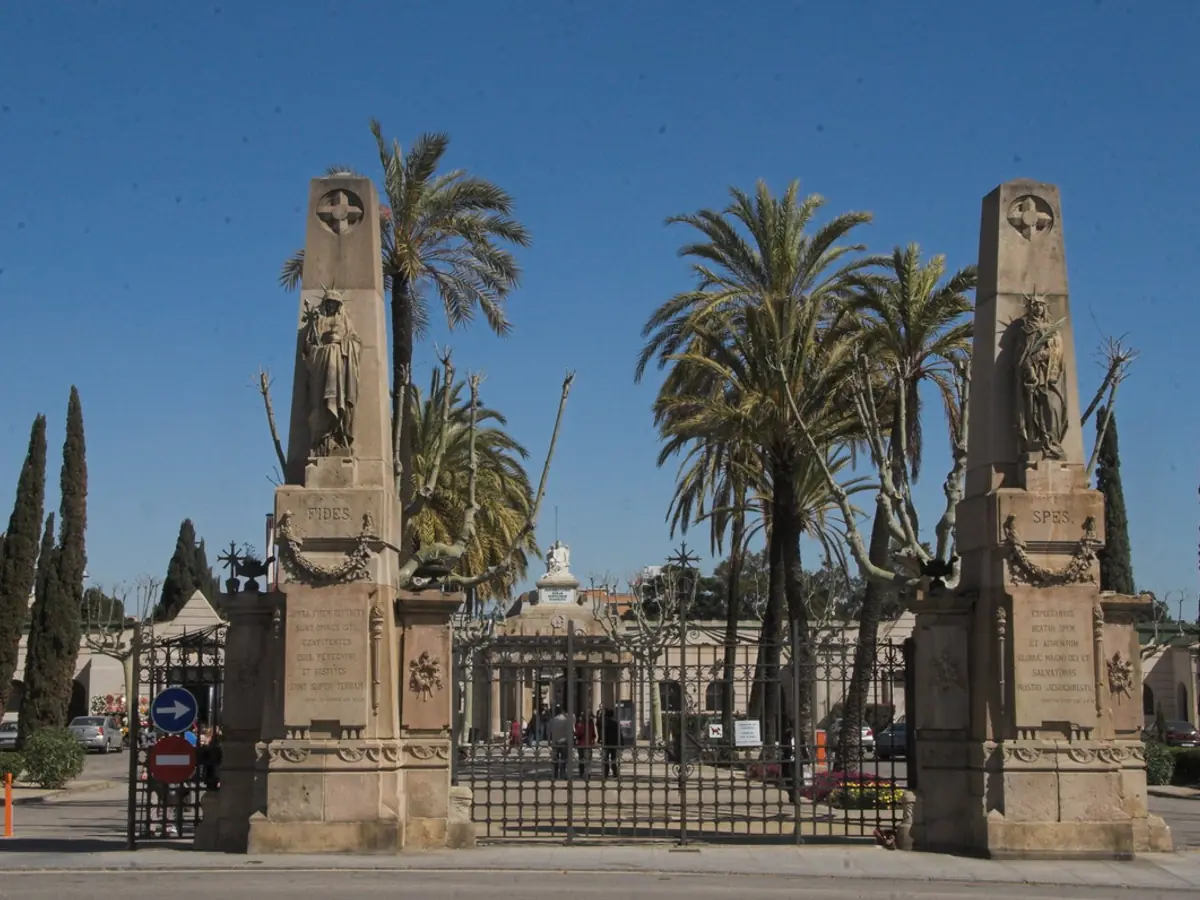
Cementiri del Poblenou, Barcelona
The Poblenou Cemetery is a funerary complex whose most striking story begins with destruction: Napoleon’s troops demolished the earlier burial ground in 1813, and Antonio Ginesi rebuilt it between 1816 and 1819. The site had opened in 1775, created to replace unhealthy parish burial grounds within the city. Ginesi’s reconstruction brought neoclassical design together with Egyptian references.
Notice the entrance composition: pyramid-like forms, sturdy Doric columns, and the seated marble angel holding a trumpet above the gateway. The cemetery was enlarged between 1849 and 1852 under Joan Nolla i Cortès and Miquel Garriga i Roca, adding grand family tombs for Barcelona’s rising bourgeoisie. The central crucifix commemorates the victims of the 1821 yellow-fever epidemic, which killed more than six thousand people in Barcelona.
At the rear, the celebrated monument known as The Kiss of Death dates from 1930. A winged skeleton touches the seemingly dead body of a young man; Jaume Barba’s name is carved into the monument’s base. Among those buried here are Narcís Monturiol, Narcís Oller, Lola Anglada, Mary Santpere, and Josep Llimona.