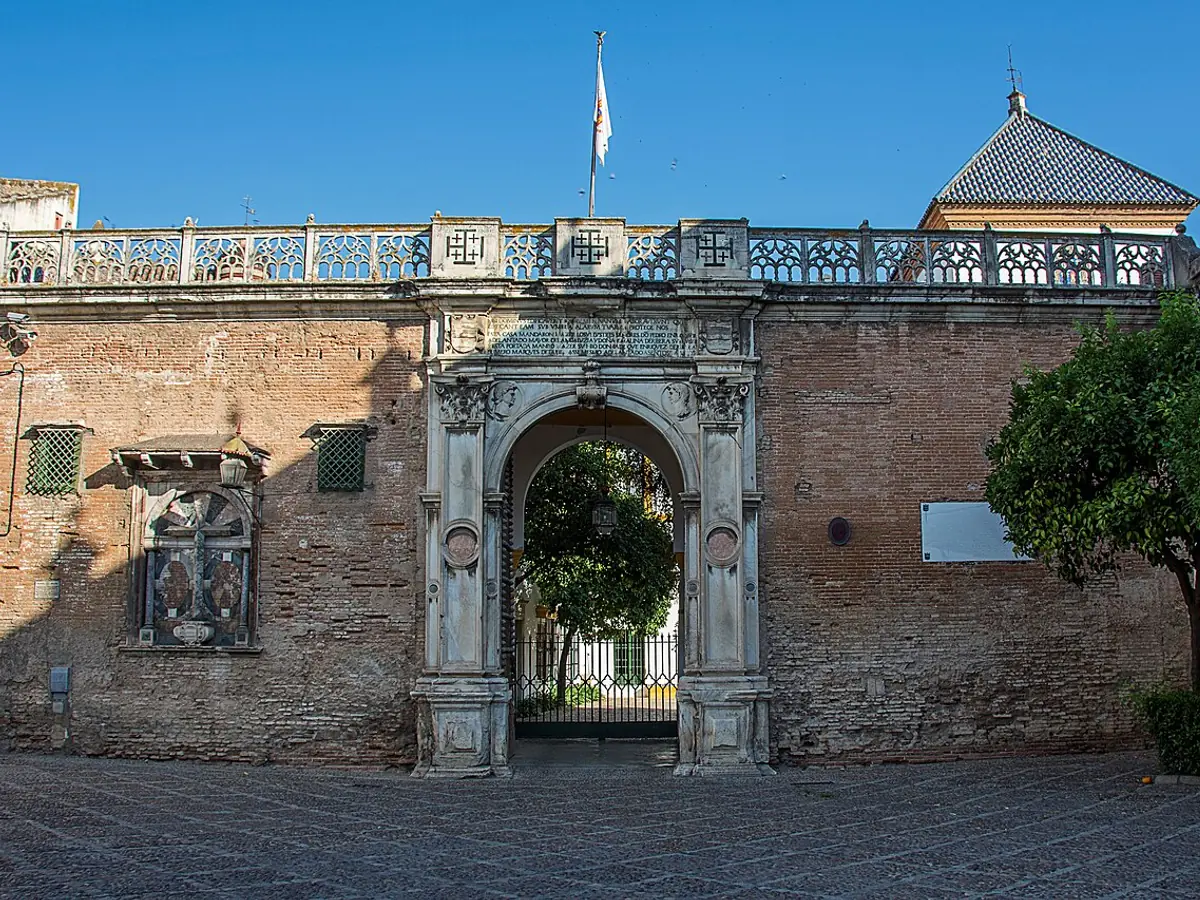
Casa de Pilatos, Seville
Casa de Pilatos is a palace where Italian Renaissance design meets Mudéjar craft, and its most astonishing treasure is under your eyes: around 150 distinct glazed-tile patterns made during the 1530s by Diego and Juan Pulido. That collection ranks among the world’s great early-modern gatherings of azulejos. The palace began in 1483 for Pedro Enríquez de Quiñones and Catalina de Ribera, and their son Fadrique later completed it.
Its familiar name grew from Fadrique’s journey to Jerusalem. After returning in 1520, he established a devotional route in Seville whose measured length matched the distance traditionally associated with the path from Pilate’s praetorium to Calvary: 1321 paces. That connection shaped the palace’s room names, though the building is not a replica of Pilate’s house.
Look at the marble entrance, designed by the Genoese Antonio Maria Aprile in 1529. It opens onto a courtyard with a fountain and a gallery displaying twenty-four busts gathered from the Roman site of Italica. From there, gardens unfold, while the staircase combines tiled decoration with a Mudéjar honeycomb ceiling by Cristobal Sanchez. The palace remains the permanent home of the Dukes of Medinaceli, and it has also provided settings for films including Lawrence of Arabia, 1492: Conquest of Paradise, and Kingdom of Heaven.