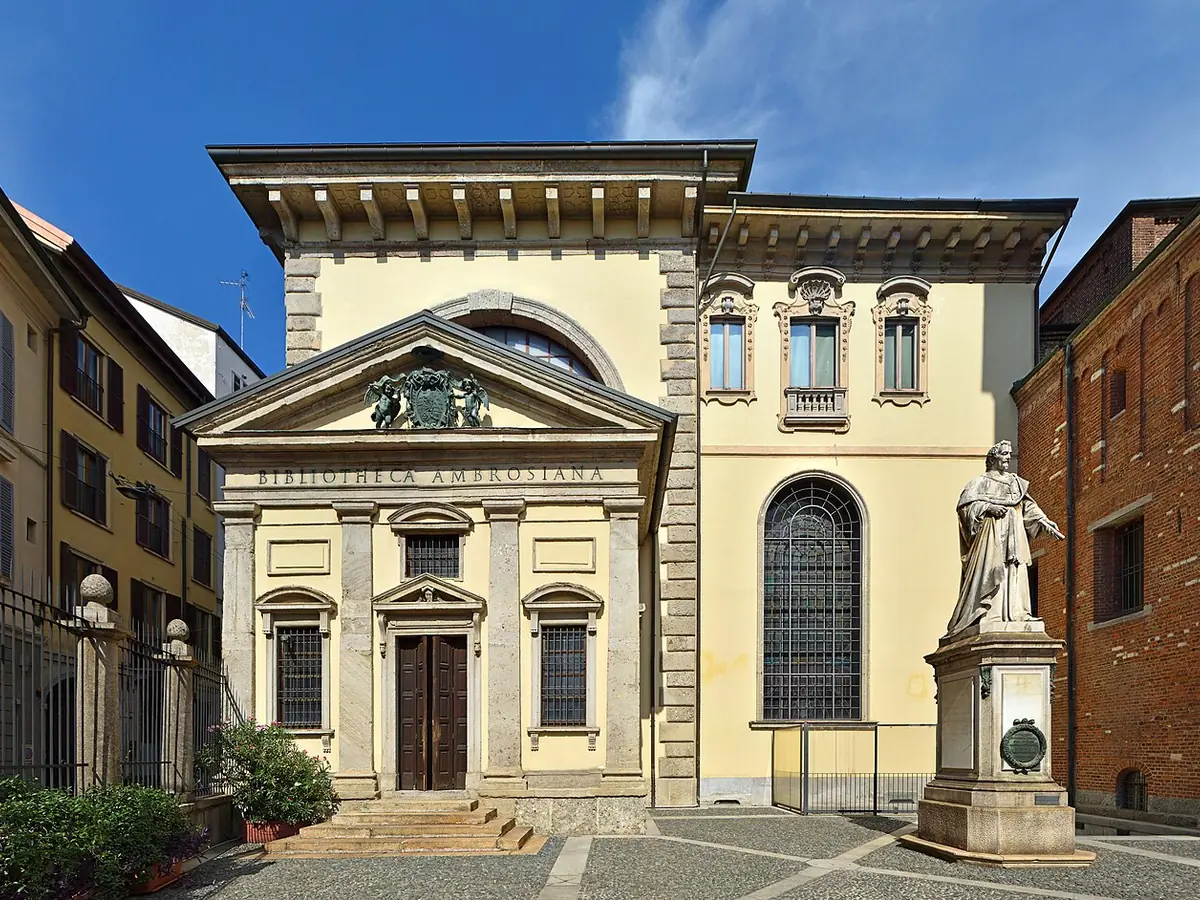
Biblioteca Ambrosiana, Milan
Biblioteca Ambrosiana is a historic library that also brings together an art gallery, making this building a meeting place for books, manuscripts, and pictures. Its name honours Ambrose, Milan’s patron saint, and Cardinal Federico Borromeo established it in 1609 after sending agents across Western Europe, Greece, and Syria to seek out manuscripts and printed works. The scale of that ambition is striking: the original collection included about 15,000 manuscripts and twice that number of printed books.
Among its celebrated acquisitions is the Ilias Picta, an ancient illustrated manuscript obtained through the library of the Paduan collector Vincenzo Pinelli. That collection contained more than 800 manuscripts, packed into 70 cases when they were transported to Milan. The building’s planning involved Francesco Maria Richini, Fabio Mangone, and Giacomo Moraglia.
The Sala Federiciana was designed as a large reading hall, with books arranged along the walls and portraits of authors and artists above the shelves. Two great semicircular windows illuminate the room. The library opened its reading room to the public on 8 December 1609, becoming one of Europe’s earliest public libraries. Inside the same institution, the Pinacoteca preserves works including Leonardo’s Portrait of a Musician, Caravaggio’s Basket of Fruit, and Raphael’s cartoon for The School of Athens.