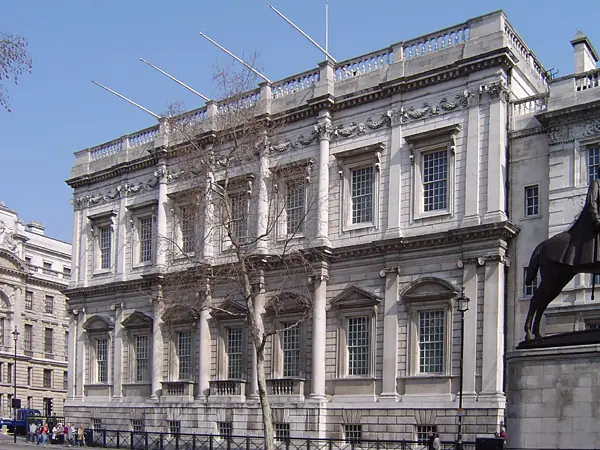
Banqueting House, London
Banqueting House is the grand surviving hall built for royal entertaining, and it is the only substantial remnant of the former Palace of Whitehall. Inigo Jones designed it, and the building was completed in 1622. Its importance reaches beyond court ceremony: it introduced a refined classical Italianate design that transformed English architecture.
The street façade gives you that design in a concentrated form. Engaged columns rise from a rugged basement and organise the windows into an ordered composition, while the balustrade keeps the roofline calm and level. The building has three floors, but the great hall occupies a double-height space, making the exterior suggest a more conventional arrangement than the interior actually has.
Look beneath the entablature for carved swags, masks and festoons: details that connect the architecture with feasting and spectacle. Inside, the ceiling carries paintings added by Peter Paul Rubens during the 1630s. The building began in 1619 and reached completion in 1622, after an earlier banqueting house on this site had been destroyed by fire. The present structure remains a Grade I listed building, and its survival preserves a decisive moment in English architectural history.