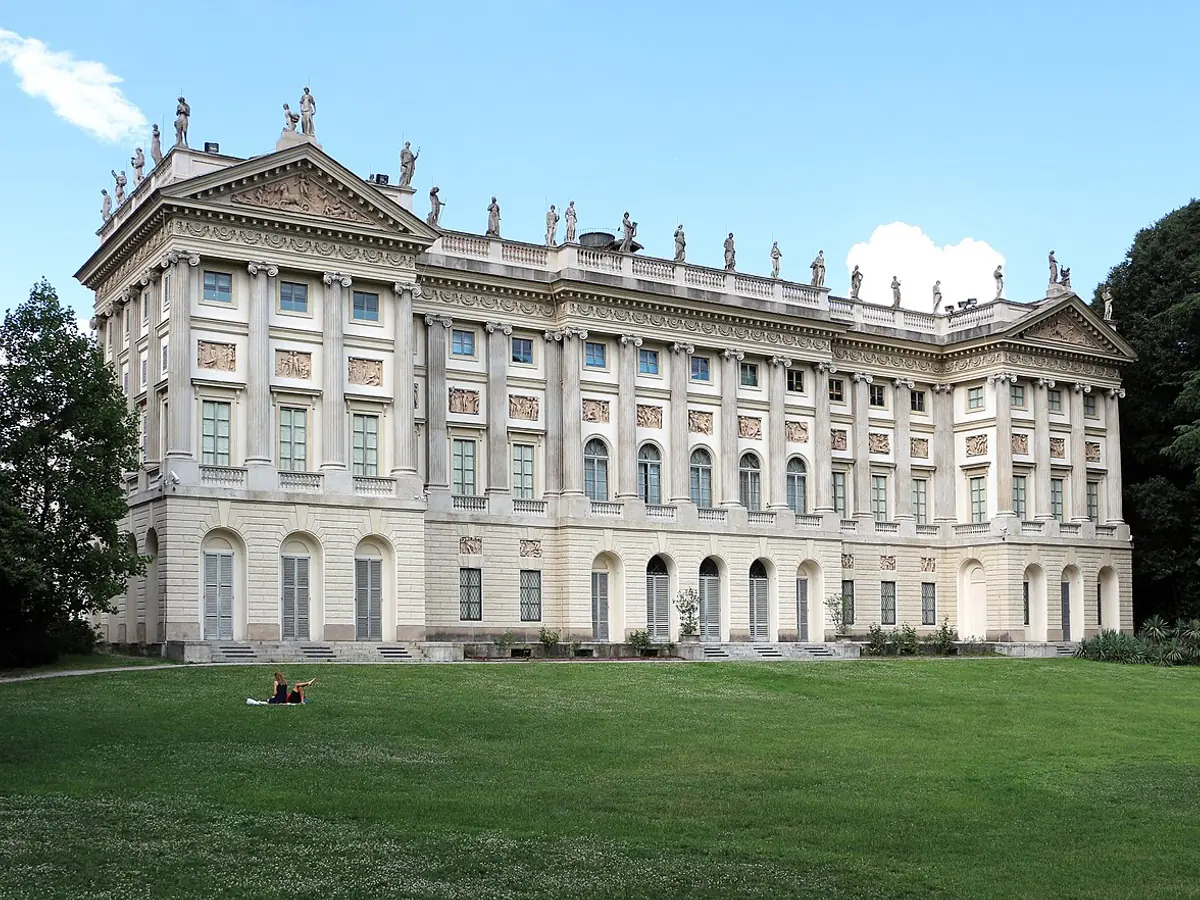
Villa Reale, Milan
Villa Reale is a palace designed by Leopoldo Pollack, built between 1790 and 1796 for Count Ludovico Barbiano di Belgiojoso. Its restrained neoclassical character belongs to the architecture of the villa itself, while the park adds a contrasting English-style garden with an artificial lake. The entrance on Via Palestro opens toward Milan’s public gardens.
This palace later became the Milan residence of Eugène de Beauharnais and his family during the Kingdom of Italy. After the Comune of Milan acquired it in 1920, the building became home to the Galleria d’Arte Moderna in 1921, and it still houses that collection. Inside are works associated with the neoclassical and Romantic periods, including pieces by Luigi Acquisti and Antonio Canova.
Look at the long, measured façade and the formal rhythm of its arches, columns, reliefs, and statues. Beside the villa stands the Padiglione d’Arte Contemporanea, built on the site of palace stables destroyed by wartime bombing. This pairing gives the stop its unusual character: an aristocratic residence shaped into an art museum, with a contemporary exhibition space alongside it.