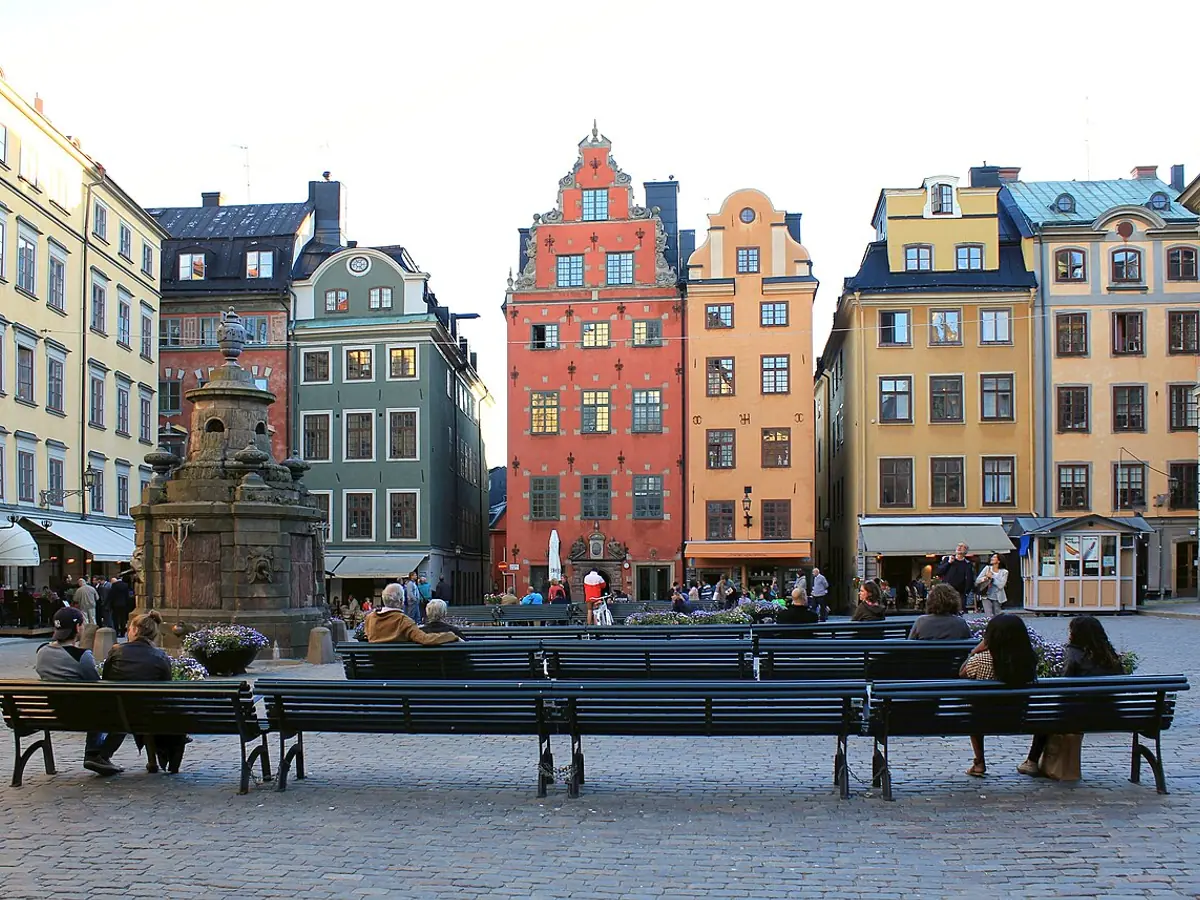
Stortorget, Stockholm
Stortorget is Stockholm’s oldest public square, and the place around which the medieval town gradually formed. Its stone surface is enclosed by historic façades, with Börshuset occupying the northern side. Erik Palmstedt designed that building, completed from 1773 to 1776; it now contains the Swedish Academy, the Nobel Museum, and the Nobel Library.
The square also holds Palmstedt’s well, made for the new exchange building. It dried up in 1856, spent time at Brunkebergstorg, and returned here in 1953, now linked to the city water system. This square carries a darker history.
Stockholm’s Bloodbath took place here in November 1520. It also saw Sweden’s earliest pharmacy open in 1575, established by Anthonius Busenius. Today, tens of thousands of visitors come each year, and the traditional Christmas market fills the square with handicrafts and food.
Look toward the corner at Skomakargatan for the cannonball set into the façade. As local legend has it, it was fired during the siege of Stockholm in 1521 and aimed at Christian II. The documented story is different: Carl Adolph Grevesmühl had it embedded in 1795 as a symbol of Gustav Vasa’s siege. That small iron sphere is the square’s sharpest meeting point between legend and history.