Stanisław Wyspiański, Kraków
Updated
Listen to how the story begins
0:00 / 0:45
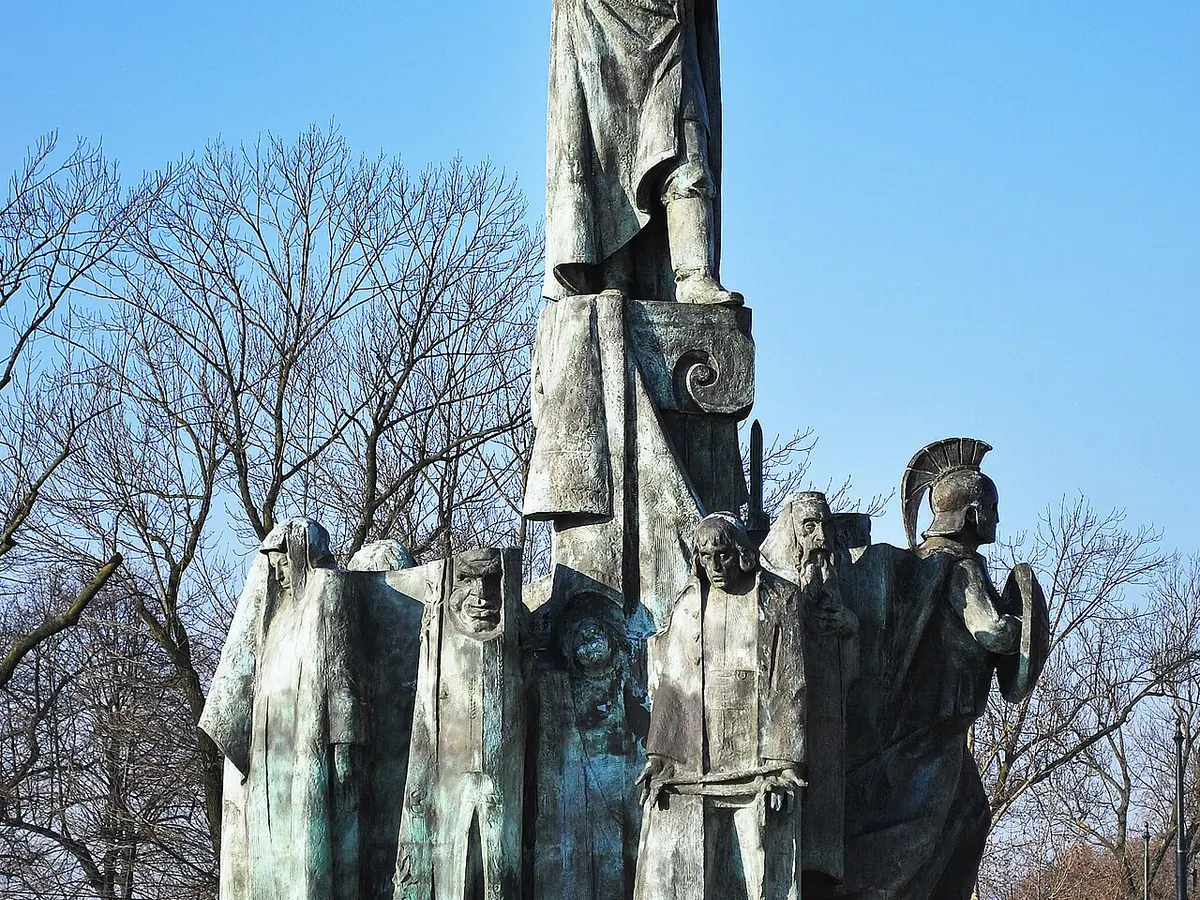
Here is Kraków’s monument to Stanisław Wyspiański, on the small green beside the National Museum’s main building. The artist himself stands high on the column, wrapped in the distinctive cape associated with Young Poland, the turn-of-the-century Polish modernist movement. Around the granite base, bronze characters form a frozen procession: figures from his dramas include Jasiek, the Jewish guest, Chochoł, Stańczyk and Isia from The Wedding, alongside the Old Veteran, Pallas Athena and others.
Wyspiański was far more than a playwright. Born in 1869, he worked as a painter, poet, designer of interiors and furniture, and a writer of patriotic symbolic dramas. He helped create the Franciscan Church’s decoration and designed its stained glass; he also worked with Kraków’s Municipal Theatre on sets, furniture and productions.
His play The Wedding grew from a real wedding celebration in nearby Bronowice and became a sharp portrait of nineteenth-century Polish society. The monument was unveiled on the twenty-eighth of November 1982, exactly seventy-five years after his death. Its path here was unusually tangled: seventy-seven designs entered the first competition, but the project built was Marian Konieczny’s, which had not been submitted to that contest. Read the inscription on the base: it names him artist, painter, poet and dramatist.
,_May_3_Av,_Krak%C3%B3w,_Poland.jpg)