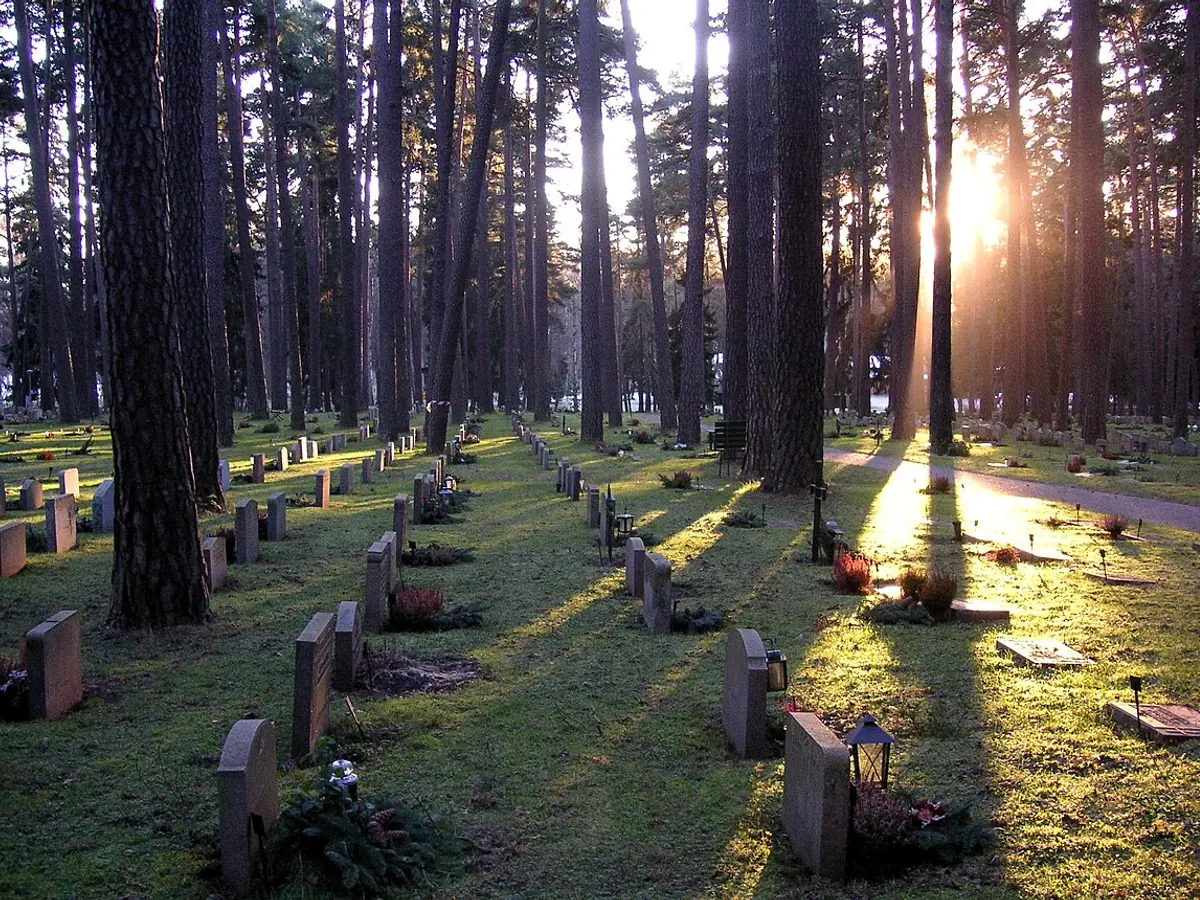
Skogskyrkogården, Stockholm
Skogskyrkogården is a cemetery where architecture and a pine landscape are planned as a single experience. The design belongs to Gunnar Asplund and Sigurd Lewerentz, whose work here moves between Nordic Classicism and functionalism. The site opened in 1920, and its creation began after an international design competition in 1915.
As you follow the paths, the landscape unfolds through a pond, a meditation hill, chapels, and a grove crossed by the Way of Seven Wells. The route ends at the Resurrection Chapel, designed by Lewerentz and completed in 1925. A large granite cross stands before Asplund’s crematorium and its chapels of Faith, Hope, and Holy Cross.
Asplund designed the crematorium in a rational modernist manner; built between 1935 and 1940, it became his final architectural work. The architects planned the complex down to its lamps, while sculptures by Carl Milles form part of the setting. Look at the granite cross as a physical meeting point between solemn monument and open interpretation: Asplund, who was agnostic, had preferred an obelisk or pylon, but an anonymous donation brought the cross here. The cemetery contains 100,000 graves and became a UNESCO World Heritage Site in 1994.