Sankt Michael, Munich
Sankt Michael is the Jesuit church before you, a monumental Catholic building whose patron is the archangel Michael. Its story begins with a striking ambition: built from 1583 to 1597, it became a powerful model for early Baroque churches across southern Germany and beyond. Friedrich Sustris and Wendel Dietrich are credited with its design.
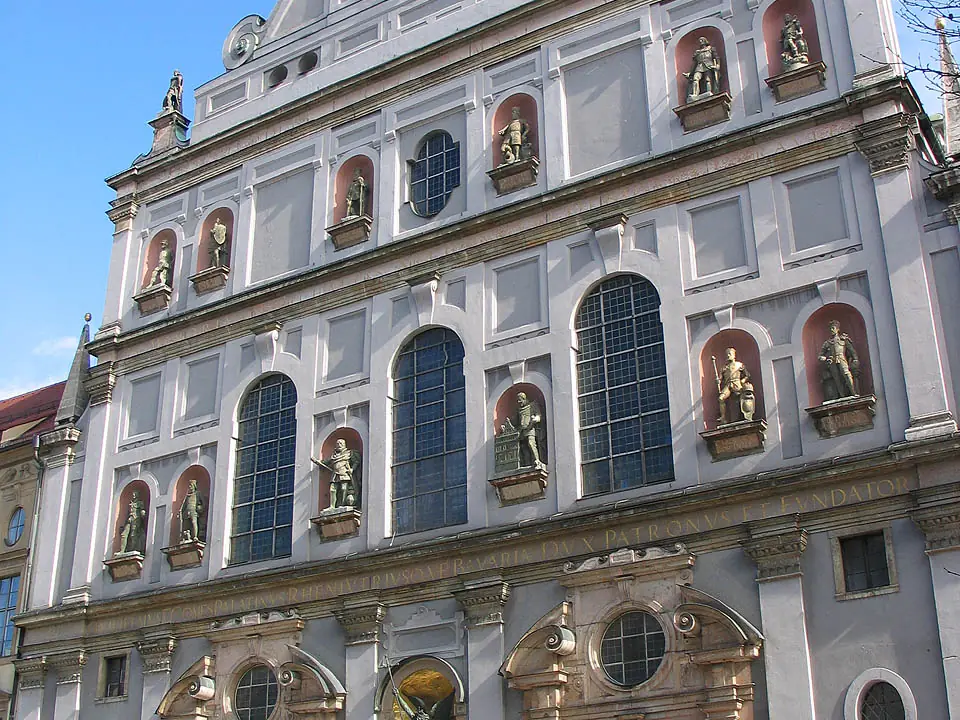
Look at the facade itself. The archangel Michael appears in the ground-level niche, wielding a lance against evil, while Christ as the Savior occupies the gable above. Between these figures, the facade presents rulers understood as defenders of the Christian faith in Bavaria; Duke Wilhelm V is shown holding a model of the church.
The archangel’s statue was made by Hubert Gerhard in 1588. The building also marks a major change in church architecture. Its ideas draw on Il Gesù in Rome, the Jesuits’ mother church, yet St.
Michael became larger than that Roman model and influenced more than 100 later buildings. It served as the spiritual stronghold of Bavaria’s Counter-Reformation. A vast barrel vault once survived a tower collapse in 1590, but wartime damage brought it down in 1944; the vault was rebuilt from 1946 to 1948. What you see is therefore both an early architectural landmark and a carefully reconstructed survivor, with the facade carrying its theology in sculpture.