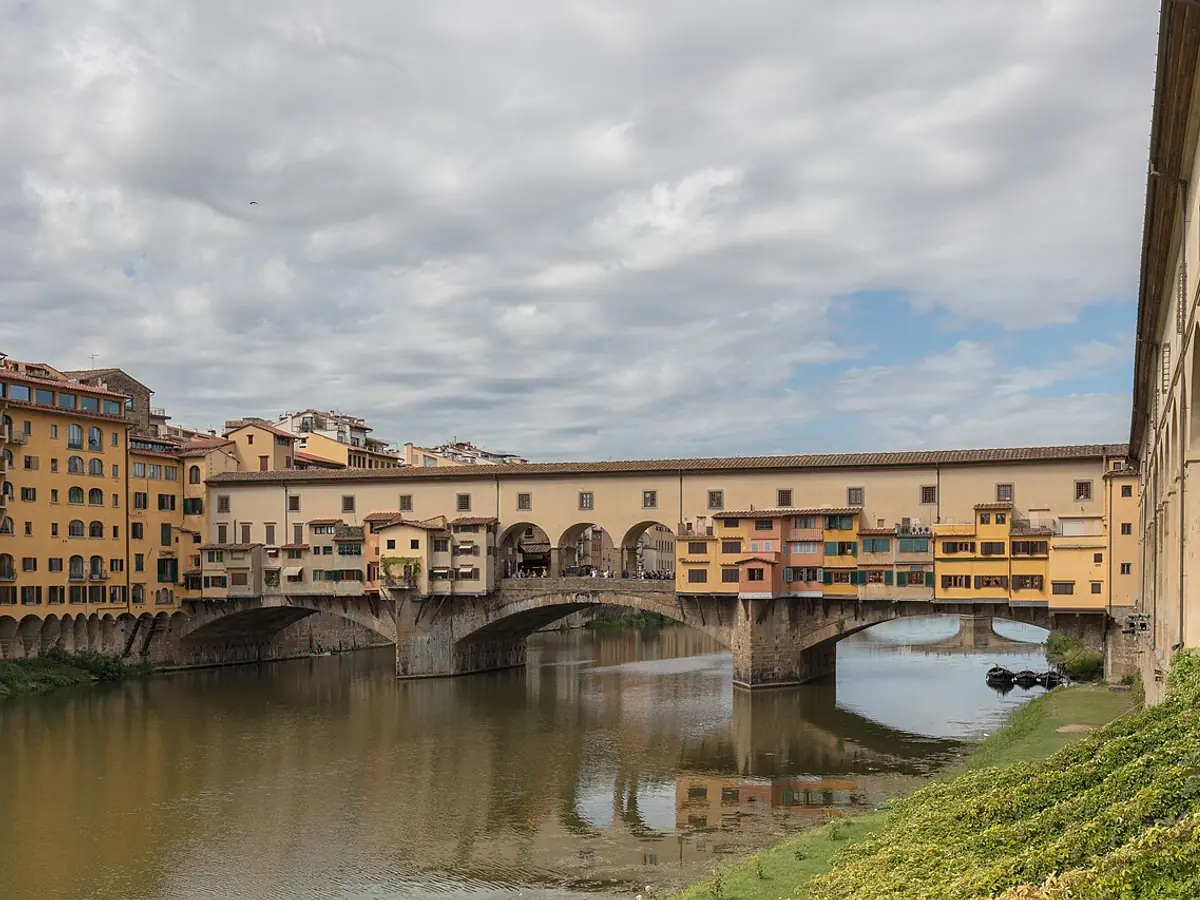
Ponte Vecchio, Florence
Ponte Vecchio is the historic stone crossing carrying you over the Arno, with a remarkably unusual feature: shops form a continuous built frontage along the bridge. This bridge took its present form between 1339 and 1345, after earlier crossings here were repeatedly destroyed by floods. (articleExtractEn) Neri di Fioravante is identified as its architect.
(architect) The enclosed shop spaces began with trades including butchers, tanners, and farmers; today, jewellers, art dealers, and sellers of souvenirs occupy them. (narrativeExtractEn) In 1565, Giorgio Vasari added the elevated passageway running over the bridge, creating a private route between Palazzo Vecchio and Palazzo Pitti. (articleExtractEn) The butchers were later removed by decree, and goldsmiths and jewellers took their place.
(articleExtractEn) Look at the broad opening within the bridge’s built-up length: it gives this crossing a small urban square rather than a simple straight passage. The structure rests on three shallow arches; its principal arch spans 30 metres, while each companion arch spans 27 metres. (articleExtractEn) The Ponte Vecchio was the only Florentine bridge left standing after the destruction of the city’s bridges during World War II. (narrativeExtractEn) Its surviving shops and layered passageway make the bridge feel like a street suspended above the river.